Qwen3.5-4B Depth-3 Dose-Response: data-limited or representational cap?
The one idea you need
Picture puzzles built as three stacked layers of nested steps — a recipe that calls sub-recipes that call basic moves. The small model cannot write them alone, but a tireless search tool grinds out correct worked examples. Train on those, and the skill sinks into the model's weights.
The question
When a small model keeps failing at deeply nested, multi-step puzzles, is it hitting a hard limit of its size, or just starved for training examples?
What we found
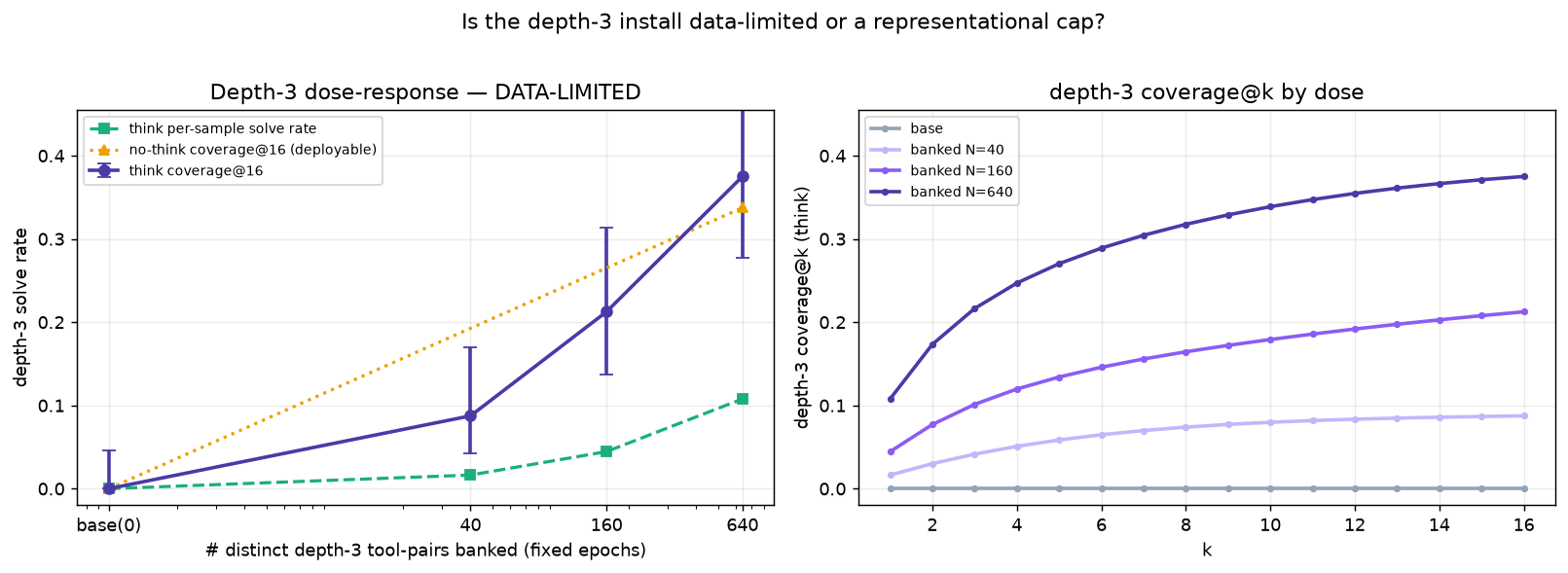
Just starved for examples. Feeding a fixed 4-billion-parameter model more search-found solutions lifted its solve rate on fresh three-layer puzzles from 0% to 38% when given sixteen tries — climbing steadily at every dose, with no sign of leveling off. It even began solving 1 in 10 fresh puzzles on a single blind attempt with no reasoning shown, versus essentially zero before.
Why it matters
Before declaring a small model too small for a hard compositional task, use a cheap search tool to auto-generate verified solutions and chart solve rate against how many you train on. A still-rising curve means you are data-limited, not capped.
On this page
Results at a glance 2
How to read
Bars grouped by training amount banked (0, 40, 160, 640 worked examples); bar height is solve rate on fresh three-layer puzzles, higher is better. Four bars per group: sixteen-try and single-shot rates, each shown with and without a reasoning scratchpad.
Takeaway → Every bar climbs left to right with no flattening; the two deployable no-scratchpad bars stay pinned at zero until the largest dose, then lift off — capability tracks the amount of data.
Data table
| condition | think coverage@16 | think single-shot greedy@1 | no-think coverage@16 (deployable) | no-think single-shot greedy@1 (deployable) |
|---|---|---|---|---|
| N=0 (base) | 0% | 0% | 0% | 0% |
| N=40 | 8.7% | 1.3% | 0% | 0% |
| N=160 | 21.2% | 3.7% | 0% | 0% |
| N=640 | 37.5% | 13.8% | 33.8% | 10% |
Numbers from
Technical framing
Depth-3 install is DATA-LIMITED: coverage rises with #tool-found pairs (no plateau) — C22 crossed the depth-3 wall but weakly (0.125) and test-time-only, leaving open: data-limited or representational cap? Bank N tool-found depth-3 solutions (interpreter search over the substrate's own DSL, no external model). Depth-3 think coverage rises MONOTONICALLY 0.00->0.087->0.212->0.375 across N=0/40/160/640 with NON-OVERLAPPING Wilson CIs (top-dose lower CI 0.28 > low-dose upper CI 0.17) -- DATA-LIMITED, not a cap. Crucially the DEPLOYABLE single-shot install scales too: no-think greedy@1 0.00->0.10 at N=640 (~0 at C22's N=130). 0-leakage held-out set (novel depth-3 rules by function AND op-composition) => genuine generalization. The deep wall is a DATA bottleneck, not a hard representational cap: tool-seeded banking scales with data into deployable capability.
How to read
Each line is one training dose (0, 40, 160, 640 examples); horizontal axis is attempts allowed per puzzle (1 to 16); vertical axis is solve rate on fresh three-layer puzzles. Higher is better; the untrained base line stays flat on the floor at zero.
Takeaway → The lines fan out cleanly in dose order, each larger dose sitting entirely above the smaller ones and none crossing — more training data lifts the whole curve, with no saturation.
Data table
| k (samples) | base (N=0) | banked N=40 | banked N=160 | banked N=640 |
|---|---|---|---|---|
| 1 | 0% | 1.6% | 4.5% | 10.8% |
| 2 | 0% | 3% | 7.7% | 17.3% |
| 3 | 0% | 4.1% | 10.1% | 21.6% |
| 4 | 0% | 5.1% | 12% | 24.7% |
| 5 | 0% | 5.9% | 13.4% | 27% |
| 6 | 0% | 6.5% | 14.6% | 28.9% |
| 7 | 0% | 7% | 15.6% | 30.4% |
| 8 | 0% | 7.4% | 16.4% | 31.8% |
| 9 | 0% | 7.7% | 17.2% | 32.9% |
| 10 | 0% | 8% | 17.9% | 33.9% |
| 11 | 0% | 8.2% | 18.6% | 34.7% |
| 12 | 0% | 8.3% | 19.2% | 35.5% |
| 13 | 0% | 8.5% | 19.7% | 36.1% |
| 14 | 0% | 8.6% | 20.3% | 36.6% |
| 15 | 0% | 8.7% | 20.8% | 37.1% |
| 16 | 0% | 8.7% | 21.2% | 37.5% |
Numbers from
Technical framing
Depth-3 coverage@k fans out with dose (base flat at 0) — Each dose's coverage@k curve sits progressively higher: base pinned at 0, N=40 to 0.09, N=160 to 0.21, N=640 to 0.375. More tool-found depth-3 solutions -> more installed depth-3 capability on novel held-out rules, with no sign of saturation through N=640.
In the author’s words from the Overview · “Results”
DATA-LIMITED. Depth-3 think cov@16: 0.00 -> 0.087 -> 0.212 -> 0.375 (N=0/40/160/640), monotone, top-dose CI [0.28,0.48] non-overlapping with low-dose [0.04,0.17]. Deployable scales: no-think cov 0.00->0.338, greedy@1 0.00->0.10 at N=640. 0 leakage (novel rules). See reports/report.md, analysis/dose_response.png.
Overview
Research Program
- Program:
structured_execution_and_compilers - Question: C22 crossed the depth-3 wall but weakly — is the install data-limited or a representational cap?
- Anchors: C22 (tool-seeded banking crossed weakly), C19 (depth-3 rep is a thread), C21 (self-banking can't seed).
Hypothesis
Pre-registered (reports/prereg.md, hardened by reports/design_review.md): DATA-LIMITED if depth-3 think coverage rises with N (top-dose CI above low-dose CI); CAP if it plateaus.
Setup
- Model: Qwen3.5-4B only. Explorer: CPU interpreter brute-search over the 16-op DSL (640/640 solved, no external model).
- Doses (nested): C21 depth-1+2 pairs + N tool-found depth-3, N in {40,160,640}; QLoRA r32/a64, epochs=3.
- Eval: ONE frozen paired held-out set, dedup by function-sig AND op-composition (0 leakage), n=80 depth-3. Think coverage@16 (Wilson CIs) + no-think deployable at top dose; depth-2 guardrail.
Run
Smoke: python scripts/tool_harvest.py --smoke Full: python scripts/tool_harvest.py --n-depth3 640 && (build train_{40,160,640}.jsonl) && bash runs/launch.sh && python scripts/analyze.py
Results
DATA-LIMITED. Depth-3 think cov@16: 0.00 -> 0.087 -> 0.212 -> 0.375 (N=0/40/160/640), monotone, top-dose CI [0.28,0.48] non-overlapping with low-dose [0.04,0.17]. Deployable scales: no-think cov 0.00->0.338, greedy@1 0.00->0.10 at N=640. 0 leakage (novel rules). See reports/report.md, analysis/dose_response.png.
Interpretation
The deep wall is a DATA bottleneck, not a hard representational cap: tool-seeded banking scales with #solutions into deployable single-shot. Completes the C13->C23 recipe (explorer + installer + data throttle).
Knowledgebase Update
- Program evidence:
research_programs/structured_execution_and_compilers/evidence.md(C23) - Claim ledger: C23 added
Artifacts
scripts/tool_harvest.py,scripts/train_lora.py,scripts/eval_ladder.py(frozen + func-sig & op-comp dedup + leakage),scripts/analyze.py(Wilson CIs)data/train_{40,160,640}.jsonl,data/eval_frozen.jsonl,runs/eval_*.json,runs/verdict.json,analysis/dose_response.png,reports/{prereg,report,design_review}.md- Adapters (~180MB each) moved out of repo; regenerable.
Report
Rendered from reports/report.md
Summary
C22 crossed the depth-3 wall with tool-seeded banking but only WEAKLY (think coverage@16 0.125, deployable no-think ≈0). Was that a data limit or a representational cap? This dose-response answers it: DATA-LIMITED, decisively. Banking N tool-found depth-3 pairs installs depth-3 coverage that rises monotonically with N and does not plateau — and, at scale, banks into deployable single-shot.
| N distinct depth-3 pairs | think cov@16 (Wilson 95%) | think greedy@1 | no-think cov@16 | no-think greedy@1 |
|---|---|---|---|---|
| 0 (base) | 0.000 [0.00, 0.05] | 0.000 | 0.000 | 0.000 |
| 40 | 0.087 [0.04, 0.17] | 0.013 | — | — |
| 160 | 0.212 [0.14, 0.31] | 0.037 | — | — |
| 640 | 0.375 [0.28, 0.48] | 0.138 | 0.338 | 0.100 |
- Monotone rise, no plateau. Think coverage@16 climbs 0.00 → 0.087 → 0.212 → 0.375 across N ∈ {0,40,160,640}. The top-dose lower CI (0.277) sits above the low-dose upper CI (0.17) — a clean, non-overlapping increase (not a bare non-significant p). Rise 40→640 = +0.29.
- The deployable install scales too. At N=640, no-think coverage@16 = 0.338 and no-think single-shot greedy@1 = 0.10 — vs C22 (N=130) where deployable was ≈0 (test-time-only). So C22's "test-time-dominated" weakness was also just insufficient data; more tool-found solutions bank depth-3 into the weights.
- Genuine generalization, not memorization. The 80 held-out depth-3 tasks have 0 leakage — none share a function-signature OR an op-composition with the 750 training rules — so every solved task is a NOVEL depth-3 composition. This closes the finite-DSL memorization confound the review flagged as make-or-break.
- Scaffold intact. Depth-2 guardrail rose (base 0.175 → banked_640 0.50); the depth-1+2 decomposition scaffold did not collapse under the depth-3-heavy mixture.
Research Program Fit
Resolves C22's central open question and, with it, the mission's "extend capability by a lot" hope: the tool-seeded-banking recipe is not just directionally valid (C22) but data-scalable — more explorer-found solutions → progressively more installed, deployable capability. Design hardened by an adversarial multi-agent review (reports/design_review.md).
Method
Substrate list, families' own 16-op DSL. No external model. Explorer = CPU interpreter brute-search (640/640 depth-3 solved). Doses (NESTED, log-spaced): C21's exact depth-1+2 pairs + N tool-found depth-3 pairs, N ∈ {40,160,640}; QLoRA r32/α64, epochs=3 held constant. Eval on ONE frozen paired held-out set, deduped vs the 640-superset by function-signature AND op-composition (0 leakage verified), n=80 depth-3. Primary: think coverage@16 with Wilson 95% CIs + a dense per-sample solve rate. Deployable: no-think coverage@16 + greedy@1 at the top dose. Guardrail: depth-2 think coverage.
Pre-registered verdicts
- P1 (monotone): HELD — think coverage@16 strictly increases 0 → 0.087 → 0.212 → 0.375.
- P2 (decision): DATA-LIMITED — rise 40→640 = +0.29 (≫ +0.10) and top-dose lower CI (0.28) > low-dose upper CI (0.17), i.e. a clean non-overlapping increase. NOT a cap through N=640.
- P3 (deployable): HELD — at N=640 the depth-3 install reaches deployable no-think coverage 0.338 and single-shot greedy@1 0.10 (both ≈0 at C22's N=130); the deployable read scales with data too.
- P4 (memorization control): HELD — 0 eval solutions (function-sig or op-composition) in training; the rise is generalization to novel depth-3 rules.
Interpretation
- The deep wall is not a hard representational bottleneck at the depths tested — it is a data bottleneck. C19 showed the base's depth-3 inverse is barely represented and C20 showed it is not steerable; C22 showed one small banking round installs only a thread. But this dose-response shows that thread thickens smoothly with more tool-found training data — through N=640 the model keeps absorbing more novel-depth-3 compositional capability, and it converts into deployable single-shot. The apparent "cap" of C22 was a small-data artifact.
- The complete, validated recipe (C13→C23), now quantitative: to extend the frontier a depth — an explorer the base lacks (tool-search) reaches the rung and produces verified solutions; banking those installs the capability; and the amount installed scales with the number of explorer-found solutions, into deployable single-shot. Self-training is the installer, external search is the explorer, and data is the throttle.
- Mission read: this is "extend capability by a lot without a larger model" demonstrated and scaling — the only external ingredient is an interpreter-backed search (a tool), and everything installed is the fixed 4B's own verified compositions.
Honesty notes / limits (from the review)
- Single training seed (nested doses): the Wilson CIs capture eval noise only, not training/seed variance; a lone helpful/harmful example or data-order roll is not averaged out. ≥3 seeds would put error bars on the dose effect itself (deferred).
- Fixed epochs: "more depth-3 data" is physically the same event as "more depth-3 gradient exposure"; this study does not separate data-diversity from compute via a fixed-step + upsampled-40 control (deferred). The claim is the applied "more distinct tool-found pairs → more installed capability," not a pure information bound.
- Search-easy bias: brute search harvests the shorter/cheaper depth-3 programs first; the curve could cap on harder compositions past N=640 (untested). No plateau is observed through 640.
Next Experiments
- Push doses past 640 (e.g. 1280/2560) to find where (if) the curve saturates, and characterize the program-length/search-difficulty of solved-vs-unsolved held-out tasks.
- Fixed-step + upsampled-40 control to split data-diversity from gradient exposure.
- Iterate the rung: with depth-3 now deployable at N=640, does tool-search harvest depth-4 more cheaply?
Artifact Manifest
See reports/artifact_manifest.yaml. Key: scripts/tool_harvest.py, scripts/train_lora.py, scripts/eval_ladder.py (frozen paired set + function-sig & op-composition dedup + leakage report), scripts/analyze.py (Wilson CIs + CI-overlap decision), data/train_{40,160,640}.jsonl, data/eval_frozen.jsonl, runs/eval_*.json, runs/verdict.json, analysis/dose_response.png, reports/design_review.md. Adapters (~180MB each) omitted from git.
Experiment log 1
Show the running log (1 entry)
Scaffold
Created as a new experiment scaffold.
Figures 1
Data files 8
Result tables and metrics copied from the experiment folder — preview inline or open the raw file.
runs/eval_b160_th3.json9.5 kBruns/eval_b40_th3.json9.4 kBruns/eval_b640_nt3.json9.5 kBruns/eval_b640_th2.json4.8 kBruns/eval_b640_th3.json9.5 kBruns/eval_base_nt3.json9.5 kBruns/eval_base_th2.json4.8 kBruns/eval_base_th3.json9.5 kB
Reproduce
Smoke test
python scripts/tool_harvest.py --smokeFull run
python scripts/tool_harvest.py --n-depth3 640 && bash runs/launch.sh && python scripts/analyze.pyRun steps are documented inside the experiment folder (README and scripts).