Qwen3.5-4B Live Tool DAgger
The one idea you need
Picture a clerk reshaping a messy spreadsheet with one example row already solved. The clerk both eyeballs an answer and writes a formula, tests that formula against the visible row, then a supervisor decides which answer to hand in — never seeing the final grade.
The question
If a small model can both guess a table's new layout and write code to compute it, does learning when to trust the code make it more accurate?
What we found
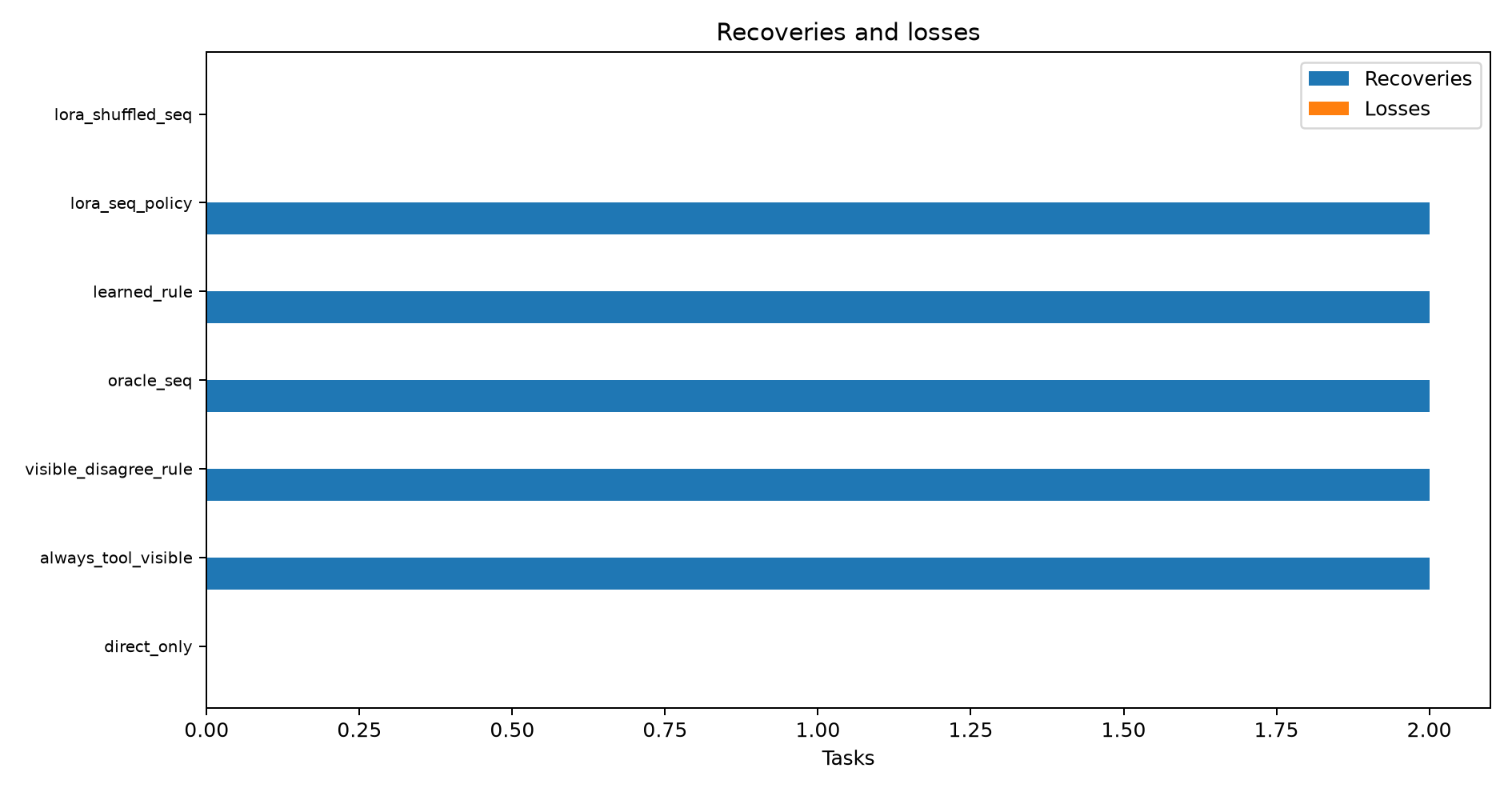
Only its cost, not its accuracy. Answering directly solved none of twelve unseen tasks; letting the model write and run code recovered two — about one in six — and spoiled nothing it already had right. But even a flawless, all-knowing chooser topped out at those same two: the ceiling is the model's raw skill, not the decision. The trained controller's real win was reaching that ceiling with half the code runs and zero wasted repairs.
Why it matters
Before engineering a policy for when your model reaches for tools, measure the ceiling with a perfect-hindsight chooser. If it only ties a cheap rule, your bottleneck is tool capability — spend the policy on cutting wasted tool calls, not accuracy.
On this page
Results at a glance 3
How to read
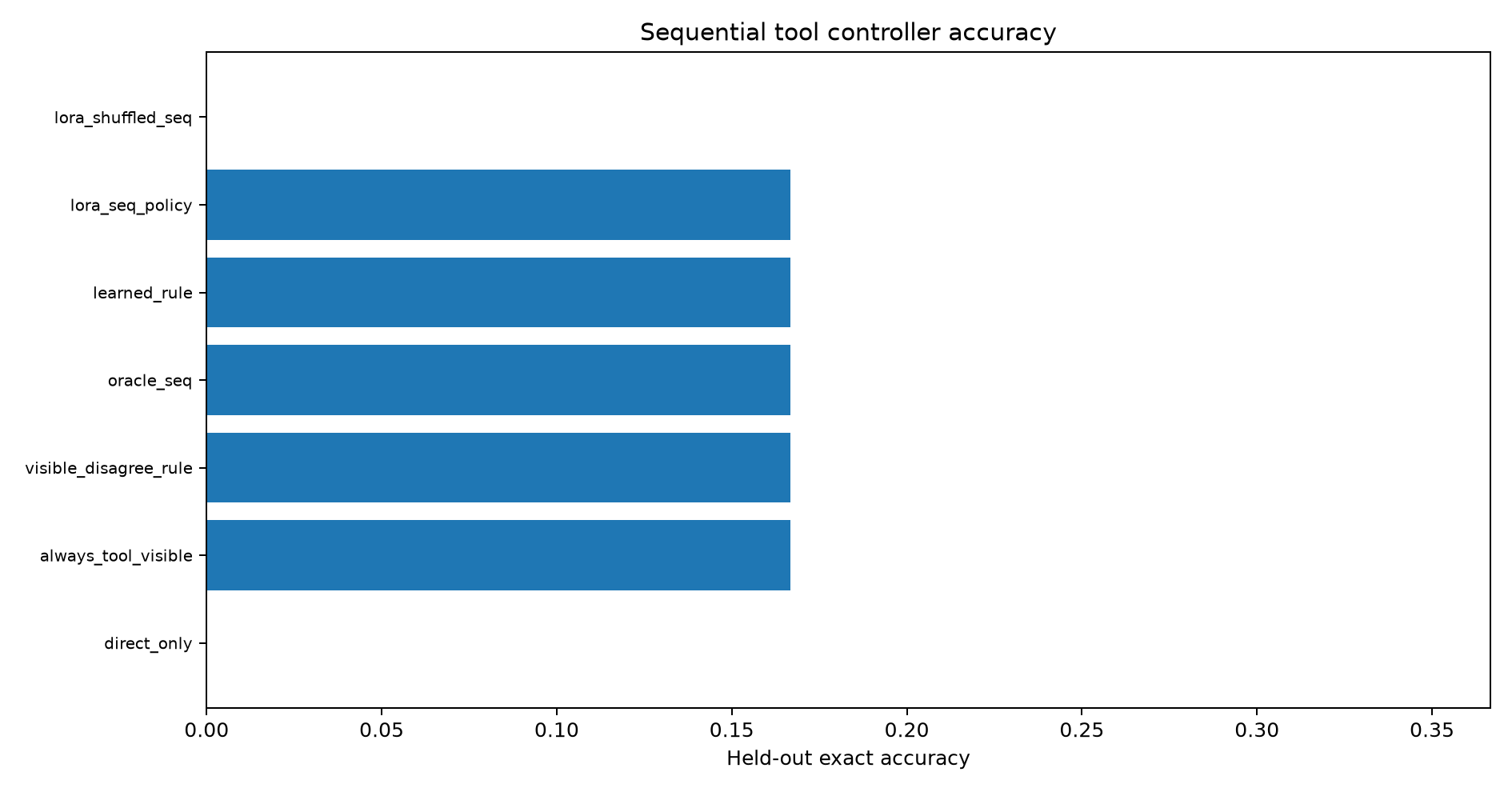
Each bar is one strategy's share of twelve unseen table tasks solved exactly; taller is better. The six: answer directly, always run code, a learned rule, a trained controller, a scrambled-label control, and a perfect-hindsight chooser.
Takeaway → Direct-only and the scrambled control sit at zero; every genuine code-using strategy, even the perfect chooser, ties at one in six, so decision quality never lifts the ceiling.
Data table
| Policy | test accuracy |
|---|---|
| direct only | 0% |
| always tool | 16.7% |
| learned rule | 16.7% |
| LoRA policy | 16.7% |
| shuffled-label LoRA | 0% |
| oracle actions | 16.7% |
Numbers from reports/final_summary.json (policy_results.*.test.accuracy)
Technical framing
Held-out test accuracy by controller policy — Tool-using controllers recover 2/12 held-out cases that direct answering misses; the shuffled-label control collapses to 0.
How to read
Paired bars per strategy: the lighter bar is the practice set, the darker the harder unseen families; height is share solved exactly, taller better. Same six strategies, from direct-only to the perfect-hindsight chooser.
Takeaway → Every strategy falls sharply from practice to unseen; even the perfect chooser drops from about 58% to one in six, so the unseen families are simply harder.
Data table
| Policy | dev | test |
|---|---|---|
| direct only | 25% | 0% |
| always tool | 58.3% | 16.7% |
| learned rule | 58.3% | 16.7% |
| LoRA policy | 33.3% | 16.7% |
| shuffled-label LoRA | 25% | 0% |
| oracle actions | 58.3% | 16.7% |
Numbers from reports/final_summary.json (policy_results.*.dev/test.accuracy)
Technical framing
Dev vs held-out test accuracy: the generalization gap — Every policy drops sharply from dev to the harder held-out families; even oracle action choice caps at 2/12 on test.
How to read
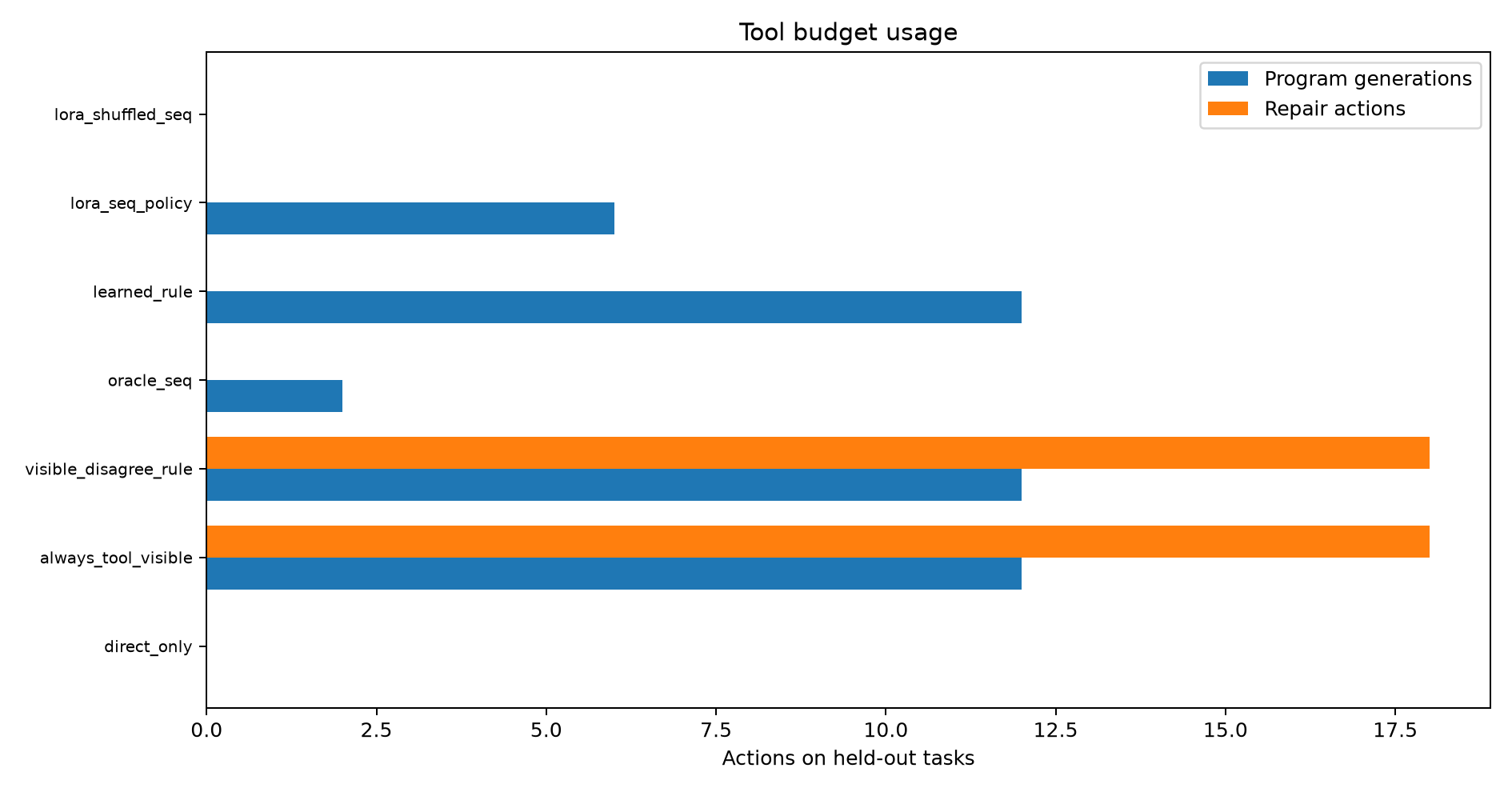
Five strategies that all solve two of twelve unseen tasks. For each, one bar counts programs written and run, the other counts repair attempts across twelve cases; lower is better since scores are equal.
Takeaway → Always-run burns twelve program runs plus eighteen repairs; the trained controller needs six runs and zero repairs, the perfect chooser just two — routing cuts compute, not accuracy.
Data table
| Policy | program generations | repair actions |
|---|---|---|
| always tool | 12 | 18 |
| visible-disagree rule | 12 | 18 |
| learned rule | 12 | 0 |
| LoRA policy | 6 | 0 |
| oracle actions | 2 | 0 |
Numbers from reports/final_summary.json (policy_results.*.test program_generations, repair_actions)
Technical framing
Tool budget on held-out test: same accuracy, very different cost — All these policies score 2/12, but the LoRA controller gets there with 6 generations and no repairs vs 12+18 for always-tool.
In the author’s words from the Report · “Summary”
This standalone experiment generates fresh tool-environment traces and trains/evaluates a sequential controller over visible tool state. The controller chooses among DIRECT, WRITE, FIX, and PROGRAM. It is evaluated by simulating those actions on the freshly generated traces.
Overview
Standalone live tool-state DAgger-style pilot.
The experiment generates fresh Qwen3.5-4B traces for a table transformation environment:
- produce a direct JSON answer,
- write an executable
transform(table)program, - run the program on the public example,
- repair when the public example fails,
- decide whether to commit the direct output or the program output.
It derives oracle action labels from held-out correctness for training/evaluation analysis, but deployed policy inputs contain only visible tool state.
Run smoke:
python scripts/run_live_tool_dagger.py \
  --root /workspace/experiments/qwen35_4b_live_tool_dagger \
  --generate-traces \
  --limit-total 6 \
  --max-repairs 1
Run full pilot:
python scripts/run_live_tool_dagger.py \
  --root /workspace/experiments/qwen35_4b_live_tool_dagger \
  --generate-traces \
  --train-lora \
  --train-shuffled-lora \
  --max-repairs 2 \
  --max-steps 60 \
  --resume
Outputs are written under reports/.
Report
Rendered from reports/report.md
Summary
This standalone experiment generates fresh tool-environment traces and trains/evaluates a sequential controller over visible tool state.
The controller chooses among DIRECT, WRITE, FIX, and PROGRAM. It is evaluated by simulating those actions on the freshly generated traces.
Split And Trace Counts
- dev: 12 records, direct 3, program 5, oracle union 7, families: potters_wheel_merge_split, proactive_wrangling_fold, synthetic_22, synthetic_51
- test: 12 records, direct 0, program 2, oracle union 2, families: potters_wheel_divide, reshape_table_structure_data_wrangler, synthetic_13, synthetic_45
- train: 36 records, direct 6, program 5, oracle union 10, families: agriculture, craigslist_data_wrangler, crime_data_wrangler, potters_wheel_fold, potters_wheel_fold_2, potters_wheel_split_fold, potters_wheel_unfold, potters_wheel_unfold2, proactive_wrangling_complex, synthetic_11, synthetic_5, synthetic_8
Held-Out Test Result
| Policy | Exact | Accuracy | Program gens | Repairs | Program commits | Recoveries | Losses | Program precision |
|---|---|---|---|---|---|---|---|---|
direct_only | 0/12 | 0.0% | 0 | 0 | 0 | 0 | 0 | n/a |
always_tool_visible | 2/12 | 16.7% | 12 | 18 | 3 | 2 | 0 | 66.7% |
visible_disagree_rule | 2/12 | 16.7% | 12 | 18 | 2 | 2 | 0 | 100.0% |
learned_rule | 2/12 | 16.7% | 12 | 0 | 2 | 2 | 0 | 100.0% |
lora_seq_policy | 2/12 | 16.7% | 6 | 0 | 2 | 2 | 0 | 100.0% |
lora_shuffled_seq | 0/12 | 0.0% | 0 | 0 | 0 | 0 | 0 | n/a |
oracle_seq | 2/12 | 16.7% | 2 | 0 | 2 | 2 | 0 | 100.0% |
Gate Verdict
The best deployable rule reached 2/12 with 2 recoveries and 0 losses. The sequential LoRA policy reached 2/12 with 2 recoveries and 0 losses. The shuffled-label control reached 0/12, providing the label-noise control for the LoRA arm.
Learned Rule
{
  "dev": {
    "accuracy": 0.5833333333333334,
    "direct_correct_losses": 0,
    "direct_miss_recoveries": 4,
    "exact": 7,
    "n": 12,
    "policy": "rule",
    "program_commits": 4,
    "program_correct": 4,
    "program_generations": 12,
    "program_precision": 1.0,
    "repair_actions": 0,
    "split": "dev"
  },
  "false": "WRITE",
  "feature": "program_disagrees_direct",
  "true": "PROGRAM"
}
Figures
Limitations
- This is a balanced pilot split, not a full benchmark run.
- The policy is evaluated on fresh precomputed traces;
WRITEandFIXreveal the corresponding fresh generated tool outputs from those traces. - Hidden labels are used only for oracle labels and evaluation, not in policy state.
Experiment log 1
Show the running log (1 entry, 2026-06-28)
2026-06-28
- Created standalone live tool-state controller package.
- Copied source cases and sandbox utilities into the package.
- Configured a family-disjoint balanced pilot split with train/dev/test families and fresh trace generation.
- Ran a 9-case smoke pass with one repair round to exercise trace generation, safe execution, report writing, and chart writing.
- Ran an initial full pass, but its held-out split had no oracle headroom on test, so it was retained only as a diagnostic artifact and not used for the final readout.
- Tightened split construction to seed recovery-positive families across train/dev/test before filling neutral families.
- Ran the corrected
split2pilot with 60 fresh traces: 36 train, 12 dev, 12 test. - Final held-out result on
split2: direct-only 0/12, learned rule 2/12, sequential LoRA 2/12, shuffled-label LoRA 0/12, oracle 2/12. - The sequential LoRA matched the oracle on the held-out split while using 6 program generations, versus 12 for the best fixed/rule policies and 2 for the oracle.
Figures 3
Data files 1
Result tables and metrics copied from the experiment folder — preview inline or open the raw file.
Reproduce
Run steps are documented inside the experiment folder (README and scripts).