Qwen3.5-4B: Can Confidence Replace the Verifier in the Banking Flywheel?
The one idea you need
This small model teaches itself: it writes many candidate programs, keeps the ones it is surest are right, and retrains on those. Like a cook who tastes to serve tonight's best plate (fine), but writes the cookbook by taste alone — subtly-wrong recipes slip in and the apprentice learns the flaws.
The question
If a small model grades its own generated code by how confident it feels instead of actually running it, can it still build a training set and teach itself to improve?
What we found
No. When training on answers checked by actually running the code lifted single-shot accuracy from 8% to 24%, confidence-filtered data — fifteen times purer than a random grab of the model's own outputs — landed right on the no-filter floor at 12%, adding nothing. Self-training tolerates almost no wrong examples, and the confident mistakes a filter lets through are plausible near-misses that teach the worst habits.
Why it matters
In a self-training loop, keep a real code-runner cleaning the training data — confidence leaks plausible-but-wrong examples that poison learning at small data sizes. Use confidence only to rank candidates, filtering by rank within difficulty tiers, never by a fixed score cutoff.
On this page
Results at a glance 4
How to read
One bar per training filter, showing depth-2 single-shot accuracy in thinking mode after fine-tuning on 70 self-generated solutions drawn from one shared pool: no training, execution-verified (all correct), confidence-picked (43% correct), and unfiltered random (3% correct). Taller is better.
Takeaway → Only the fully-verified bar rises, 8% to 24%; the confidence-picked bar sits at 12%, dead level with random despite being fifteen times cleaner — near-purity bought nothing.
Data table
| condition | depth-2 single-shot accuracy, thinking mode (n=25, frozen paired eval) |
|---|---|
| base (no training) | 8% |
| execution-verified (purity 1.00) | 24% |
| confidence-picked (purity 0.43) | 12% |
| unfiltered random (purity 0.03) | 12% |
Numbers from runs/verdict.json (think.greedy_full.d2.POSTHOC), runs/eval_*_think.json
Technical framing
Fine-tuning on self-picked solutions: only execution-verified data teaches; confidence-picked = unfiltered — All arms fine-tune on 70 same-size pairs from the SAME candidate pool; only the filter differs. The ~15x purity advantage of the confidence filter buys nothing over no filter (trichotomy verdict: conf~rand; post-hoc cell, exec-vs-base CI [+0.04,+0.32], p=0.011). Banking tolerates almost no confidently-wrong data.
How to read
Two judging methods side by side: an instant one-token self-score versus one given room to reason first. Dark bars measure how reliably it separates right from wrong answers on the SAME task (higher is better); light bars are a flattering score inflated by mixing easy and hard tasks together.
Takeaway → Instant scoring sits at a coin flip within a task; thinking first lifts it to reliable. The flattering pooled bar hides this failure — always check the within-task bar.
Data table
| condition | within-task AUROC (right vs wrong, same task) | pooled AUROC (inflated by task difficulty) |
|---|---|---|
| instant (no-think) judge | 0.471 | 0.749 |
| thinking judge (512-token budget) | 0.845 | 0.961 |
Technical framing
The one-token self-score is blind here unless the model thinks before scoring — On this substrate correctness must be mentally EXECUTED, not read off a docstring -- the C46 single-token law is substrate-scoped, and C44's serial-compute law governs the judge seat: 99% of thinking judgments hit the 512-token budget and the rescue still holds. Pooled AUROC conceals the failure: gate on within-task.
How to read
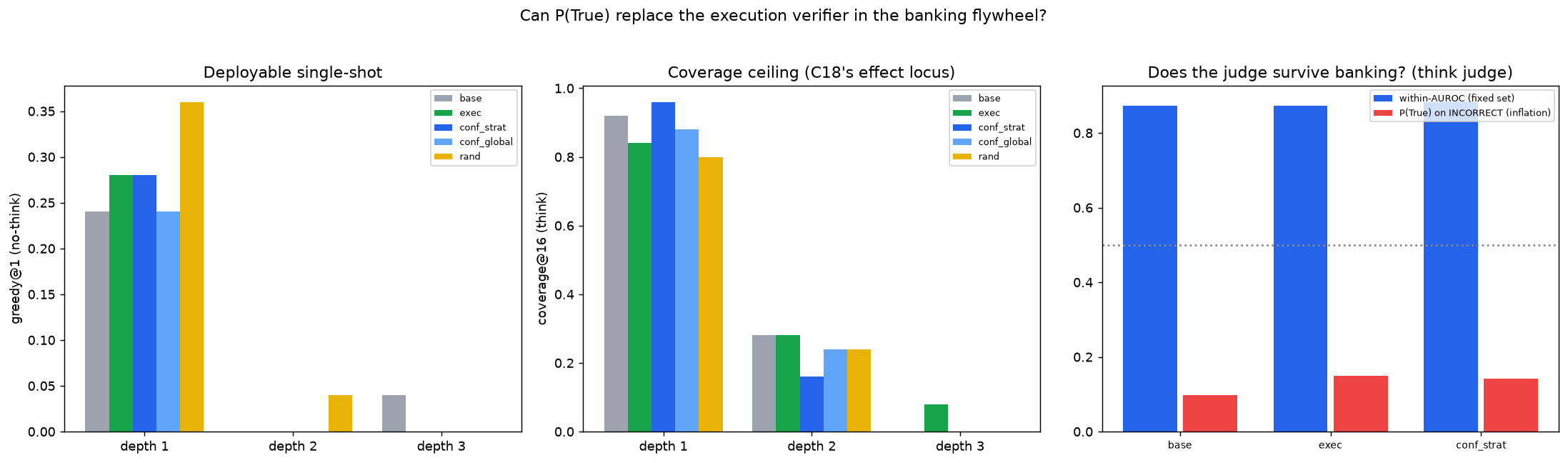
Three models each grade the identical set of 777 candidates: untrained, trained on verified data, and trained on its OWN approvals. Dark bars: how well it separates right from wrong answers (higher is better, near-flat across all three). Light bars: confidence wrongly given to incorrect answers (lower is better, creeping up after training).
Takeaway → The judge's ranking survives even after training on its own approvals, but its confidence on wrong answers drifts upward — so filter by rank each round, never by a fixed score cutoff.
Data table
| condition | within-task AUROC, fixed 777 candidates (thinking judge) | P(True) given INCORRECT, fixed set |
|---|---|---|
| base | 0.872 | 0.098 |
| trained on verified data | 0.873 | 0.149 |
| trained on its OWN approvals | 0.883 | 0.141 |
Numbers from runs/calib_think_*.json, runs/calib_self_think_*.json
Technical framing
Does the judge survive self-training? Ranking intact, scores inflate on its own mistakes — Every model judges the IDENTICAL 777 candidates, so any change is a change in the judge. Discrimination survives even for the arm trained on its own approvals; on its OWN new candidates the score on wrong answers doubles (0.091 -> 0.204). Flywheel rule: filter by rank each round, never by a fixed score threshold.
How to read
Bars show depth-1 answer variety in instant no-think mode after each fine-tune — the share of tasks where at least one of 16 tries is correct (higher is better). Left to right: base, execution-verified, confidence-stratified, confidence-global, and unfiltered random.
Takeaway → Most trained arms roughly halve base variety (72% down to 32-40%) as correct answers get crammed onto one banked program family; the light-dose stratified arm (76%) is spared, and reasoning mode stays untouched.
Data table
| condition | depth-1 coverage@16, no-think (frozen paired eval) |
|---|---|
| base | 72% |
| execution-verified | 36% |
| confidence-stratified | 76% |
| confidence-global | 32% |
| unfiltered random | 40% |
Numbers from runs/eval_*_nothink.json + per-task forensics in reports/report.md (Result 6)
Technical framing
Side effect: banking reallocates the no-think proposal distribution onto the banked op-family — Not capability loss: correct samples are conserved (126/115/130/106/108 per 400) but crammed onto the banked program family -- the dedup-op family drops from 9/10 tasks covered to 0/10. The stratified arm banks only 15 depth-1 pairs (sub-threshold dose) and is spared. Chain-of-thought re-derivation shields think-mode sampling, which is what a flywheel harvests.
In the author’s words from the Overview · “Results”
stats in runs/verdict.json; saga in experiment_log.md. Gate stop first (kept): the NO-think P(True) judge is at chance within-task on this substrate (0.471; pooled 0.749 = task difficulty). C46's within-problem law is substrate-scoped: it holds where correctness is semantically readable, not where it must be computed. Serial compute rescues the judge: CoT judging (judge_think, budget 512, 99% forced-close) lifts within-task AUROC to 0.845 (pooled 0.961), P(True) correct/incorrect 0.61/0.08 full-pool — C44's law governs the judge seat. The pivot re-ranked the conf arms on think-P(True); gate passed (purity gap 0.400). Trichotomy = conf~rand. No pre-registered cell cleared exec−base ≥ 0.10. … Read the full result →
Overview
Research Program
- Program:
posttraining_and_adaptation(×evidence_conditioned_selection) - Program question: the banking arc (C11–C24) requires an executable verifier at every rung; the confidence arc (C40–C46) built a calibrated verification-free judge. Can the second power the first — extending self-training to domains with no interpreter?
- Prior anchors: C18 (
qwen35_4b_coverage_banking— the harness and effect this replicates), C46 (qwen35_4b_code_confidence+ HumanEval — P(True) is the program-level confidence), C11 (banking law), C29 (read-only verifier 2AFC 0.81), C24 (banking gain is diversity-driven).
Question
Does banking the model's own high-P(True) solutions — with NO execution anywhere in the training pipeline — recover the capability gain of banking execution-verified solutions? And does the calibration signal itself SURVIVE being trained on (flywheel viability), or does self-training inflate P(True) / collapse the judge?
Hypothesis
C46 says top-P(True) selection approaches visible-test execution per-candidate, so a top-fraction filter over a large harvest should yield a training set pure enough (~0.8+) for C18-style banking, whose gain is diversity- not purity-driven (C24). Falsifiers, each a distinct autopsy: (a) banking is less noise-tolerant than selection — confident-but-WRONG pairs teach the confidently-wrong modes; (b) the filter biases toward easy tasks, collapsing the diversity that drives banking; (c) training on own confident outputs inflates P(True) and destroys calibration (feedback collapse — kills round 2 even if round 1 works).
Setup
- Model: Qwen3.5-4B, QLoRA r32/α64 (C18-identical: epochs 3, lr 2e-4, no-think prompt→code pairs).
- Dataset/task source: contamination-free procedural list-DSL identification tasks (
families.py), 90 train tasks at depths 1/2/3 (C18 schedule), K=40 think-mode samples each. - Train/eval split: frozen held-out eval set (
eval_ladder.py), behavioral func-sig + op-composition dedup vs ALL train tasks, 0 leakage, paired across arms. - Baseline: base model (no training) and
rand(same-size, draw-frequency-weighted sample of the same pool — what "bank with no filter" actually means; uniform-over-unique would deflate the floor). - Arms (all filter the SAME candidate pool; matched size is enforced HARD = matched optimizer steps; identical training recipe; the ONLY variable is the keep-test):
exec(execution-verified, C18-identical — the ceiling),conf_strat(PRIMARY: depth-stratified top think-P(True), per-depth quotas ∝ pool judge-score MASS — attempt-2 pivot: candidate-count quotas provably allocate slots where wrong candidates explode; verifier-free, isolates the keep-test from cross-depth slot allocation),conf_global(ablation: naive global top-P(True), the fully-deployable policy; its expected depth-collapse is reported, not conflated),rand. - Gate (pre-registered, run.py hard-stops otherwise): pool P(True)-vs-full_pass AUROC ≥ 0.65 AND conf_strat−rand purity gap ≥ 0.10 AND matched n ≥ 60. Below the gate the finding is "the judge does not transfer to this substrate" and training is not burned. (The gate reads oracle purity — an experiment-level run/stop decision, documented like the matched-n scalar.)
- Primary metric & decision rule (pre-registered): per cell (mode × metric × depth, incl. pooled) where exec−base ≥ 0.10, classify by paired-bootstrap CIs into a TRICHOTOMY —
conf~rand(conf_strat-vs-rand CI ≤ 0: filter adds nothing),intermediate(beats rand, below exec),conf~exec(beats rand, CI vs exec includes 0: verifier replaceable). The joint-bootstrap recovery ratio (conf−base)/(exec−base) is reported with CI as a magnitude, not a cutoff (n=25/depth cannot resolve 0.8 vs 1.0). - Secondary: calibration survival — (a) fixed judge set (base's no-think eval-task samples; every model judges the SAME candidates → judge-change isolated), inflation headline = P(True)-on-INCORRECT drift (overall mean drift confounds inflation with real ability); (b) self-distribution pass (each model judges its OWN think-mode eval-task candidates — the actual round-2 flywheel number).
- Oracle-only metrics:
full_passgrades all evals, builds theexecarm, and gates the run; in the conf arms' selection it never appears (post-hoc purity reporting only). - Hidden-label boundary: conf-arm selection reads nothing but the model's own P(True) logit (no-think A/B judge, P(A) after "Answer: ") + generator metadata (task depth, draw frequency for tiebreaks). Matching size to the exec arm leaks one scalar (documented design constant).
- Known limits (pre-registered): single LoRA seed per arm (~30 optimizer steps — arm deltas include seed noise); no depth-4 cell (C18 comparability cell dropped for time); conf_global gets no think-mode eval (ablation, nothink only).
Run
Smoke (~10 min end-to-end, all five stages):
python scripts/run.py --smokeFull (~12 h on the RTX 4090: harvest ~2 h, pool think-judge ~50 min, 4 trains ~12 min, 9 pipeline evals ~5 h + 1 held-back conf_global think eval post-pipeline, 10 calib passes ~4 h — the think-judge and self-distribution passes dominate):
python scripts/run.py            # idempotent; safe to re-run after interruption
python scripts/analyze.py
Results
Full narrative in reports/report.md; stats in runs/verdict.json; saga in experiment_log.md.
- Gate stop first (kept): the NO-think P(True) judge is at chance within-task on this substrate (0.471; pooled 0.749 = task difficulty). C46's within-problem law is substrate-scoped: it holds where correctness is semantically readable, not where it must be computed.
- Serial compute rescues the judge: CoT judging (
judge_think, budget 512, 99% forced-close) lifts within-task AUROC to 0.845 (pooled 0.961), P(True) correct/incorrect 0.61/0.08 full-pool — C44's law governs the judge seat. The pivot re-ranked the conf arms on think-P(True); gate passed (purity gap 0.400). - Trichotomy = conf~rand. No pre-registered cell cleared exec−base ≥ 0.10. In the post-hoc cell where exec moved (d2 think greedy 0.08 → 0.24, CI [+0.04,+0.32], p=0.011), conf_strat +0.04 = rand +0.04 exactly, despite ~15× purity (0.429 vs 0.029). Recovery 0.25, CI [−1,+1]. Banking is far less noise-tolerant than selection.
- The exec ceiling is dose-limited: first matched-dose C18 re-run under the strict frozen paired eval → d2 think coverage flat (0.28 → 0.28). With the lineage audit (C18: p=0.082, 3/20 d2 eval tasks leaked under the canonical probe-set func-sig; C22/C23 replications at 3.5× dose; C24 dose law), C18's headline was a low-dose overestimate, not a false effect.
- Calibration survives banking as a RANKER: fixed-set think-judge within-AUROC 0.872 → 0.873 (exec) / 0.883 (conf_strat). But P(True) on own INCORRECT candidates doubles on the self-distribution (0.091 → 0.204). Rank filters survive round 2; fixed thresholds silently degrade. Own pass-rate 0.120 → 0.093 (no capability gain, consistent with 3).
- No-think SFT reallocates the no-think proposal prior; CoT shields think: d1 no-think cov@16 collapses 0.72 → 0.32–0.40 for exec/conf_global/rand (conserved correct mass crammed onto the banked op-family; dedup-family tasks 9/10 → 0/10) but conf_strat's d3-heavy quota is sub-threshold (0.76); think-mode diversity untouched. Registered prediction for the held-back conf_global think eval: d1 cov_any ≈ 0.80–0.88, losses on dedup tasks — result: 0.88, uniq 8.6, all 3 residual losses in the dedup/unique family (3/3 confirmed).
Interpretation
The verifier is load-bearing at the TRAINING seat, not the JUDGING seat. As a selector (C41/C46), P(True) approaches execution; as a training filter it fails — not because the judge ranks badly (0.845) but because banking at this dose tolerates almost no confidently-wrong data, and the wrongs a confidence filter admits are precisely the plausible ones. The judge itself is robust to self-training (ranks survive, scores inflate on the self-distribution), so the flywheel's binding constraint is not feedback collapse but dose (C24): scale the harvest so the top-rank slice is pure AND diverse, or keep the executable verifier. Deployment rules: think-judge (never no-think) on computational substrates; filter by rank within depth strata (score-mass quotas), never by a fixed threshold.
Knowledgebase Update
- Program evidence updated:
posttraining_and_adaptation×evidence_conditioned_selection - Claim ledger updated: C47 (this experiment); C18 annotated with the eval audit + dose-law framing
Artifacts
src/— shared banking substrate (families list-DSL, gen_lib with the P(True) judge, code_env)scripts/—harvest_pool.py(shared pool + oracle + P(True) annotations, AUROC canary),build_arms.py(matched-size exec/conf/rand sets),train_lora.py(C18-identical),eval_ladder.py(frozen paired eval, C24 version),calib_eval.py(fixed-judge-set calibration survival),run.py,analyze.pydata/— train_tasks, pool, per-arm training sets, frozen eval, judge setruns/— adapters (moved external before commit), eval/calib JSONsreports/— design_review.md, report.md, artifact_manifest.yaml
Report
Rendered from reports/report.md
Summary
Split verdict, and the split is the finding. At the capability seat: no — in the one eval cell where execution-verified banking produced a real gain (depth-2 think greedy 0.08 → 0.24, CI [+0.04, +0.32]; a post-hoc cell — no pre-registered cell cleared the bar), the pre-registered trichotomy RULE classifies confidence-filtered banking exactly on the no-filter floor (both +0.04): conf~rand, despite the confidence arm being ~15× purer than random (0.43 vs 0.03). At the judge seat: yes, with a caveat — think-judge discrimination fully survives being trained on its own approvals (fixed-set within-task AUROC 0.872 → 0.883), but P(True) scores inflate on the model's own post-banking distribution (P(True) on own incorrect candidates 0.091 → 0.204, doubled). A flywheel that filters by rank keeps its filter at round 2; one that filters by a fixed threshold silently degrades. Two upstream findings condition everything: the no-think P(True) judge is at chance within-task on this substrate (C46's law is substrate-scoped), and CoT judging rescues it (0.47 → 0.85 within-task) — verification of computational correctness is itself a serial computation (C44's law reaches the judge seat).
Research Program Fit
posttraining_and_adaptation × evidence_conditioned_selection: first experiment to connect the banking arc (C11–C24: self-training needs an executable verifier at every rung) to the confidence arc (C40–C46: a calibrated verification-free judge exists). The connection fails at the training seat and succeeds at the judging seat, which cleanly relocates where the verifier is load-bearing.
Method
Shared candidate pool: 90 procedural list-DSL identification tasks (depths 1/2/3 = 20/35/35), K=40 think-mode samples each → 2,130 unique candidates, oracle-graded (unique-candidate pass rate 0.033) and judged twice: no-think P(True) at harvest, think-P(True) (judge_pool_think.py, budget 512) after the gate-forced pivot. Four matched-size arms (n=70 pairs, hard trim; identical C18 QLoRA recipe r32/α64, 3 epochs, lr 2e-4, no-think prompt→code; the ONLY variable is the keep-test): exec (execution-verified, C18-identical keep rule — the ceiling, purity 1.0, depth mix 43/20/7), conf_strat (PRIMARY verifier-free arm: depth-stratified top think-P(True), per-depth quotas ∝ judge-score MASS, purity 0.429, mix 15/30/25), conf_global (ablation: naive global top-score, purity 0.614, mix 36/29/5), rand (draw-frequency-weighted floor, purity 0.029). Frozen paired eval (75 held-out tasks, behavioral func-sig + op-composition dedup, 0 leakage), 25/depth, K=16, greedy@1 + coverage. Pre-registered run/stop gate and trichotomy decision rule; paired-bootstrap CIs on every delta; calibration survival on a fixed judge set (777 identical base-generated candidates judged by every arm) plus a self-distribution pass (each model think-judges its OWN K=8 eval-task candidates — the round-2 flywheel condition).
Results
1. The no-think judge reads difficulty, not correctness, on this substrate (gate stop). Pooled no-think P(True) AUROC 0.749 but within-task 0.471 = chance (mean P(True) by depth 0.38/0.25/0.20 merely tracks solvability). C46's within-problem discrimination (0.74 MBPP, 0.78 HumanEval) does not transfer to a substrate where correctness is only computable (mentally execute the candidate on 8 examples), not semantically readable from a docstring.
2. Serial compute rescues the judge. judge_think (CoT before the same A/B verdict token) lifts within-task AUROC 0.471 → 0.845 on the full pool (pooled 0.961; diagnostic subset 0.49 → 0.802), P(True) correct/incorrect 0.61/0.08 full-pool (0.58/0.10 on the diagnostic subset) — with thinking budget-truncated at 512 tokens in 99% of judgments. C44's serial-compute law governs the judge seat: verifying a computational candidate IS a serial computation. This is what made the experiment runnable verifier-free: the conf arms rank on think-P(True); the gate passed (pool AUROC 0.961, purity gap 0.400).
3. MAIN — trichotomy verdict: conf~rand; purity is not the binding constraint. No pre-registered cell cleared the exec-gain ≥ 0.10 bar (see Result 4). The only significant pre-registered exec effect is depth-2 think cov_frac +0.035 (CI [+0.003, +0.072]) — concentration of sample mass on already-covered tasks, not expansion. In the post-hoc cell (labeled .POSTHOC in runs/verdict.json; added after seeing raw evals) exec moved hard — depth-2 think greedy 0.08 → 0.24 (CI [+0.04, +0.32], p=0.011):
| arm | Δ vs base (d2 think greedy) | purity | role |
|---|---|---|---|
| exec | +0.160 (CI [+0.04, +0.32]) | 1.000 | ceiling |
| conf_strat | +0.040 (n.s.) | 0.429 | conf~rand |
| rand | +0.040 (n.s.) | 0.029 | floor |
Recovery ratio (conf−base)/(exec−base) = 0.25, joint-bootstrap CI [−1.0, +1.0] (uninformative at n=25). The ~15× purity advantage bought zero deployable gain — only the 100%-pure arm moved. Banking is far less noise-tolerant than selection (C41/C46's seat): 40% confidently-wrong pairs — plausible near-misses, by construction of the filter — erase what 100%-pure data teaches. Suggestive (multiple-comparison caveat): conf_strat is the only arm that did NOT collapse depth-1 no-think coverage (Result 6) and shows small d1 think cov_frac wins over both rand (+0.110, CI [+0.018, +0.207]) and exec (+0.090, CI [+0.005, +0.185]).
4. The exec ceiling itself is dose-limited: C18's headline was a low-dose overestimate. The exec arm is the first matched-dose re-run of the C18 recipe (20 d2 pairs / 8 distinct d2 functions vs C18's 24 / 9) under the strict C24-standard eval — and C18's depth-2 coverage expansion (0.15 → 0.45) is flat here (0.28 → 0.28). Lineage audit: (a) C18's headline was 3/20 vs 9/20 (Fisher p=0.082) on a leak-permissive eval — exact-ops dedup only; 3/20 of its d2 eval tasks were train-identical under the canonical probe-set func-sig (the same criterion the frozen eval dedups on), leak-excluded 2/17 vs 7/17 (p=0.118); (b) the expansion effect is real but was re-established at 3.5× the d2 dose — C22 0.225 → 0.425 (n=40), C23 0.175 → 0.50 (n=40, p=0.004, 83 pairs / 26 distinct functions); (c) under C24's diversity dose law, 8–9 distinct d2 functions sit at the bottom of the curve where a null at n=25 is expected. Consequence: at matched dose the exec ceiling is intrinsically small, so the trichotomy had little headroom — conf~rand holds in the one cell that cleared the bar, with n=25 power caveats.
5. Calibration survives banking as a RANKER; scores inflate on the self-distribution. Fixed judge set (777 identical candidates, 47 correct; think judge = the flywheel's filter):
| model | within-AUROC | pooled | P(True)\|correct | P(True)\|incorrect |
|---|---|---|---|---|
| base | 0.872 | 0.961 | 0.613 | 0.098 |
| exec-banked | 0.873 | 0.962 | 0.708 | 0.149 |
| conf_strat-banked | 0.883 | 0.957 | 0.682 | 0.141 |
Self-distribution (own think-mode K=8 eval-task candidates — the round-2 harvest):
| model | within-AUROC | pooled | P(True)\|incorrect | own pass-rate |
|---|---|---|---|---|
| base | 0.842 | 0.930 | 0.091 | 0.120 |
| conf_strat-banked | 0.878 | 0.923 | 0.204 | 0.093 |
Discrimination is untouched — even for the arm trained on its own judge approvals; the self-reinforcement collapse hypothesis (falsifier c) is dead. But P(True) on own incorrect candidates doubles (fixed-set drift only +0.043 → the inflation is distribution-specific).
6. Banking reallocates the no-think proposal distribution; CoT shields the think one. Banked arms collapse depth-1 no-think coverage@16 (base 0.72 → exec 0.36 / conf_global 0.32 / rand 0.40; conf_strat 0.76 does NOT collapse) while greedy stays flat. Per-task paired forensics: zero-sum mode reallocation, not capability loss — correct d1 samples per 400 are conserved across arms (126/115/130/106/108) while covered-task count crashes 18 → 9/8/10; the same correct mass gets crammed onto the banked program family. All four banks' d1 pairs come exclusively from the arithmetic-map/reorder/slice families and 0% from dedup_adjacent/unique_stable; exactly that family goes from 9/10 tasks covered (66 correct samples) at base to 0/10 (0) under exec/conf_global. Dose-dependent (exec banks 43 d1 pairs → collapse; conf_strat only 15 via its d3-heavy score-mass quotas → sub-threshold, 7/10 dedup tasks survive) and correctness-dependent (rand collapses by the other route: mass shifts toward wrong programs, diversity retained). Training pairs are NO-THINK, so the sharpening lives in the immediate-answer prior; CoT re-derives the answer and shields the think distribution (think-mode unique-programs unchanged, 7.7 → 7.8–9.0). Registered prediction (logged before running): the missing conf_global think eval should show d1 cov_any ≈ 0.80–0.88 with residual losses on dedup tasks, vs its 0.32 no-think collapse. Test result: 3/3 — d1 cov_any 0.88 (top of the predicted band), uniq 8.6 (predicted 7–9), and all three residual lost-vs-base tasks are exactly the dedup/unique family (unique_stable, dedup_adjacent, unique_stable). The out-of-sample test confirms the mechanism.
Controls
randis draw-frequency-weighted (what "bank with no filter" means); uniform-over-unique would deflate the floor. Matched size is a hard trim (C23 count-confound), matched optimizer steps.- Score-mass quotas for conf_strat exist because candidate-count quotas provably allocate slots where wrong candidates explode (d2: 915 wrong / 20 correct; d3: 1066 / 7) — the attempt-2 lesson.
- The fixed judge set isolates judge-change from candidate-change (every arm judges the identical 777 candidates); the inflation headline is P(True)-on-INCORRECT drift, since overall mean drift confounds inflation with real ability gain.
- No-think judge secondary control: its within-task AUROC improves after banking (0.679 → 0.71–0.82: exec 0.815, rand 0.800, conf_strat 0.792, conf_global 0.713) in every arm including rand (97% wrong pairs) — a generic task-domain-SFT effect on the readout, not learning of correctness. (It also shows the no-think judge is not uniformly at chance: on the cruder no-think error distribution it is partially informative, 0.679; on the plausible think-harvest near-misses it is chance, 0.471.)
Oracle Versus Deployable Evidence
Oracle (full_pass) appears ONLY in: exec's keep-test (the ceiling arm by design), the experiment-level gate, and post-hoc purity/calibration REPORTING. The conf arms' selection reads nothing but the model's own think-P(True) logit + generator metadata (depth, draw frequency); matching size to exec leaks one scalar (documented design constant). The deployable recipe this experiment licenses: think-judge rank filtering (no oracle) — but for training data, its 0.43 purity was not enough to matter at this dose.
Interpretation
The verifier is load-bearing at the TRAINING seat, not the JUDGING seat. Confidence transfers across seats asymmetrically: as a selector (C41/C46) P(True) approaches execution; as a training filter it fails not because the judge ranks badly (0.845 within-task) but because banking tolerates almost no confidently-wrong data at this dose — and the wrongs a confidence filter admits are precisely the plausible ones. Meanwhile the judge itself is robust to self-training (ranks survive, scores inflate), so the flywheel's failure mode is not feedback collapse but simple dose: at 70 pairs the exec ceiling is already at the bottom of C24's diversity dose curve, and a 0.43-pure filter recovers none of it. Three laws sharpen: C46 is substrate-scoped (single-token readouts work where verification is shallow; computational correctness needs serial compute — C44 governs the judge seat too); C24's dose law now has a matched-dose null confirming its bottom end (and retro-explains C18 as a low-dose overestimate on a leak-permissive eval); and the banking arc gains a distribution rule — no-think SFT reallocates the no-think proposal prior toward banked families while CoT shields the think distribution, so flywheel harvests (think-mode) survive banking that would look catastrophic no-think.
Next Experiments
- Scale the harvest, not the filter: K=40 → K=160+ on more tasks, then take the top-rank slice at conf_strat's quota — does purity×diversity at larger dose cross the banking threshold verifier-free? (The direct test of "dose is the binding constraint".)
- Threshold-vs-rank flywheel round 2 in anger: run one actual round-2 harvest+train with rank filtering (predicted fine) vs fixed-threshold filtering (predicted purity decay via the +0.113 inflation).
- Semantically-readable substrate (natural-language task descriptions, C37-style): does the NO-think judge's within-task discrimination return, making the cheap filter viable there?
- Judge-budget dose-response: think-judge scores fell by depth (0.36/0.10/0.07 mean by depth) at budget 512, 99% forced-close — does budget 1024/2048 lift deep-candidate ranking?
Artifact Manifest
runs/verdict.json (full stats incl. .POSTHOC labels), runs/arms_summary.json (gate + arm composition), runs/judge_think_diag.json (Result 2 diagnostic), runs/calib*.json (Result 5: fixed / think / self-think), runs/eval_*.json (10 arm×mode evals, 25 tasks/depth), analysis/ verifier_free_banking.png, experiment_log.md (full saga incl. two failed attempts and the session crash), reports/design_review.md (pre-registration). Adapters (5 × 182 MB) moved out of the repo — external paths + regenerate commands in reports/artifact_manifest.yaml.
Experiment log 10
Show the running log (10 entries, 2026-07-07 → 08)
2026-07-07 design + review
Scaffolded from the C18 harness (harvest/train_lora) + C24 frozen-paired eval; the P(True) judge (judge_nothink) was already present, unused, in every banking experiment's gen_lib.py. Adversarial design review (reports/design_review.md): sound_with_fixes; all seven must-fixes applied (smoke/full artifact separation, hard gate, stratified-conf primary arm, draw-weighted rand, matched-size hard trim, self-distribution calibration, trichotomy decision rule). Two smoke passes green, second covering adapter-loaded eval/calib and analyze.
2026-07-08 attempt 1: CUDA OOM (two stacked environment bugs)
Full harvest OOM'd at batch 48 fifteen minutes in. Causes: (1) launched without PYTORCH_CUDA_ALLOC_CONF=expandable_segments:True (mandatory per docs/compute_environment.md — C18 ran this exact config WITH it); (2) torch 2.12 raises generation OOM as torch.AcceleratorError, which gen_lib's six batch-halving catch sites (except torch.cuda.OutOfMemoryError) do not catch — the designed graceful degradation became a hard crash. A third bug hid the failure: cmd | grep | tee | tail reports the LAST pipe stage's exit code — the dead run looked like exit 0. Fixes: run.py sets the alloc env var itself; gen_lib catches OOM_ERRORS = (OutOfMemoryError, AcceleratorError); relaunches use pipefail.
2026-07-08 attempt 2: GATE STOP — the no-think judge reads difficulty, not correctness
Harvest succeeded (90 tasks × K=40 → 2,130 unique candidates). The pool is needle-in-haystack, unlike MBPP: unique-candidate purity 0.033 (draws ~0.21) — wrong programs EXPLODE combinatorially at depths 2–3 (~1,000 distinct wrong each vs 20/7 correct), while correct answers concentrate + duplicate at depth 1.
The pre-registered gate stopped the run before training, and its numbers contain the experiment's first finding: pooled P(True) AUROC 0.749 but WITHIN-task AUROC 0.471 — chance. All apparent signal is between-task difficulty (mean P(True) by depth 0.38/0.25/0.20 tracks solvability). The C46 within-problem discrimination (0.74 on MBPP) does NOT transfer to this substrate: here correctness is only COMPUTABLE (mentally execute the candidate on 8 examples), not semantically readable from a docstring. Also caught: pool-candidate-count quotas for conf_strat allocate slots exactly where wrong candidates are most numerous (perfect-ranker purity ceiling ≈ 0.44; actual 0.10); conf_global still concentrated purity 8× over random (0.243 vs 0.029) on the between-task component alone.
2026-07-08 diagnostic: serial compute RESCUES the judge (0.49 → 0.80 within-task)
Hypothesis from C44 (induction is a serial-compute limit) applied to the JUDGE seat: verifying a candidate transform requires serially executing it; a single no-think forward pass cannot. Test: judge_think (CoT before the A/B verdict) on 524 pool candidates (all 70 correct + 6 wrong/task). RESULT: within-task AUROC 0.49 → 0.802; pooled 0.719 → 0.924; mean P(True) correct/incorrect 0.48/0.26 → 0.58/0.10. Verification of computational correctness is itself a serial computation — C44's law governs metacognition too. Notable: thinking was budget-truncated (forced-close) in 99% of judgments and still reached 0.80 — the first 512 thinking tokens carry the decisive execution steps. (Tooling: judge_think returns (p_values, forced_flags) — a tuple, not a list.)
2026-07-08 attempt 3: pipeline relaunched on the think-P(True) filter
Pivot codified: new stage judge_pool_think.py (think-judge the full pool); build_arms.py ranks conf arms on p_true_think, and conf_strat quotas switch from candidate-count-proportional to JUDGE-SCORE-MASS-proportional (the count version provably allocates slots where wrong candidates explode); calibration survival now measured on the THINK judge (fixed set for base/exec/conf_strat; self-distribution for base/conf_strat) since that is the filter the flywheel would actually use. Same gate, same trichotomy. Gate PASSED: pool think-AUROC 0.961 pooled, purity gap conf_strat-rand 0.400; arms at matched n=70: exec purity 1.0 {d1:43,d2:20,d3:7}, conf_strat 0.429 {15,30,25}, conf_global 0.614 {36,29,5}, rand 0.029.
2026-07-08 session crash mid-pipeline (harness, not experiment)
The CLI session died with repeated EACCES while the pipeline ran; the orphaned run.py SURVIVED (trains + evals kept writing). No permission error appears anywhere in the run logs -- the crash was the harness's own session files. Recovery: verify PID alive, re-arm a log monitor from the new session, continue. Lesson: launch long pipelines so they don't die with the session (they did not -- subprocess detach was sufficient), and make every stage idempotent so a relaunch resumes from disk (it is).
2026-07-08 eval grid complete: trichotomy = conf~rand in the only cell exec moved
NO pre-registered cell clears the exec-gain >= 0.10 bar. The only significant pre-registered exec effect is d2 think cov_frac +0.035 CI[+0.003,+0.072] (concentration on already-covered tasks). POST-HOC cell (labeled .POSTHOC in verdict.json -- added after seeing raw evals): d2 think greedy base 0.08 -> exec 0.24 (CI[+0.04,+0.32], p=0.011); there conf_strat +0.04 = rand +0.04 exactly -> trichotomy conf~rand. Purity 0.43 (~15x rand) bought zero deployable gain; only the 100%-pure exec arm moved anything. Suggestive (multiple-comparison caveat): conf_strat is the only arm not collapsing d1 no-think coverage and shows small d1 cov_frac wins over BOTH rand (+0.110) and exec (+0.090) in think mode.
2026-07-08 forensics (read-only agents, while calibration runs)
d1 no-think coverage collapse (0.72 -> 0.36 exec / 0.32 conf_global / 0.40 rand, but 0.76 conf_strat) is zero-sum mode reallocation, not capability loss. Correct d1 samples/400 are CONSERVED across arms (126/115/130/106/108) while covered tasks crash 18 -> 9/8/10; correct mass gets crammed onto the banked program family. All four banks' d1 pairs come exclusively from the map/reorder/slice families (square/negate/drop_k/ rotate/sort/reverse/mul_k/abs) and 0% dedup_adjacent/unique_stable -- and the dedup/unique family goes 9/10 tasks covered (66 correct samples) at base to 0/10 (0) under exec/conf_global. Dose x correctness: exec banks 43 d1 pairs (collapse), conf_strat only 15 (sub-threshold, 7/10 dedup tasks survive), rand collapses by the other route (97% wrong pairs shift mass off-target with diversity retained). Training pairs are NO-THINK, so the sharpening lives in the immediate-answer prior; CoT re-derives and shields the think distribution (think uniq unchanged 7.7 -> 7.8-9.0). Flywheel-relevant: round-2 harvest is think-mode, i.e. on the SHIELDED distribution. REGISTERED PREDICTION before running the missing cell: conf_global_think d1 cov_any ~0.80-0.88, uniq ~7-9, residual losses concentrated on dedup/unique tasks (vs its 0.32 no-think collapse). Will run post-pipeline when the GPU frees.
"C18 fails to replicate" is the WRONG frame -- it is C24's dose law. Audit of the lineage: C18's 0.15->0.45 was 3/20 vs 9/20 (Fisher p=0.082, n=20) on a leak-permissive eval (exact-ops dedup only; 3/20 d2 eval tasks train-identical under the canonical probe-set func-sig; leak-excluded 2/17 -> 7/17 p=0.118). The d2 expansion DID survive frozen leak-proof evals -- C22 0.225->0.425 (n=40) and decisively C23 0.175->0.50 (n=40, p=0.004) -- but at 3.5x the d2 dose (83 pairs / 26 distinct functions vs C18's 24 / 9). Our exec arm is the first MATCHED-DOSE re-run (20 pairs / 8 distinct d2 functions) under the strict eval: flat cov_any 0.28->0.28 is the bottom of the C24 dose curve, not an anomaly. Correct statement: C18's effect size was a low-dose overestimate; cite against C23 + C24, not as a standalone replication failure. Consequence for THIS experiment: at matched dose the exec ceiling is intrinsically small, so the trichotomy had little headroom -- the conf~rand verdict holds in the one cell that cleared the bar, with n=25 power caveats.
2026-07-08 calibration complete: the judge survives banking as a RANKER
Fixed judge set (777 identical base no-think candidates, 47 correct): think-judge within-AUROC base 0.872 -> exec 0.873 / conf_strat 0.883 -- discrimination untouched, even for the arm trained on its own approvals (falsifier c dead). Scores inflate mildly on the fixed set (P(True)|incorrect 0.098 -> 0.149/0.141) and HARD on the self-distribution (base 0.091 -> conf_strat 0.204, doubled; own pass-rate 0.120 -> 0.093, no capability gain). Flywheel rule: rank filters survive round 2, fixed thresholds silently rot. Secondary: the NO-think judge's within-task AUROC improves after banking in EVERY arm including rand (0.679 -> 0.71-0.82) -- a generic task-domain-SFT readout effect, not correctness learning; and it is not uniformly chance (0.679 on crude no-think errors vs 0.471 on plausible think-harvest near-misses -- the failure is distribution-dependent).
2026-07-08 registered prediction test: 3/3 CONFIRMED
Post-pipeline, ran the held-back conf_global think eval against the pre-logged prediction (d1 cov_any ~0.80-0.88, uniq ~7-9, residual losses on dedup/unique tasks): measured cov_any 0.88, uniq 8.6, and ALL THREE residual lost-vs-base tasks are the dedup/unique family (unique_stable, dedup_adjacent, unique_stable). The mode-reallocation + CoT-shield mechanism survives an out-of-sample test. Final analyze covers 10 eval tags / 20 paired cells; verdict.json + figure final. Claim C47 filed; C18 annotated with the eval audit; playbook updated; adapters (5 x 182MB) moved to scratchpad/verifier_free_banking_artifacts/ per reports/artifact_manifest.yaml.
Figures 1
Data files 14
Result tables and metrics copied from the experiment folder — preview inline or open the raw file.
runs/arms_summary.json1.5 kBruns/arms_summary_smoke.json1.1 kBruns/eval_base_nothink.json9.2 kBruns/eval_base_think.json9.1 kBruns/eval_conf_global_nothink.json9.7 kBruns/eval_conf_global_think.json9.6 kBruns/eval_conf_strat_nothink.json9.6 kBruns/eval_conf_strat_think.json9.5 kBruns/eval_exec_nothink.json9.2 kBruns/eval_exec_think.json9.1 kBruns/eval_rand_nothink.json9.2 kBruns/eval_rand_think.json9.1 kBruns/eval_smbase_nothink.json755 Bruns/eval_smconf_nothink.json755 B
Reproduce
Smoke test
python scripts/run.py --smokeFull run
python scripts/run.py && python scripts/eval_ladder.py --tag conf_global_think --K 16 --n-per-depth 25 --depths 1 2 3 --adapter runs/lora_conf_global --think && python scripts/analyze.pyRun steps are documented inside the experiment folder (README and scripts).