Degradation ladder: does confidence track the size of the damage?
Ground truth: the rung number. Rung 0 is a real, error-free summary of the PKPD paper written by a showdown model. Each rung adds one logged damage step (a planted factual error such as “27 classes” → “34 classes”, a deleted sentence, or two swapped sentences) to the rung below, so every rung is strictly worse than the one before.
python examples/ladder_eval.py verifyreplays the log from the original text and must reproduce every rung.
A good judge should get pairs of summaries many steps apart right almost every time, and be less sure about pairs one step apart. This is the calibration test Eric called “the calibration killer.”
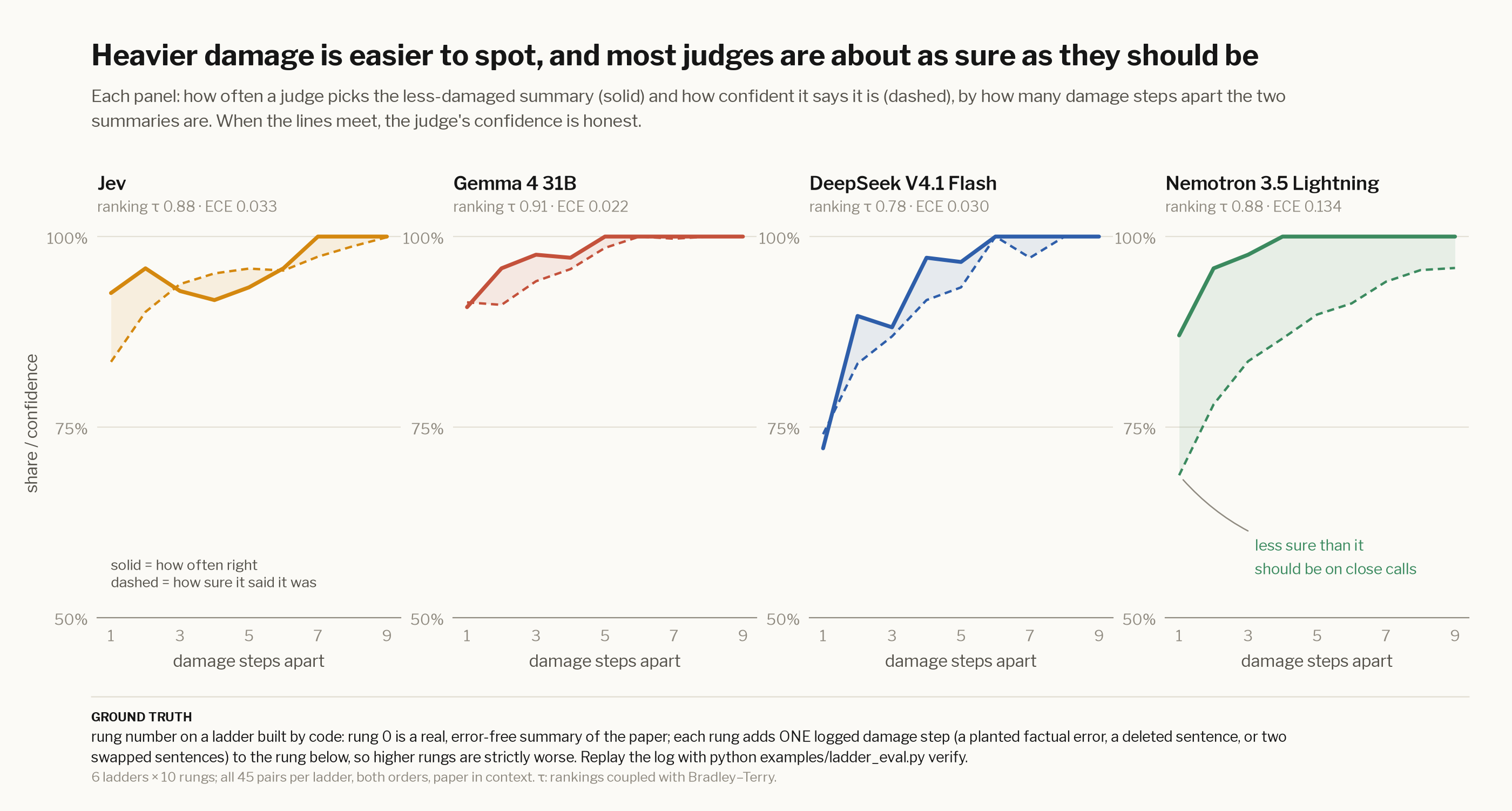
Results
| judge | ranking τ (BT) | pairs right | mean confidence | ECE | 1 step apart: right / sure | cost |
|---|---|---|---|---|---|---|
| Jev | 0.88 | 94.4% | 92.2% | 0.033 | 93% / 84% | $0.016 |
| DeepSeek V4.1 Flash | 0.78 | 90.0% | 87.8% | 0.030 | 72% / 74% | $0.063 |
| Gemma 4 31B | 0.91 | 96.7% | 95.0% | 0.022 | 91% / 91% | $0.324 |
| Nemotron 3.5 Lightning | 0.88 | 96.3% | 82.9% | 0.134 | 87% / 69% | $0.138 |
6 ladders × 10 rungs, all 45 pairs per ladder, both orders, with the paper text in the judge’s context. τ couples the answers with Bradley–Terry; the paper’s Eq. 7 saturates when a judge is near-certain (see the JSON for both).
Reproduce
python examples/ladder_eval.py generate && python examples/ladder_eval.py verify
python examples/ladder_eval.py judge     # ≈ $0.55 on OpenRouter
python examples/ladder_eval.py plots
← Market eval · Code runtime → · All docs