Verifiable eval: an exact ground truth you can recount
Ground truth: exact counts fixed by construction. For each summary, how many of its statements contradict the source (accuracy) and how many of the source’s 16 facts it mentions (completeness). The source documents are fictional and generated from a fixed random seed, so no model can have memorized them. Anyone can recount every number with
python examples/verifiable_eval.py verify.
The Summary Showdown has no ground truth: nobody can say which summary of a paper is truly best, so it reports an AI jury and compares it with another LLM. The 16-paper demo has a ground truth that the dataset author assigned. This eval removes the judgment call entirely.
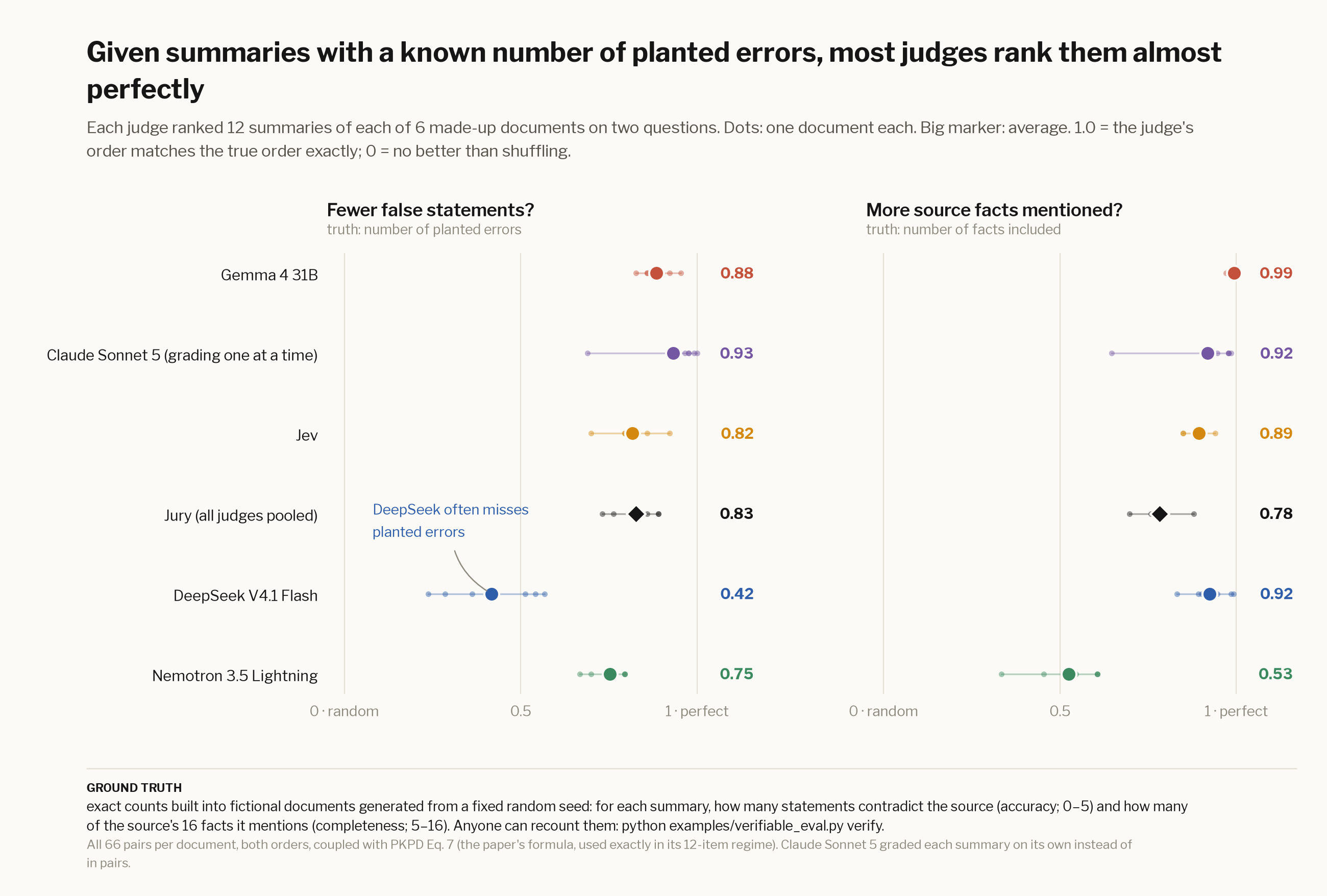
Results
| judge | accuracy τ | accuracy τ (BT) | accuracy: pairs right | completeness τ | completeness τ (BT) | completeness: pairs right | cost |
|---|---|---|---|---|---|---|---|
| Gemma 4 31B | 0.88 ± 0.04 | 0.90 | 97.2% | 0.99 ± 0.01 | 0.99 | 99.7% | $0.097 |
| Claude Sonnet 5, pointwise rubric | 0.93 ± 0.11 | – | 96.2% | 0.92 ± 0.12 | – | 94.9% | $0.100 |
| Jev 1.13 (TypeSafe) | 0.82 ± 0.07 | 0.88 | 96.4% | 0.89 ± 0.03 | 0.88 | 94.4% | $0.022 |
| jury (pairwise judges pooled) | 0.83 ± 0.06 | 0.86 | 95.0% | 0.78 ± 0.05 | 0.86 | 95.2% | $0.259 |
| DeepSeek V4.1 Flash | 0.42 ± 0.13 | 0.44 | 57.2% | 0.92 ± 0.06 | 0.92 | 91.2% | $0.073 |
| Nemotron 3.5 Lightning | 0.75 ± 0.05 | 0.74 | 86.7% | 0.53 ± 0.10 | 0.49 | 75.3% | $0.068 |
Measured correlation between the two true counts (errors vs facts mentioned) across all 72 summaries: r = 0.02. Error counts and fact counts are assigned independently, so answering one question (or preferring longer summaries) does not answer the other. τ uses PKPD Eq. 7 (the paper’s formula); τ (BT) couples the same answers with Bradley–Terry, which is more robust when a judge gives near-certain answers (Eq. 7 then saturates and produces ties).
“Pairs right” is the share of the judge’s own pairwise answers (both orders averaged) that pick the item with the better true count; τ is Kendall’s τ between the judge’s coupled ranking of the 12 summaries and the true order, averaged over 6 documents.
How the data is built
- A fictional source document. A report on an invented institute with 16 facts: founding year, headquarters
city, founder, staff count, laboratories, budget, director, patents, funding share, and so on. Names are
random syllables (“Zusor Banzu Institute”, “Sorailost”). Values are drawn from a seeded random generator
(
SEED = 20260923). A few neutral filler sentences are mixed in. - 12 summaries per document, built by code. Summary i mentions exactly
c_iof the 16 facts and states exactlye_iof those with a deliberately wrong value (a different year, count, name or place). Within a document thecvalues are 5, 6, …, 16 (each once) and theevalues are 0, 0, 1, 1, …, 5, 5, assigned independently at random. Everyeis at most everyc, so no constraint links them, and length doesn’t give away accuracy (the measured correlation is printed under the results). Sentence order is shuffled. - The truth is in the text. Every summary sentence is one fact template with either the true or the wrong
value.
verifymaps each sentence back to its fact and recounts both numbers from the text alone.
The data lives in examples/data/verifiable.json.
How judges are scored
- Pairwise judges (Jev and the logprob LLM judges) answer, for every one of the 66 pairs per document and in both orders: “Which summary contains fewer statements that contradict the source document?” and “Which summary mentions more of the facts in the source document?”, with the source document in context. Their answers are coupled per document with PKPD Eq. 7 (K = 12, the regime the paper was written for).
- The jury pools all pairwise judges’ answers before coupling.
- The pointwise grader (Claude Sonnet 5, the model used as the showdown’s reference) is asked for both counts directly for each summary. Scoring it here shows how far that reference can be trusted.
Reproduce
python examples/verifiable_eval.py generate   # deterministic: same seed, same data
python examples/verifiable_eval.py verify     # recount everything
python examples/verifiable_eval.py judge      # ≈ $0.30 on OpenRouter
python examples/verifiable_eval.py plots
← Evaluation · Market eval → · All docs