Qwen3.5-4B: Beating Sample-More with the Model's Own Uncertainty
The one idea you need
Ask a small model the same puzzle twelve times; each answer comes stamped with the model's own certainty. Majority vote trusts whichever answer repeats most, but the model often confidently repeats one wrong rule. Its single surest answer instead catches the rare try that truly cracked it.
The question
When a small model answers the same problem twelve times, is picking the most popular answer really the best way to combine those tries?
What we found
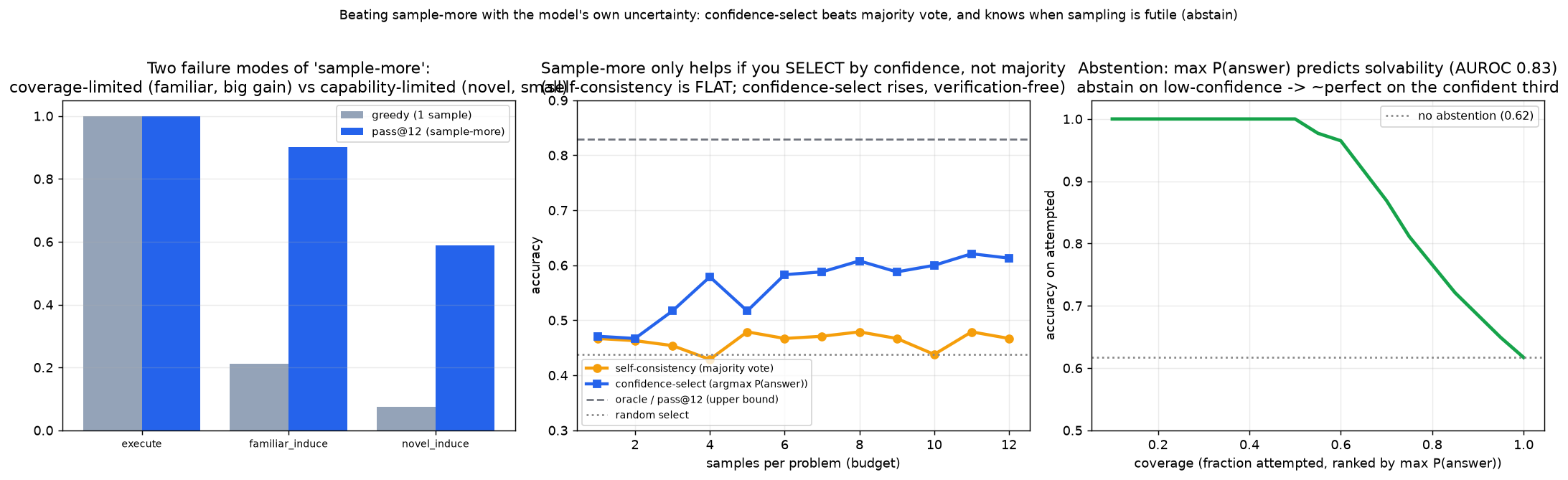
No. Picking the most common answer wastes the extra tries: accuracy stays flat near 48% however many you draw, because the model keeps confidently repeating the same wrong rule. Picking the answer it was surest of instead climbs from 47% to 62%, beating the popular vote at every budget and approaching the 83% a perfect picker would reach.
Why it matters
When you sample a small model many times, rank the candidates by how sure the model is of each answer, not by how often each appears. It costs one cheap extra read, needs no separate checker, and also tells you when to stop.
On this page
Results at a glance 2
How to read
Horizontal axis: tries drawn per problem (1 to 12). Vertical axis: accuracy, higher is better. The flat lower line picks the most common answer, the rising line picks the most-confident answer, and the top reference line marks a perfect picker.
Takeaway → The vote line stays flat near 48% while the confidence line climbs to 62%, closing most of the gap to the perfect picker: confidence beats popularity at every budget.
Data table
| samples per problem (budget) | self-consistency (majority vote) | confidence-select (argmax P(answer), verification-free) | oracle / pass@12 (upper bound) |
|---|---|---|---|
| 1 | 46.7% | 47.1% | 82.9% |
| 2 | 46.3% | 46.7% | — |
| 3 | 45.4% | 51.7% | — |
| 4 | 42.9% | 57.9% | — |
| 5 | 47.9% | 51.7% | — |
| 6 | 46.7% | 58.3% | — |
| 7 | 47.1% | 58.8% | — |
| 8 | 47.9% | 60.8% | — |
| 9 | 46.7% | 58.8% | — |
| 10 | 43.8% | 60% | — |
| 11 | 47.9% | 62.1% | — |
| 12 | 46.7% | 61.3% | 82.9% |
Numbers from
Technical framing
Sample-more only helps if you SELECT by confidence, not majority: self-consistency is flat, confidence-select rises (verification-free) — Mission = beat sample-more. C40 unearthed a calibrated implicit confidence signal (answer-token probability P(answer)). Here: sample k=12 per problem on a mix of the C40 successor task, and compare ways to pick the answer at matched budget. Self-consistency (majority vote -- the standard verifier-free method) is FLAT at ~0.48 across ALL budgets: sample-more is WASTED, because on hard problems the model's MODE is confidently wrong (it repeats a wrong rule). Confidence-select (pick the sample with the highest P(answer), verification-FREE -- no execution, no verifier) RISES from 0.47 to 0.62 and beats majority at every budget, closing most of the gap to the oracle/pass@12 upper bound (0.83). It works because P(answer) is calibrated (C40): when the model derives the right rule it is confident, so the most-CONFIDENT sample beats the most-COMMON one. Turning naive sample-more into a rising accuracy-vs-compute curve.
How to read
Three problem types along the bottom; accuracy up the side, higher is better. Each type has two bars: a single best guess versus whether any of twelve tries was correct. Easy problems are solved either way; the two harder types differ sharply.
Takeaway → On coverage-limited problems twelve tries jump from 21% to 90%; on capability-limited ones they stall at 59%, below the 72% blind guessing would give, so more sampling is futile there.
Data table
| condition | greedy (1 sample) | pass@12 (sample-more ceiling) |
|---|---|---|
| execute | 100% | 100% |
| familiar_induce (coverage-limited) | 21% | 90% |
| novel_induce (capability-limited) | 7% | 59% |
Numbers from
Technical framing
Two failure modes of sample-more, and abstention: max P(answer) predicts which problems are solvable (AUROC 0.83) — Sample-more has TWO failure modes. Coverage-limited (familiar_induce): greedy gets it right only 21% but pass@12 reaches 90% -- more samples help enormously. Capability-limited (novel_induce): greedy 7%, pass@12 only 59% (BELOW the pure-luck ceiling of 72% at chance 0.10 -- the model concentrates its samples on WRONG rules, so sampling is largely futile). The model's confidence distinguishes them: the max per-sample P(answer) predicts per-problem solvability at AUROC 0.83, so abstaining on low-confidence problems yields ~100% accuracy on the confident top third -- a working abstain/escalate signal for exactly the capability-limited problems where sampling does not pay. (Confidence-guided budget ALLOCATION was roughly tied with uniform confidence-select; the win is in SELECTION and ABSTENTION, not allocation.)
In the author’s words from the Overview · “Results”
Self-consistency (majority vote) is FLAT (~0.48); confidence-select (argmax P(answer), verification-free) RISES 0.47->0.62, beating majority at every budget (oracle 0.83). Max P(answer) predicts solvability (AUROC 0.83) -> abstain on low-confidence -> ~1.0 on the confident third. Allocation ~tied with uniform confidence-select. See reports/report.md, analysis/confidence_guided_compute.png.
Overview
Research Program
- Program:
benchmark_generalization - Question: turn C40's calibrated implicit confidence (answer-token probability) into a compute tool -- can it beat uniform sample-more?
Setup
- A mix of C40 successor problems spanning easy (execute), coverage-limited (familiar_induce), capability-limited (novel_induce). Sample k=12/problem; read each sample's P(answer) (one forward pass). Compare selection/allocation/abstention policies at matched budget.
Run
python scripts/eval_sampling.py --n 80 --k 12 then python scripts/analyze.py.
Results
Self-consistency (majority vote) is FLAT (~0.48); confidence-select (argmax P(answer), verification-free) RISES 0.47->0.62, beating majority at every budget (oracle 0.83). Max P(answer) predicts solvability (AUROC 0.83) -> abstain on low-confidence -> ~1.0 on the confident third. Allocation ~tied with uniform confidence-select. See reports/report.md, analysis/confidence_guided_compute.png.
Interpretation
The fixed 4B's own logits tell you which sample to trust and when to stop -- no verifier, no execution. Beats the standard verifier-free method (self-consistency). Deployable use of C40.
Knowledgebase Update
- Claim ledger: C41
Artifacts
scripts/succ_family.py,scripts/eval_sampling.py(greedy + k sampled, each with P(answer)),scripts/analyze.pyruns/sampling_records.json,runs/verdict.json,analysis/confidence_guided_compute.png,reports/report.md
Report
Rendered from reports/report.md
Motivation
The mission is "beat sample-more." C40 unearthed a deployable implicit confidence signal (the model's answer-token probability P(answer) is calibrated to its own correctness). This turns that signal into a compute tool.
Method
A mix of problems on the C40 successor task ("advance k in a cyclic order") spanning three regimes: easy (execute), coverage-limited (familiar_induce), capability-limited (novel_induce). Sample k=12 per problem; read each sample's P(answer) (softmax over the 10 digit tokens, one forward pass). Compare selection/allocation policies at matched forward-pass budget. Verifiable ground truth; single seed.
Results (n=80/condition, k=12)
Two failure modes of sample-more:
| condition | greedy (1) | pass@12 |
|---|---|---|
| execute | 1.00 | 1.00 |
| familiar_induce (coverage-limited) | 0.21 | 0.90 |
| novel_induce (capability-limited) | 0.07 | 0.59 (below pure-luck 0.72) |
Verification-free selection (pick 1 of 12 samples):
| method | accuracy |
|---|---|
| random | 0.44 |
| self-consistency (majority vote) | 0.48 |
| confidence-select (argmax P(answer)) | 0.62 |
| oracle (pass@12 upper bound) | 0.83 |
Across budgets: self-consistency is flat (~0.48) — sample-more is wasted — while confidence-select rises 0.47 → 0.62 and beats majority at every budget. It works because P(answer) is calibrated (C40): on hard problems the model's mode is confidently wrong, but when it derives the right rule it is confident, so the most-confident sample beats the most-common one.
Abstention: max per-sample P(answer) predicts per-problem solvability at AUROC 0.83; abstaining on low-confidence yields ~1.0 accuracy on the confident top third (a working abstain/escalate signal for the capability-limited problems where sampling is futile).
Conclusion
The fixed 4B's own logits tell you which sample to trust and when to stop — no verifier, no execution — turning naive sample-more (flat under majority vote) into a rising accuracy-vs-compute curve. This is a deployable use of C40's unearthed self-knowledge, and it beats the standard verifier-free method (self-consistency).
Honest scope
- Confidence-guided allocation (probe-then-allocate budget) is roughly tied with uniform confidence-select — the win is in selection and abstention, not allocation.
- Single toy substrate (successor task). Generalizing the signal to real code/MBPP (where "sample-more" is the standard baseline) is the owed next step.
- Single seed; the design review agent died on an API error (not re-run), so the design was self-vetted against the arc's prior selection findings (C10, C17).
Artifact Manifest
See reports/artifact_manifest.yaml.
Experiment log 1
Show the running log (1 entry)
Scaffold
Created as a new experiment scaffold.
Figures 1
Reproduce
Smoke test
python scripts/eval_sampling.py --n 15 --k 8Full run
eval_sampling.py --n 80 --k 12; analyze.pyRun steps are documented inside the experiment folder (README and scripts).