Qwen3.5-4B Foofah Program Strategy Portfolio
The one idea you need
To reshape a messy table, the model writes several small programs and runs each against the one worked example it can check, like trying a ring of keys against a test lock. Programs that pass become candidates; a commit rule picks which to trust.
The question
When a small model reshapes messy tables, does having it write and test several small programs beat just asking it for the finished table directly?
What we found
Yes, but modestly, and which passing program you trust matters more than the programs. Asking directly for the finished table got 42% right. The rule the team locked in, commit only when two programs agree, reached just 48%. A simpler rule they also wrote down beforehand, trust the first program that passes the check, hit 56%, nearly the 58% best-possible ceiling. Consensus quietly discarded correct lone hits.
Why it matters
When candidate programs self-check against a worked example, commit the first that passes rather than requiring two to agree, since one correct program is usually right. Gains cluster in a few table shapes, so route effort, do not run every strategy everywhere.
On this page
Results at a glance 3
How to read
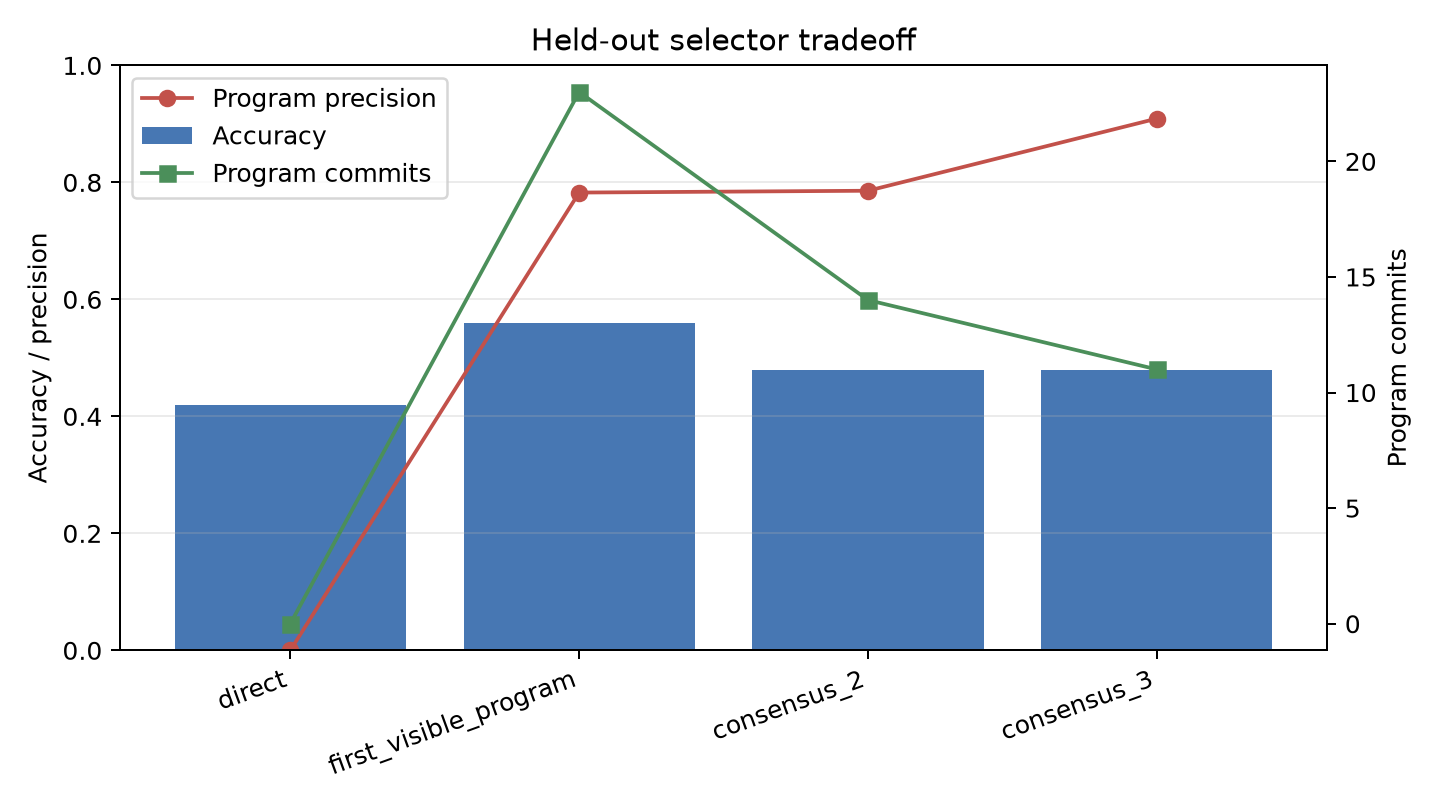
Height is exact-match accuracy on 50 reserved test tables; taller is better. Left bar asks the model directly; the two middle bars require two or three programs to agree; the next trusts the first program that passes; the rightmost is the best-possible ceiling.
Takeaway → The first-passing bar (56%) nearly touches the 58% ceiling while the agree-rules stall near 48%, so the picking rule, not the programs, capped the gain.
Data table
| condition | exact-match accuracy |
|---|---|
| direct JSON | 42% |
| consensus_2 (dev-selected) | 48% |
| consensus_3 | 48% |
| first visible program | 56% |
| direct-or-program oracle | 58% |
Numbers from reports/test_summary.json
Technical framing
Held-out Foofah accuracy: direct JSON vs frozen strategy portfolio — The dev-selected consensus_2 policy gains modestly (42%→48%); the predeclared first-visible selector nearly reaches the 58% oracle.
How to read
For three picking rules, grouped bars count cases out of 50: programs committed, wrong direct answers rescued (higher is better), and correct direct answers broken (lower is better).
Takeaway → Trusting the first passing program commits 23 and rescues 8 wrong answers at just 1 break; the agree-rules commit fewer and rescue only 3 to 4, safer but too timid.
Data table
| condition | program commits | direct-miss recoveries | direct-correct losses |
|---|---|---|---|
| consensus_2 (dev-selected) | 14 | 4 | 1 |
| consensus_3 | 11 | 3 | 0 |
| first visible program | 23 | 8 | 1 |
Numbers from reports/test_summary.json
Technical framing
Program-commit precision vs recoveries by selector (held-out) — First-visible commits more programs and recovers 8 direct misses at only 1 loss; consensus rules are safer but too conservative.
How to read
Two bars show total forward tokens across the 50-case test run; lower is cheaper. Left is asking the model directly; right runs all five program strategies with example-checked repairs on every case.
Takeaway → The portfolio burns about twelve times more tokens (890,030 versus 73,911) for a modest accuracy gain, real added coverage but not yet an efficient policy.
Data table
| condition | forward tokens |
|---|---|
| direct JSON | 73.91k |
| 5-strategy portfolio | 89k |
Numbers from report table (reports/report.md); reports/test_summary.json (total_forward_tokens)
Technical framing
Token cost of the strategy portfolio vs direct generation (held-out run) — The portfolio spends about 12x more tokens than direct generation, so the accuracy gain is not yet an efficient policy.
In the author’s words from the Overview
Standalone experiment for searching a small portfolio of executable program-generation strategies for Foofah table transformations. Strategy selection is performed on train/dev task families, then the frozen portfolio is evaluated on held-out families.
Overview
Standalone experiment for searching a small portfolio of executable program-generation strategies for Foofah table transformations.
The experiment uses only the local Foofah benchmark files under /workspace/large_artifacts/external_sources/foofah_benchmarks, with cases materialized in data/cases.jsonl. Strategy selection is performed on train/dev task families, then the frozen portfolio is evaluated on held-out families.
Report
Rendered from reports/report.md
Question
Can a small, searched portfolio of executable program-generation strategies improve Foofah table-transformation accuracy over direct JSON generation on held-out task families?
The experiment searches strategy prompts on train/dev families, freezes the selected portfolio, and evaluates it once on held-out families. Hidden answers are used for measurement and for train/dev strategy selection only, never as inputs to generation.
Selected Portfolio
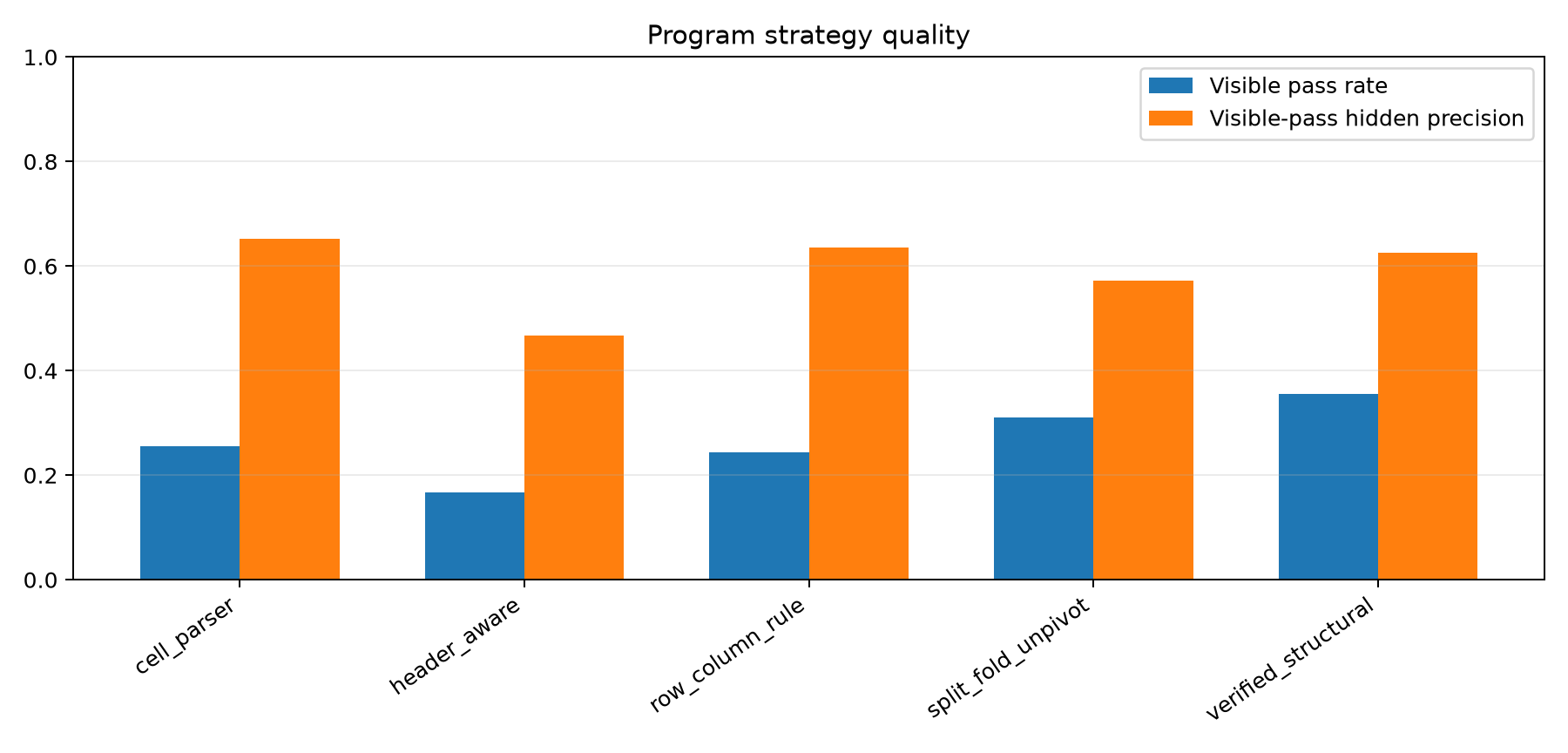
- Selected variants:
verified_structural, cell_parser, row_column_rule, header_aware, split_fold_unpivot - Selected policy:
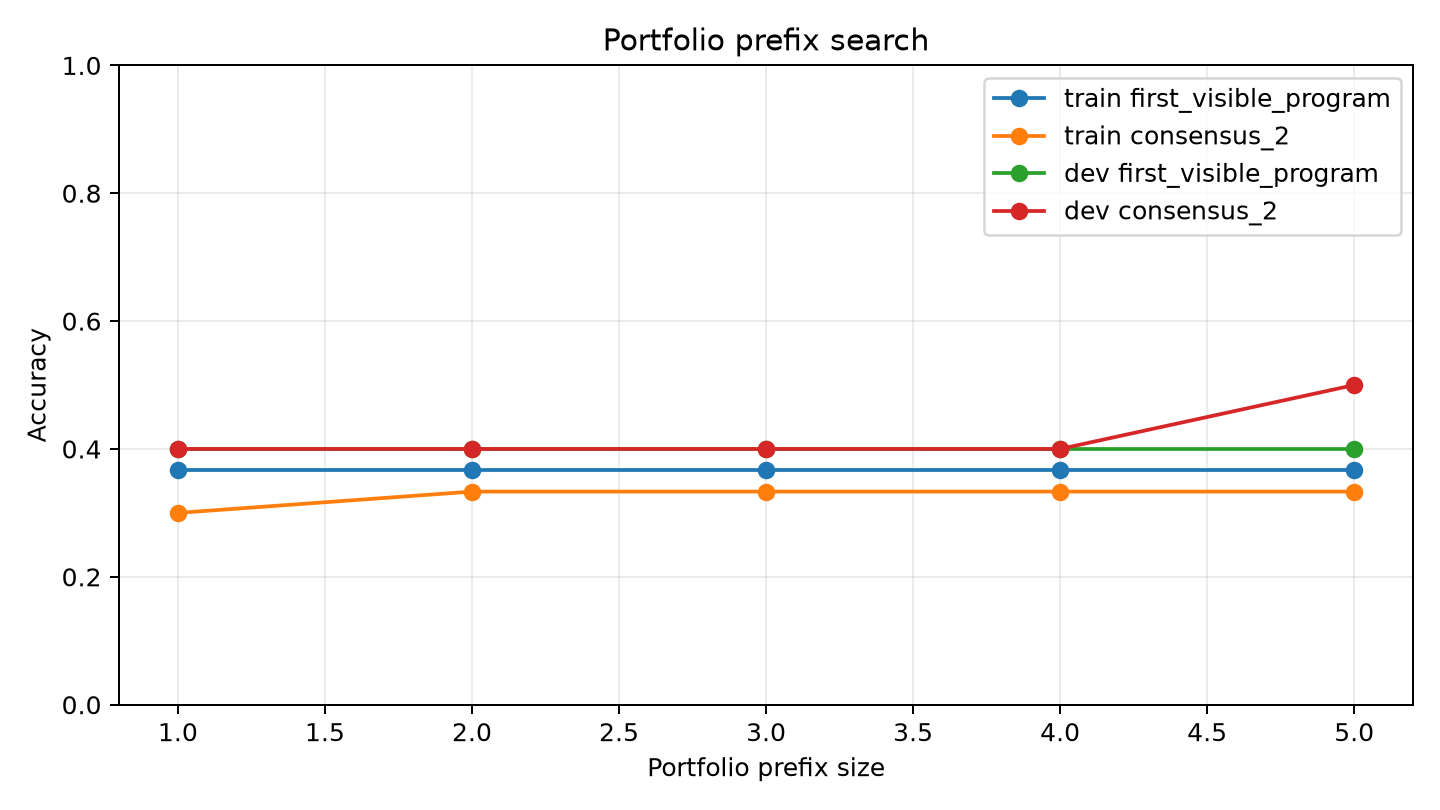
consensus_2 - Selection rule: greedy ordered variants on train; choose prefix and selector maximizing dev exact accuracy with loss/precision/token tie-breaks
Main Held-Out Result
| arm | exact | rate | program commits | program precision | direct-miss recoveries | direct-correct losses | forward tokens |
|---|---|---|---|---|---|---|---|
| Direct JSON | 21/50 | 42.0% | 0 | - | 0 | 0 | 73911 |
| Selected portfolio | 24/50 | 48.0% | 14 | 78.6% | 4 | 1 | 890030 |
| Direct OR selected-program oracle | 29/50 | 58.0% | - | - | - | - | - |
Held-Out Selector Tradeoff
| selector | exact | rate | program commits | program precision | recoveries | losses |
|---|---|---|---|---|---|---|
direct | 21/50 | 42.0% | 0 | - | 0 | 0 |
first_visible_program | 28/50 | 56.0% | 23 | 78.3% | 8 | 1 |
consensus_2 | 24/50 | 48.0% | 14 | 78.6% | 4 | 1 |
consensus_3 | 24/50 | 48.0% | 11 | 90.9% | 3 | 0 |
Figures
reports/figures/accuracy_by_split.pngreports/figures/portfolio_prefix_search.pngreports/figures/variant_quality.pngreports/figures/test_selector_tradeoff.png
Read
The primary dev-selected policy is a real but modest positive: consensus_2 improves held-out accuracy from 21/50 to 24/50, with 4 direct-miss recoveries and 1 direct-correct loss. It is safer than committing every visible-passing program, but it leaves a large share of candidate coverage unused.
The strongest predeclared held-out selector is first_visible_program: 28/50, with 8 direct-miss recoveries and 1 direct-correct loss. This nearly reaches the direct-or-program oracle of 29/50. It was not chosen by the dev selector, so it should be read as an important selector-mismatch finding rather than as the primary frozen-policy result.
The gain is highly family-concentrated. potters_wheel_merge_split moves from 0/5 direct to 4/5 with first-visible programs, and synthetic_8 moves from 0/5 direct to 4/5. Other families, especially crime_data_wrangler, potters_wheel_unfold, and potters_wheel_unfold2, mostly consume repair budget without producing deployable correct programs.
The cost is substantial: direct generation used 73,911 forward tokens on test, while the five-strategy portfolio used 890,030. This is not yet an efficient policy. The experiment establishes that strategy portfolios can create real held-out executable coverage, but the next iteration should be an adaptive budget/router that spends program attempts only on families or cases likely to benefit.
The most actionable result is therefore not "use all five strategies everywhere." It is: executable program strategies create complementary candidates, visible-pass first fallback captures most of the candidate oracle on some structural families, and the dev-selected consensus rule is too conservative for singleton-correct strategy hits.
Family Readout
| family | direct | first-visible | consensus_2 | oracle |
|---|---|---|---|---|
| agriculture | 4/5 | 3/5 | 3/5 | 4/5 |
| crime_data_wrangler | 0/5 | 0/5 | 0/5 | 0/5 |
| potters_wheel_merge_split | 0/5 | 4/5 | 3/5 | 4/5 |
| potters_wheel_unfold | 2/5 | 2/5 | 2/5 | 2/5 |
| potters_wheel_unfold2 | 0/5 | 0/5 | 0/5 | 0/5 |
| proactive_wrangling_fold | 5/5 | 5/5 | 5/5 | 5/5 |
| synthetic_12 | 5/5 | 5/5 | 5/5 | 5/5 |
| synthetic_25 | 4/5 | 4/5 | 4/5 | 4/5 |
| synthetic_48 | 1/5 | 1/5 | 1/5 | 1/5 |
| synthetic_8 | 0/5 | 4/5 | 1/5 | 4/5 |
Iteration Notes
- Eight strategy prompts were smoke-tested first. The full eight-strategy sweep was too slow, and three variants were repair-heavy or non-incremental in the smoke.
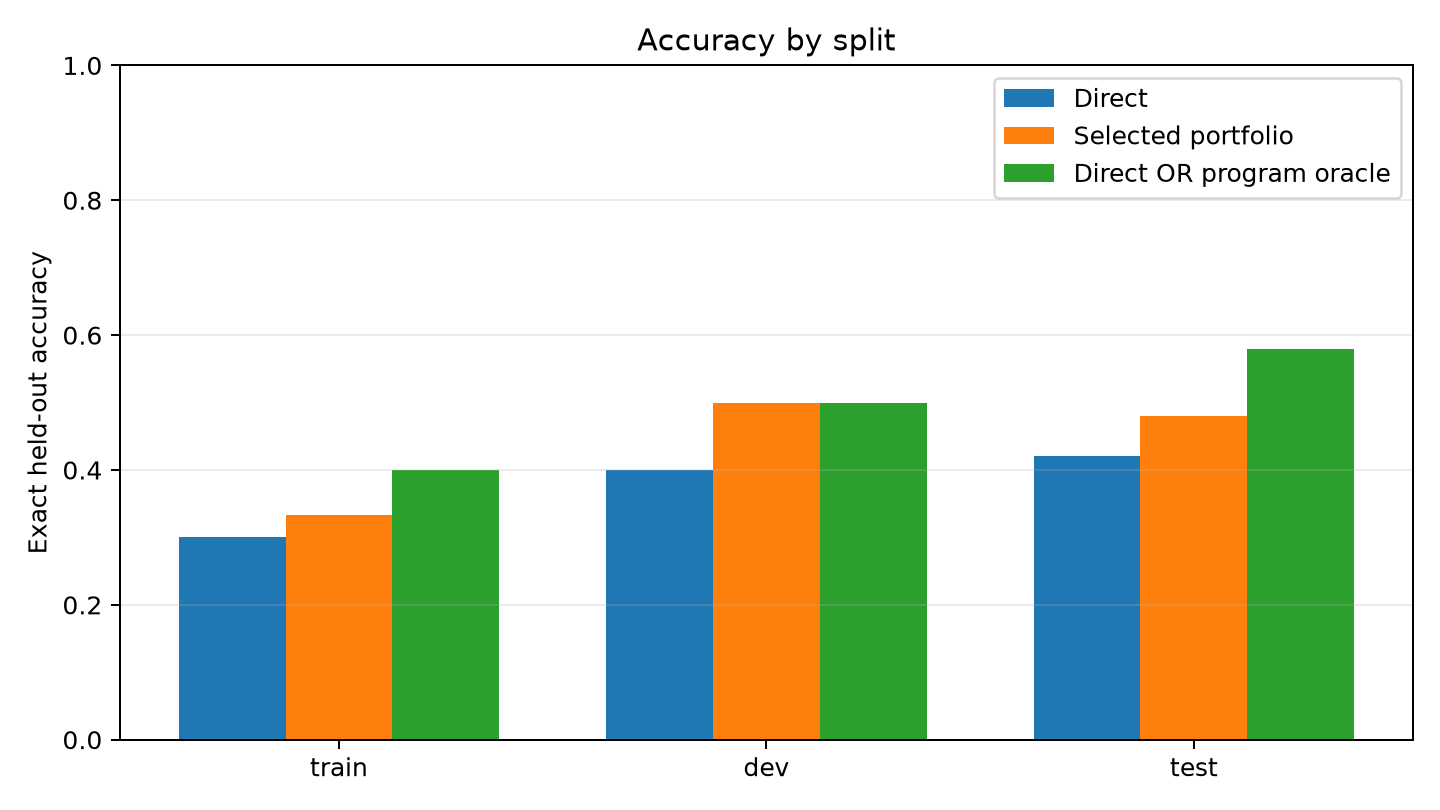
- The train/dev pilot used five pruned strategies on one case per train/dev family. Train showed direct 9/30, consensus_2 10/30, oracle 12/30. Dev showed direct 4/10, consensus_2 5/10, oracle 5/10.
- The frozen held-out run evaluated all 50 cases from the 10 test families with the dev-selected five-strategy portfolio.
- The held-out split revealed a mismatch: dev favored consensus_2, but singleton correct visible-program hits on
synthetic_8made first-visible much better on test.
Caveats
- Family-heldout evaluation is stricter than a random case split but still uses one external benchmark.
- Program candidates are verified on the visible example only; hidden answers are used solely for evaluation and train/dev strategy selection.
- The selected strategy portfolio is greedy and small; it is not a global optimum over all possible prompts.
- The dev split is only 10 cases, so selector choice is noisy; this run directly showed that dev selected a conservative policy that underfit singleton-correct held-out families.
- The portfolio is expensive because every test case receives five program attempts and visible-feedback repairs. Accuracy gains should not be read without the token-cost column.
- Exact table matching normalizes all cells to strings and requires exact row/column equality.
Experiment log 1
Show the running log (1 entry, 2026-06-28)
2026-06-28
- Created standalone experiment package for Foofah program-strategy portfolio search.
- Protocol: deterministic family split; search candidate executable-program prompt variants on train/dev families; freeze selected portfolio; evaluate on held-out families.
- Primary comparison: direct JSON versus frozen selected program portfolio, with direct-miss recoveries, direct-correct losses, visible-program oracle, commit precision, and forward-token accounting.
- Smoke run started with eight prompt variants. It was stopped after two cases because the full eight-variant sweep was too slow for the intended staged protocol. The smoke also showed
shape_first,aggregation_grouping, andtranspose_restructurewere repair-heavy or non-incremental on the first two cases, so the pilot candidate set was pruned to five variants:verified_structural,row_column_rule,split_fold_unpivot,header_aware, andcell_parser. - Fixed a selector tie-sort bug found by the tiny smoke output and added
--max-cases-per-familyfor family-balanced pilots. - Train pilot completed on one case per train family: direct 9/30, consensus_2 10/30, first-visible 8/30, direct-or-program oracle 12/30.
- Dev pilot completed on one case per dev family: direct 4/10, consensus_2 5/10, direct-or-program oracle 5/10. The frozen selected portfolio uses all five pruned variants with
consensus_2. - Held-out test completed on all 50 cases from 10 test families: direct 21/50, selected
consensus_224/50, first-visible 28/50, direct-or-program oracle 29/50. - Generated final report and figures under
reports/.
Figures 4
Data files 6
Result tables and metrics copied from the experiment folder — preview inline or open the raw file.
reports/final_summary.json17 kBreports/pilot_train_dev_summary.json1.5 kBreports/pilot_train_summary.json1.5 kBreports/portfolio_search_summary.json38 kBreports/smoke_selection_summary.json38 kBreports/test_summary.json1.5 kB
Reproduce
Runnable scripts exist in the experiment folder, but the exact invocation was not written down.