Qwen3.5-4B Foofah Program Ensemble Consensus
The one idea you need
Think of fixing a messy spreadsheet: the model writes a few small transform-the-table programs, then checks each against one worked example whose answer is known. The question is whether making several programs agree beats simply running the first one that passes the example.
The question
When a small model writes several little programs to reshape a table, does making them agree beat just running the first one that passes a checkable example?
What we found
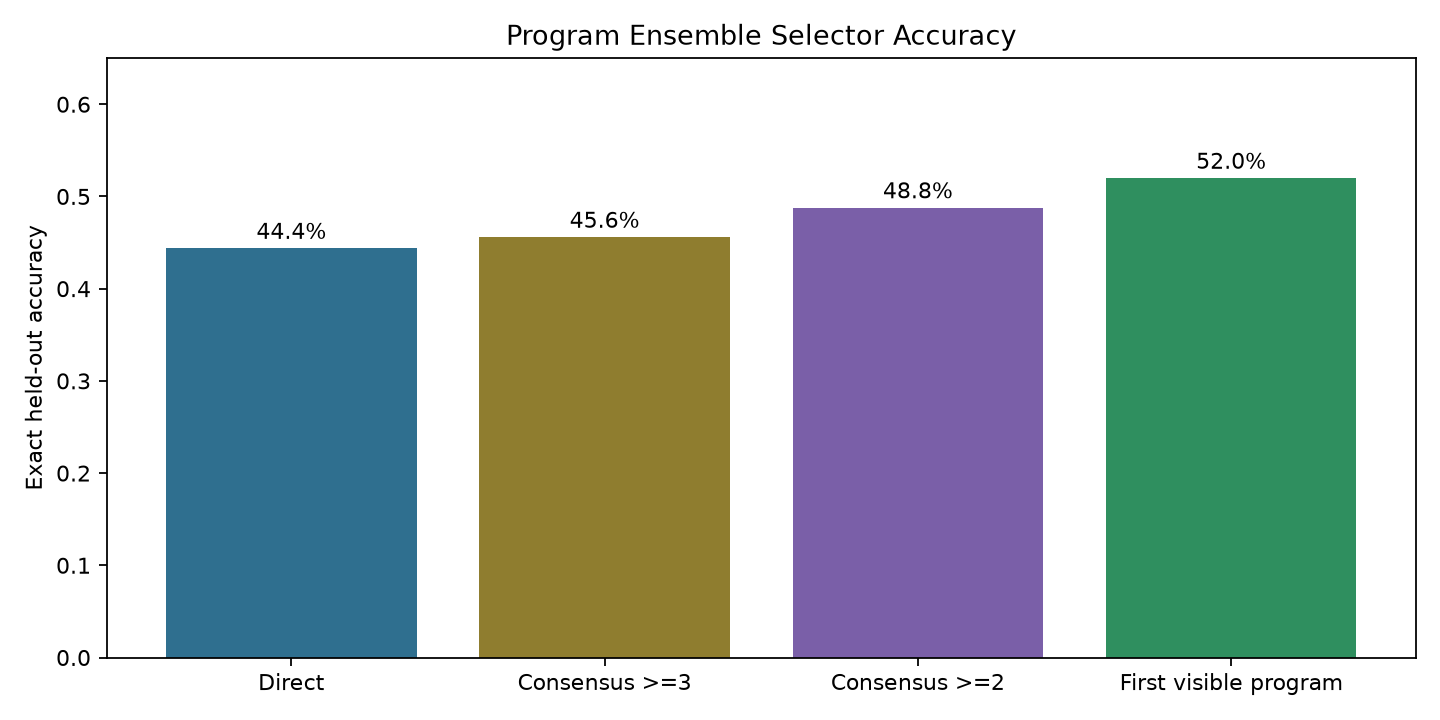
No. The simplest rule won: run the first program that passes a single worked example. It solved 52% of tables versus 44% when the model just answered directly, rescuing 23 tables it had otherwise botched while breaking only 4. Requiring several programs to agree was more careful but far too timid, recovering fewer mistakes and topping out at 49%.
Why it matters
For structured tasks where you can write code and check it against a known example, have the small model generate programs and deploy the first one that passes. Don't gate on ensemble agreement — it trades away most of the wins.
On this page
Results at a glance 4
exact-match accuracy · selection policy →
Data table
| selection policy | accuracy |
|---|---|
| direct JSON | 44.4% |
| consensus >= 3 | 45.6% |
| consensus >= 2 | 48.8% |
| first visible-passing program | 52% |
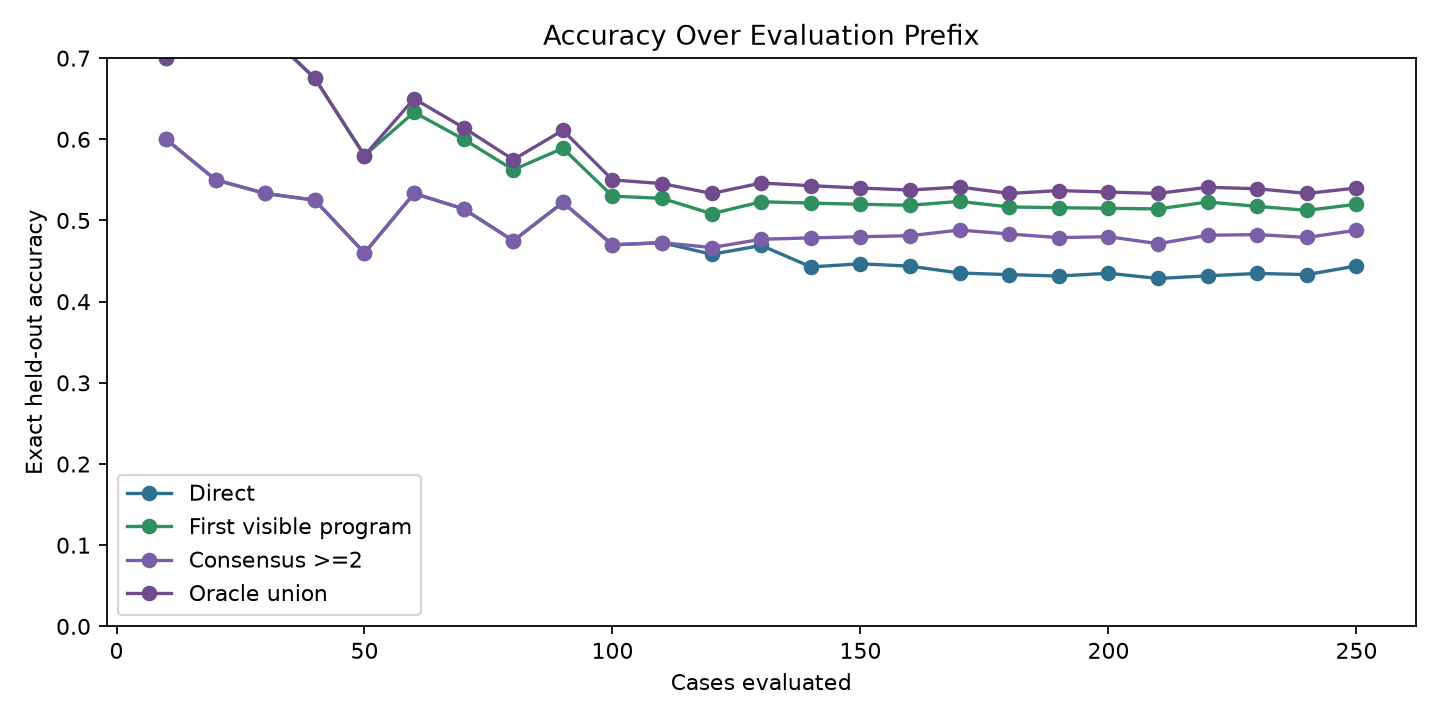
| oracle union | 54% |
Numbers from reports/final_summary.json (oracle union = oracle_union/n)
tasks changed vs direct JSON · selection policy →
Data table
| selection policy | direct-miss recoveries | direct-correct losses |
|---|---|---|
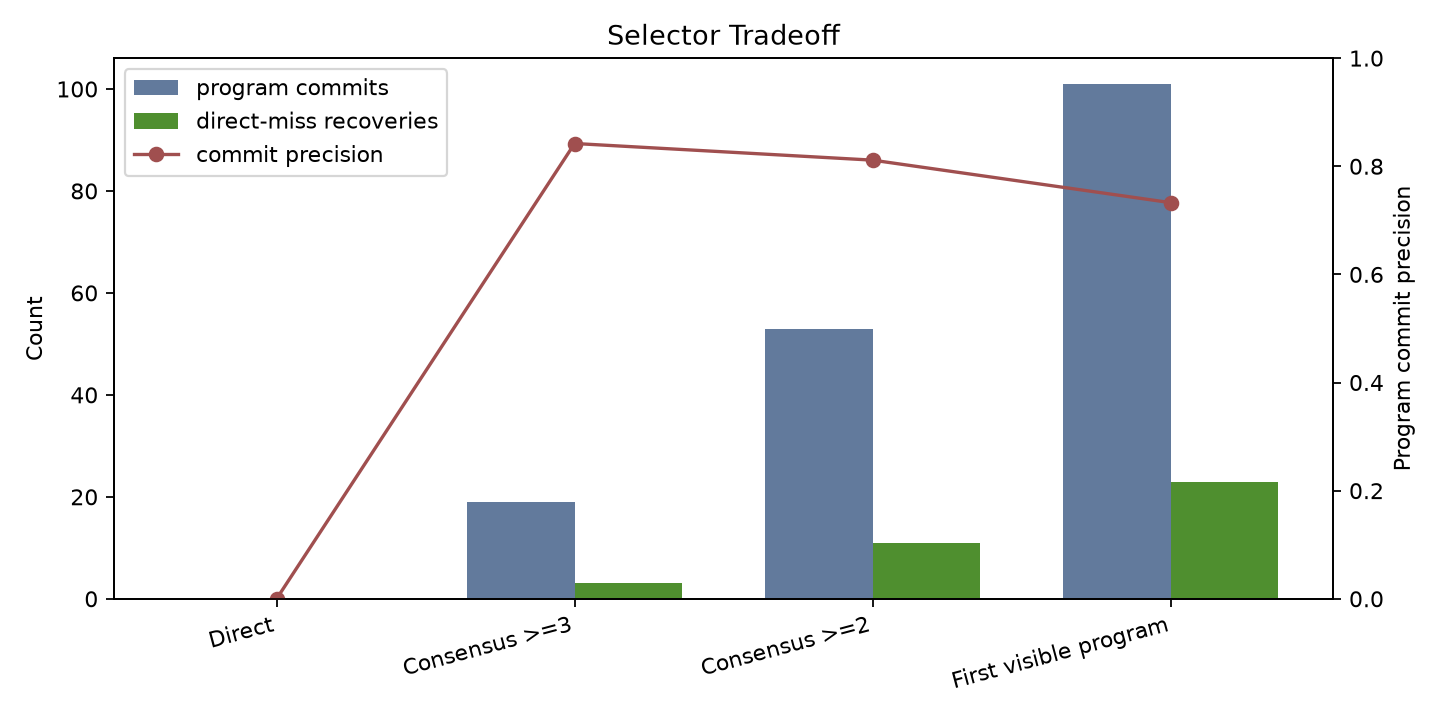
| consensus >= 3 | 3 | 0 |
| consensus >= 2 | 11 | 0 |
| first visible-passing program | 23 | 4 |
Numbers from reports/final_summary.json
commit precision · selection policy →
Data table
| selection policy | precision |
|---|---|
| consensus >= 3 | 84.2% |
| consensus >= 2 | 81.1% |
| first visible-passing program | 73.3% |
Numbers from reports/final_summary.json
tasks passing visible example · prompt variant →
Data table
| prompt variant | passed initially | added by repair |
|---|---|---|
| row_column_rule | 52 | 12 |
| structural_python | 29 | 28 |
| verified_structural | 53 | 6 |
Numbers from reports/variant_summary.json
In the author’s words from the Overview
This standalone experiment tests whether multiple independently prompted executable table-transform programs can produce safer fallback answers than a single visible-verified program. Each Foofah task is evaluated with: one direct JSON answer, multiple program candidates from different prompts, one visible-feedback repair attempt per program candidate, visible-example filtering, held-out output clustering for consensus policies. Primary question: > Does agreement among independently prompted visible-verified programs improve deployed exact-match accuracy over direct JSON generation and over a single visible-verified program fallback? The final report is generated by scripts/make_report.py.
Overview
This standalone experiment tests whether multiple independently prompted executable table-transform programs can produce safer fallback answers than a single visible-verified program.
Each Foofah task is evaluated with:
- one direct JSON answer,
- multiple program candidates from different prompts,
- one visible-feedback repair attempt per program candidate,
- visible-example filtering,
- held-out output clustering for consensus policies.
Primary question:
Does agreement among independently prompted visible-verified programs improve deployed exact-match accuracy over direct JSON generation and over a single visible-verified program fallback?
The final report is generated by scripts/make_report.py.
Report
Rendered from reports/report.md
Question
Can Qwen3.5-4B improve Foofah table-transformation accuracy by generating several independently prompted executable transform(table) programs, verifying them on the visible example, and selecting by output consensus on the held-out input?
The benchmark is Foofah (https://github.com/markjin1990/foofah_benchmarks). Hidden answers are used only for evaluation.
Setup
Each of 250 tasks was evaluated with one direct JSON answer and three program variants:
verified_structuralstructural_pythonrow_column_rule
Each program variant received one visible-feedback repair attempt if the initial program failed the visible example. A program candidate was eligible for selection only if it passed the visible example and executed on the held-out input.
Main Result
| selector | exact held-out | rate | program commits | program precision | direct-miss recoveries | direct-correct losses |
|---|---|---|---|---|---|---|
| Direct JSON | 111/250 | 44.4% | 0 | - | 0 | 0 |
| Direct/program agreement only | 111/250 | 44.4% | 0 | - | 0 | 0 |
| Program consensus >= 3 | 114/250 | 45.6% | 19 | 84.2% | 3 | 0 |
| Program consensus >= 2 | 122/250 | 48.8% | 53 | 81.1% | 11 | 0 |
| First visible-passing program | 130/250 | 52.0% | 101 | 73.3% | 23 | 4 |
The best deployed policy was first visible-passing program: 130/250 (52.0%), versus direct JSON at 111/250 (44.4%). It recovered 23 direct misses but lost 4 direct-correct cases.
The oracle union of direct JSON or any visible-correct program reached 135/250 (54.0%). That leaves 5 cases of selector headroom after the best deployed policy.
Consensus
Consensus was safer but too conservative:
- Consensus >= 2 committed 53 times with 81.1% precision, recovering 11 direct misses.
- Consensus >= 3 committed 19 times with 84.2% precision, recovering 3 direct misses.
There were 101 tasks with at least one visible-passing program, 57 with at least two visible-passing programs, and 53 with an output cluster of size at least two. The ensemble had 24 direct-miss tasks where at least one visible program was hidden-correct.
Variant Diagnostics
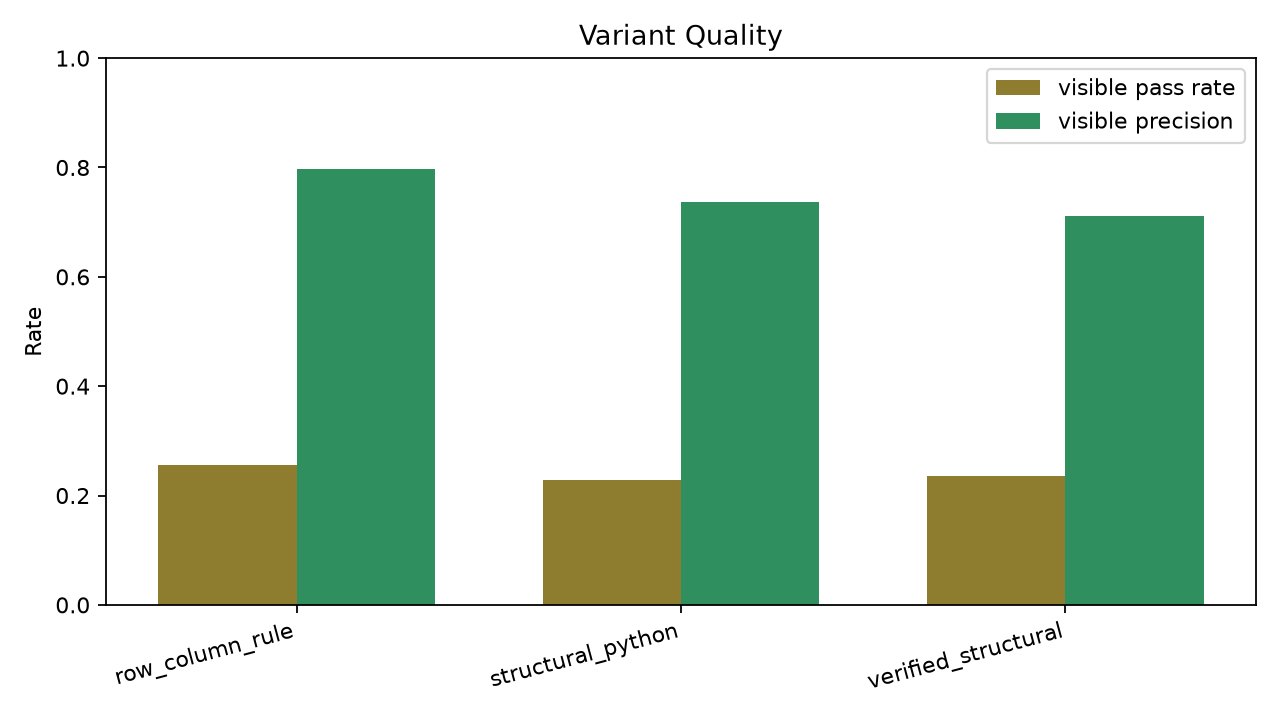
| variant | visible pass | visible precision | initial visible pass | repair-added visible |
|---|---|---|---|---|
| row_column_rule | 64/250 (25.6%) | 79.7% | 52 | 12 |
| structural_python | 57/250 (22.8%) | 73.7% | 29 | 28 |
| verified_structural | 59/250 (23.6%) | 71.2% | 53 | 6 |
Iteration
The first six-case smoke exposed direct-output parsing fragility, so JSON extraction was updated to accept the first valid array prefix and the direct prompt was tightened to forbid prose or markdown.
After that fix, a six-case smoke reached direct 5/6 and first-visible program 5/6. A harder stride-10 smoke with the first prompt set showed no oracle gain and poor visible-program precision, so the weak minimal-code variant was replaced with verified_structural.
The full run used the revised three-variant ensemble with one repair round per variant.
Read
The ensemble generated real additional candidate coverage. Direct JSON solved 111 tasks; direct plus any visible-correct program could solve 135. The simple first-visible selector captured most of that gain, reaching 130.
The specific hypothesis that independent program consensus would be the best selector did not hold. Consensus improved precision over first-visible fallback but under-recovered too many direct misses. On this benchmark, visible-example pass plus fixed prompt order was a better deployed selector than requiring agreement.
Caveats
- The full run uses one greedy direct answer and one greedy generation per program variant, with one greedy repair attempt per variant.
- The ensemble has three prompt variants; larger or sampled ensembles may change the coverage/precision tradeoff.
- Program execution is sandboxed and limited to safe builtins plus
re,math,Counter, anddefaultdict. - Exact table matching is strict after converting cells to strings.
Experiment log 1
Show the running log (1 entry, 2026-06-27)
2026-06-27
- Created standalone Foofah program-ensemble-consensus experiment.
- Objective: test whether multiple independently prompted executable programs, filtered by the visible example and selected by output consensus, outperform direct JSON generation and single-program fallback.
- Copied 250 Foofah cases into
data/cases.jsonl. Planned process:
- Build evaluator with direct JSON generation, diverse program generation, one visible-feedback repair per program, safe execution, and output clustering.
- Run a small smoke and inspect whether prompt variants produce non-identical visible-passing candidates.
- Iterate prompt set if the ensemble collapses to duplicates or fails to produce visible-passing programs.
- Run full 250-case evaluation.
- Generate report, figures, and validation evidence.
- Built
scripts/eval_program_ensemble.pywith three program variants, one visible-feedback repair round, safe execution, and selector policies. First six-case smoke:
- direct parser accepted only 1/6 due to valid JSON followed by stray markdown or an extra bracket.
- program candidates produced visible-passing correct programs on 5/6 cases.
- consensus-2 committed on 3/6 and was correct on all committed cases.
- Updated direct prompt to require first/last bracket and updated JSON extraction to accept the first valid array prefix before rerunning the smoke.
Second six-case smoke after parser/prompt fix:
- direct parse 6/6, direct exact 5/6.
- visible-program oracle 5/6.
- first visible-program fallback, consensus-2, and direct all reached 5/6.
- The easy prefix did not test direct-miss recovery, so selected a stride-10 25-case smoke next.
First stride-10 25-case smoke, three variants, one repair:
- direct 9/25.
- visible-program oracle 3/25 and oracle union 9/25, so programs added no direct-miss coverage.
- first visible-program fallback 8/25 with one direct-correct loss.
- consensus-2 committed 7 times but only 2/7 were hidden-correct.
- The
minimal_pythonvariant produced visible-passing hidden-wrong candidates and no correct visible programs. - Replaced
minimal_pythonwithverified_structuraland selected a second stride smoke with two repairs.
Second stride-10 smoke, revised variants with two repairs:
- stopped after 12/25 records because direct and program oracle were still tied at 6/12 and runtime was high.
- overlap inspection showed some formerly program-recoverable cases were now solved by the stricter direct prompt/parser, so the full run remains informative but should use resume support.
- Added
--resumesupport to the evaluator before launching the full run.
Full 250-case run, revised three-variant ensemble, one repair per variant:
- direct JSON: 111/250 (44.4%), parse 234/250.
- first visible-passing program fallback: 130/250 (52.0%).
- consensus >= 2: 122/250 (48.8%).
- consensus >= 3: 114/250 (45.6%).
- oracle union of direct JSON or any visible-correct program: 135/250 (54.0%).
- tasks with at least one visible-passing program: 101/250.
- first visible-passing program recovered 23 direct misses and lost 4 direct-correct cases.
- consensus >= 2 committed 53 times with 43 correct (81.1% precision), recovering 11 direct misses with 0 direct-correct losses.
- consensus was safer but under-recovered; first visible-passing program was the best deployed selector.
Generated final report and figures:
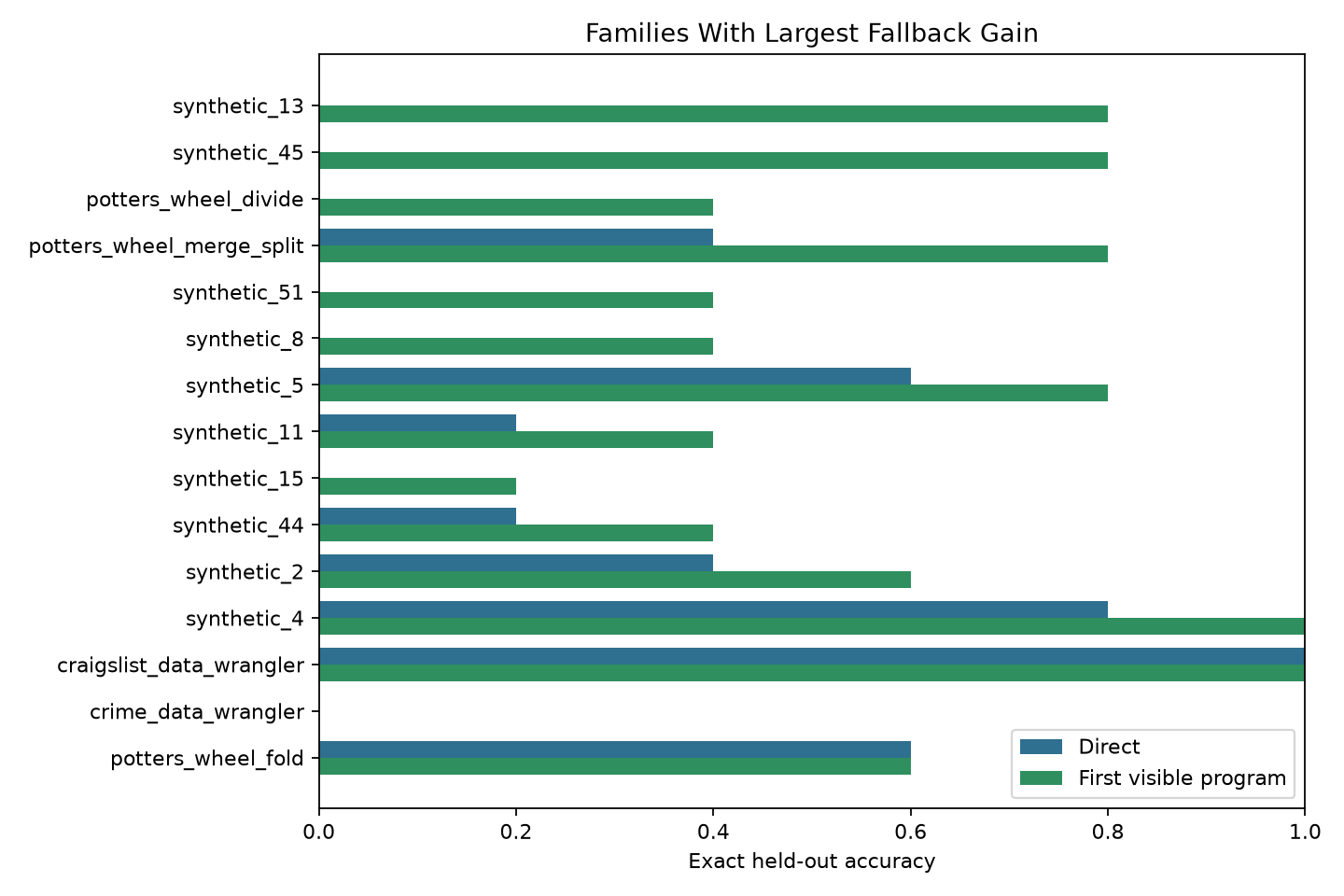
reports/report.mdreports/final_summary.jsonreports/variant_summary.jsonreports/family_summary.jsonreports/prefix_summary.jsonreports/consensus_diagnostics.jsonreports/figures/policy_accuracy.pngreports/figures/selector_tradeoff.pngreports/figures/prefix_progress.pngreports/figures/variant_quality.pngreports/figures/family_gains.png
Validation:
data/cases.jsonlandreports/full_ensemble_records.jsonlboth contain 250 records.python -m py_compile src/*.py scripts/*.pypassed.- required report artifacts are non-empty.
- human-authored standalone-content grep found no broader-context references.
- no evaluator process remained after the run.
Figures 5
Data files 8
Result tables and metrics copied from the experiment folder — preview inline or open the raw file.
reports/family_summary.json94 kBreports/final_summary.json1.8 kBreports/full_ensemble_summary.json1.8 kBreports/prefix_summary.json4.0 kBreports/smoke6_summary.json1.8 kBreports/smoke6_v2_summary.json1.8 kBreports/smoke_stride10_summary.json1.8 kBreports/variant_summary.json740 B
Reproduce
Runnable scripts exist in the experiment folder, but the exact invocation was not written down.