Qwen 3.5 4B GraphIR Self Repair
The one idea you need
The model writes a program two ways: a dense one-line formula, or an editable step-by-step diagram. A separate fix-it pass proofreads that diagram, but it practiced only on randomly scrambled versions, so it catches obvious damage while missing a clean-looking step that quietly computes the wrong answer.
The question
If a small model writes code as an editable step-by-step diagram, then runs a learned fix-it pass over its failures, does that beat a plain one-liner?
What we found
No. The plain one-line formula fully solved 29% of brand-new tasks; the step-by-step diagram managed only 22%, and the fix-it pass recovered part of that gap to 24% — still behind. That pass genuinely works: on randomly scrambled diagrams it lifted success from 3% to 27%, an eightfold jump. But the model's own errors are confident, consistent wrong logic, not obvious damage, so repair rarely helps.
Why it matters
Do not assume a fix-it loop that aces synthetically broken inputs fixes a model's real errors — it patches random damage, not systematic wrong logic. Test repair on the model's own failures, and check whether a fancier program format earns its complexity.
On this page
Results at a glance 3
How to read
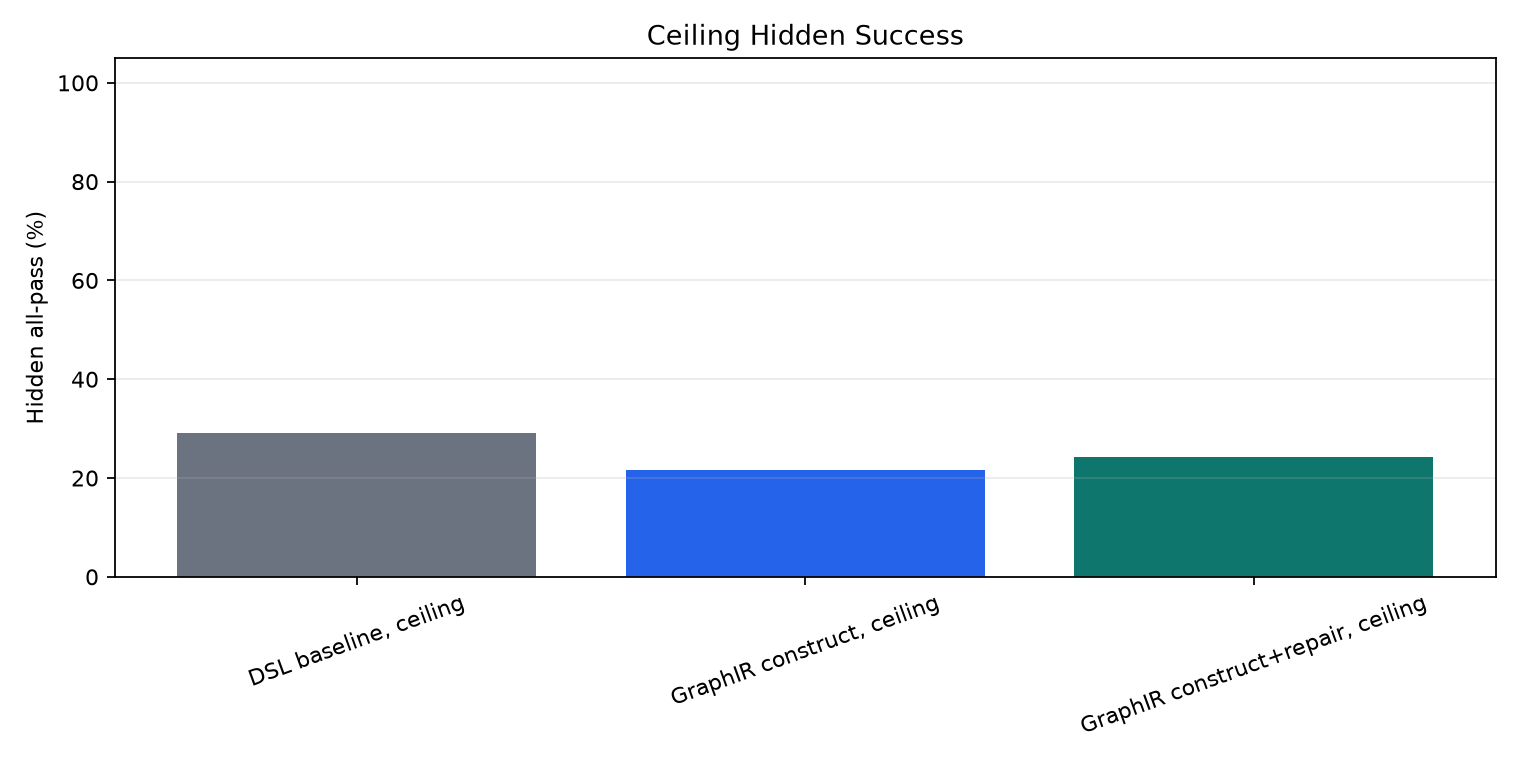
Three bars give the share of 120 brand-new tasks whose every hidden test passes: the plain one-line formula, the step-by-step diagram alone, and the diagram plus the fix-it pass. Taller is better.
Takeaway → The plain formula is tallest at 29%; the fix-it pass lifts the diagram from 22% to 24% but never closes the gap — the extra machinery does not pay off.
Data table
| condition | hidden all-pass |
|---|---|
| DSL baseline | 29.2% |
| GraphIR construct | 21.7% |
| GraphIR construct + repair | 24.2% |
Numbers from report table (Ceiling Results), reports/qwen35_4b_graphir_self_repair_report.md
Technical framing
Held-out ceiling: GraphIR pipeline does not beat the DSL baseline — Repair lifts GraphIR from 21.7% to 24.2%, but the plain DSL baseline still wins at 29.2% (out of 120 tasks).
How to read
Two bars show the share of 120 tasks whose every hidden test passes on diagrams damaged by random scrambling: before the fix-it pass runs, and after it. Taller is better; the leap measures raw repair skill.
Takeaway → Success jumps from 3% to 27%, an eightfold rise, proving the repair skill is real — yet it barely helps the full pipeline because real mistakes differ from random damage.
Data table
| stage | hidden all-pass |
|---|---|
| corrupted input (before repair) | 3.3% |
| after repair | 26.7% |
Numbers from report table (Repair Diagnostic), reports/qwen35_4b_graphir_self_repair_report.md
Technical framing
Repair skill exists: synthetic corrupted graphs before vs after repair — On synthetic corrupted GraphIR, repair jumps 3.3% to 26.7% — the skill is real but does not transfer to the model's own construction errors.
How to read
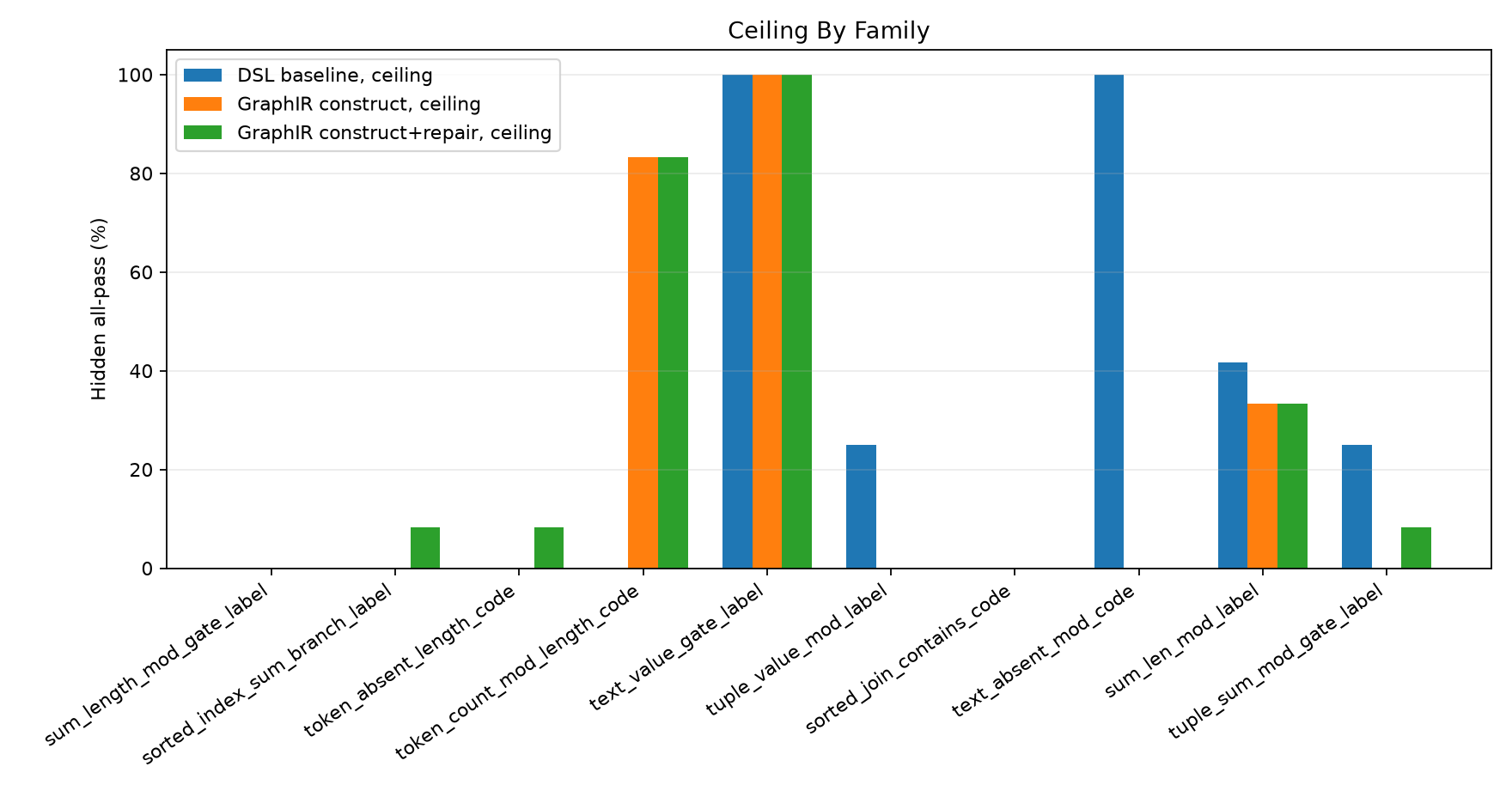
Six task families along the bottom; three bars each give the share solved on every hidden test — plain formula, diagram, and diagram-plus-repair. Taller is better; families are ordered by how much the approaches diverge.
Takeaway → Gains and losses cancel: the diagram unlocks one family the formula fails completely (83% vs 0%) but collapses to zero on families the formula solves perfectly.
Data table
| task family | DSL baseline | GraphIR construct | GraphIR construct + repair |
|---|---|---|---|
| token_count_mod_length | 0% | 83.3% | 83.3% |
| text_absent_mod | 100% | 0% | 0% |
| text_value_gate | 100% | 100% | 100% |
| sum_len_mod | 41.7% | 33.3% | 33.3% |
| tuple_value_mod | 25% | 0% | 0% |
| tuple_sum_mod_gate | 25% | 0% | 8.3% |
Numbers from report table (Ceiling By Family), reports/qwen35_4b_graphir_self_repair_report.md
Technical framing
Ceiling families where representations diverge most — Gains and losses are family-specific: GraphIR unlocks one family DSL fails (83.3% vs 0%) but collapses on others DSL solves.
In the author’s words from the Overview · “Result”
The main ceiling result was negative for the GraphIR pipeline: DSL baseline rerank: 35/120 hidden all-pass. GraphIR construction: 26/120 hidden all-pass. GraphIR construction plus repair: 29/120 hidden all-pass. Direct synthetic corrupted-GraphIR repair diagnostic: 4/120 input hidden all-pass to 32/120 repaired hidden all-pass. The repair adapter learned useful behavior on synthetic corrupted graphs and fixed the two GraphIR support failures, but actual construction errors on held-out ceiling families did not transfer well enough for GraphIR plus repair to beat the DSL baseline.
Overview
This standalone experiment tests whether Qwen 3.5 4B can improve held-out executable repair by configuring a typed register graph and then applying a verifier-guided graph repair step.
The model receives:
- an input schema,
- a current wrong program or candidate graph,
- visible execution cases with expected and got values,
- and must output either one DSL expression or a GraphIR register program.
The trained conditions are:
dsl_static60_lora: DSL baseline trained on 180 base records plus 60 support bridge records.graphir_construct_lora: same source records, target is typed GraphIR.graphir_repair_lora: corrupted candidate GraphIR plus visible mismatches, target is corrected GraphIR.
Large adapters and checkpoints are intentionally outside this compact directory:
/workspace/large_artifacts/qwen35_4b_graphir_self_repair/
Layout
configs/experiment.json: fixed design and hyperparameters.src/: standalone DSL, GraphIR, data, prompt, and model utilities.scripts/: dataset generation, training, evaluation, and report entry points.data/: generated JSONL datasets and manifest.reports/: evaluation JSON files and final report.figures/: generated charts.logs/andrun_logs/: experiment notebook and command output.large_artifacts_manifest.md: pointers to adapter directories stored outside this compact directory.
Report
Final report:
reports/qwen35_4b_graphir_self_repair_report.md
Result
The main ceiling result was negative for the GraphIR pipeline:
- DSL baseline rerank: 35/120 hidden all-pass.
- GraphIR construction: 26/120 hidden all-pass.
- GraphIR construction plus repair: 29/120 hidden all-pass.
- Direct synthetic corrupted-GraphIR repair diagnostic: 4/120 input hidden all-pass to 32/120 repaired hidden all-pass.
The repair adapter learned useful behavior on synthetic corrupted graphs and fixed the two GraphIR support failures, but actual construction errors on held-out ceiling families did not transfer well enough for GraphIR plus repair to beat the DSL baseline.
Report
Rendered from reports/qwen35_4b_graphir_self_repair_report.md
Question
Can a Qwen 3.5 4B adapter improve held-out executable repair by configuring a typed register graph, then applying a verifier-guided repair step?
Design
- Base model:
Qwen/Qwen3.5-4B. - Training: 4-bit NF4 QLoRA adapters.
- Fixed budget: 240 records per adapter.
- DSL baseline: emits one prefix DSL expression.
- GraphIR construct adapter: emits typed register assignments ending in
out. - GraphIR repair adapter: receives a candidate graph plus visible execution mismatches and emits a corrected graph.
- Inference policy: generate configured construction candidates, execute visible cases, keep the best graph, optionally repair it, and score hidden cases.
- Large adapter/checkpoint files are stored outside the compact experiment directory.
Dataset
- Base train records: 180.
- Support bridge train records: 60.
- Train records per adapter: 240.
- IID eval records: 60.
- Support eval records: 120.
- Ceiling eval records: 120.
- Visible cases per record: 6.
- Hidden cases per record: 18.
- Support bridge families: 10.
- Ceiling families: 10.
Ceiling Results
| Condition | Data | Prompt | Samples | Main Hidden | Secondary Hidden |
|---|---|---|---|---|---|
| DSL baseline, ceiling | dsl_ceiling.jsonl | trace | 1 | 29.2% (35/120) | 27.5% (33/120) |
| GraphIR construct, ceiling | graph_ceiling.jsonl | trace | 1 | 21.7% (26/120) | 21.7% (26/120) |
| GraphIR construct+repair, ceiling | graph_ceiling.jsonl | trace | 1 | 24.2% (29/120) | 21.7% (26/120) |
Support Results
| Condition | Data | Prompt | Samples | Main Hidden | Secondary Hidden |
|---|---|---|---|---|---|
| DSL baseline, support | dsl_support.jsonl | trace | 3 | 100.0% (120/120) | 100.0% (120/120) |
| GraphIR construct, support | graph_support.jsonl | trace | 0 | 98.3% (118/120) | 98.3% (118/120) |
| GraphIR construct+repair, support | graph_support.jsonl | trace | 1 | 100.0% (120/120) | 98.3% (118/120) |
IID Results
| Condition | Data | Prompt | Samples | Main Hidden | Secondary Hidden |
|---|---|---|---|---|---|
| DSL baseline, IID | dsl_iid.jsonl | trace | 0 | 100.0% (60/60) | 100.0% (60/60) |
| GraphIR construct, IID | graph_iid.jsonl | trace | 0 | 100.0% (60/60) | 100.0% (60/60) |
| GraphIR construct+repair, IID | graph_iid.jsonl | trace | 0 | 100.0% (60/60) | 100.0% (60/60) |
Repair Diagnostic
| Condition | Data | Prompt | Samples | Main Hidden | Secondary Hidden |
|---|---|---|---|---|---|
| GraphIR repair, corrupted ceiling | graph_repair_ceiling_corrupt.jsonl | trace | 0 | 26.7% (32/120) | 3.3% (4/120) |
Ceiling By Family
| Family | DSL baseline, ceiling | GraphIR construct, ceiling | GraphIR construct+repair, ceiling |
|---|---|---|---|
sum_length_mod_gate_label | 0.0% (0/12) | 0.0% (0/12) | 0.0% (0/12) |
sorted_index_sum_branch_label | 0.0% (0/12) | 0.0% (0/12) | 8.3% (1/12) |
token_absent_length_code | 0.0% (0/12) | 0.0% (0/12) | 8.3% (1/12) |
token_count_mod_length_code | 0.0% (0/12) | 83.3% (10/12) | 83.3% (10/12) |
text_value_gate_label | 100.0% (12/12) | 100.0% (12/12) | 100.0% (12/12) |
tuple_value_mod_label | 25.0% (3/12) | 0.0% (0/12) | 0.0% (0/12) |
sorted_join_contains_code | 0.0% (0/12) | 0.0% (0/12) | 0.0% (0/12) |
text_absent_mod_code | 100.0% (12/12) | 0.0% (0/12) | 0.0% (0/12) |
sum_len_mod_label | 41.7% (5/12) | 33.3% (4/12) | 33.3% (4/12) |
tuple_sum_mod_gate_label | 25.0% (3/12) | 0.0% (0/12) | 8.3% (1/12) |
Readout
- Ceiling hidden all-pass: DSL baseline 29.2% (35/120), GraphIR construction 21.7% (26/120), GraphIR construction plus repair 24.2% (29/120).
- GraphIR construction greedy ceiling hidden all-pass: 21.7% (26/120).
- GraphIR pipeline construction-only selected ceiling hidden all-pass: 21.7% (26/120).
- The GraphIR repair stage improved the actual ceiling pipeline from 21.7% (26/120) to 24.2% (29/120), but did not beat the DSL baseline.
- On synthetic corrupted ceiling GraphIR candidates, repair improved hidden all-pass from 3.3% (4/120) to 26.7% (32/120), indicating repair skill exists but does not transfer enough to actual construction errors.
Figures
Failure Signatures
sum_length_mod_gate_labelDSL top: 6x(if (and (gt (sum values) target) (eq (mod (len text) modulus) target)) high_label low_label); 3x(if (and (gt (sum values) target) (eq (mod (sum values) modulus) target)) high_label low_label); GraphIR construct top: 4x `r0 = SUM values
r1 = LEN text r2 = MOD r1 modulus r3 = EQ r2 target r4 = AND r3 GT r0 0 r5 = IF r4 high_label low_label out = r5; GraphIR pipeline top: 4xr0 = SUM values r1 = LEN text r2 = MOD r1 modulus r3 = EQ r2 target r4 = AND r3 GT r0 0 r5 = IF r4 high_label low_label out = r5`.
sorted_index_sum_branch_labelDSL top: 6x(if (gt (tuple_get (sort values) index) threshold) high_label low_label); 6x(if (gt (tuple_get values index) threshold) high_label low_label); GraphIR construct top: 12x `r0 = GET values index
r1 = GT r0 threshold r2 = IF r1 high_label low_label out = r2; GraphIR pipeline top: 11xr0 = GET values index r1 = GT r0 threshold r2 = IF r1 high_label low_label out = r2`.
token_absent_length_codeDSL top: 9x(if (and (not (contains tokens needle)) (gt (count_eq tokens needle) min_len)) "ABSENT_LONG" "OTHER"); 2x(if (and (contains tokens needle) (gt (count_eq tokens needle) min_len)) "ABSENT_LONG" "OTHER"); GraphIR construct top: 11x `r0 = CONTAINS tokens needle
r1 = LEN tokens r2 = GT r1 min_len r3 = AND r0 r2 r4 = IF r3 "ABSENT_LONG" "OTHER" out = r4; GraphIR pipeline top: 11xr0 = CONTAINS tokens needle r1 = LEN tokens r2 = GT r1 min_len r3 = AND r0 r2 r4 = IF r3 "ABSENT_LONG" "OTHER" out = r4`.
token_count_mod_length_codeDSL top: 7x(if (and (contains tokens needle) (gt (count_eq tokens needle) min_len) (eq (mod (count_eq tokens needle) modulus) target)) "COUNT_MOD_LONG" "MISS"); 3x(if (and (contains tokens needle) (gt (count_eq tokens needle) target) (gt (mod (count_eq tokens needle) modulus) 0) (gt (len tokens) min_len)) "COUNT_MOD_LONG" "MISS"); GraphIR construct top: 9x `r0 = CONTAINS tokens needle
r1 = COUNT_EQ tokens needle r2 = MOD r1 modulus r3 = EQ r2 target r4 = LEN tokens r5 = GT r4 min_len r6 = AND r0 r3 r5 r7 = IF r6 "COUNT_MOD_LONG" "MISS" out = r7; GraphIR pipeline top: 9xr0 = CONTAINS tokens needle r1 = COUNT_EQ tokens needle r2 = MOD r1 modulus r3 = EQ r2 target r4 = LEN tokens r5 = GT r4 min_len r6 = AND r0 r3 r5 r7 = IF r6 "COUNT_MOD_LONG" "MISS" out = r7`.
text_value_gate_labelDSL top: 12x(if (and (contains text needle) (gt (sum values) threshold) (gt (len text) min_len)) high_label low_label); GraphIR construct top: 12x `r0 = CONTAINS text needle
r1 = LEN text r2 = GT r1 min_len r3 = SUM values r4 = GT r3 threshold r5 = AND r0 r2 r4 r6 = IF r5 high_label low_label out = r6; GraphIR pipeline top: 12xr0 = CONTAINS text needle r1 = LEN text r2 = GT r1 min_len r3 = SUM values r4 = GT r3 threshold r5 = AND r0 r2 r4 r6 = IF r5 high_label low_label out = r6`.
tuple_value_mod_labelDSL top: 8x(format "TV{}" (mod (add (tuple_get item index) (sum values)) modulus)); 3x(format "TV{}" (add (tuple_get item index) (mod (sum values) modulus))); GraphIR construct top: 6x `r0 = GET item index
r1 = MOD r0 modulus r2 = FORMAT "TV{}" r1 out = r2; GraphIR pipeline top: 5xr0 = GET item index r1 = MOD r0 modulus r2 = FORMAT "TV{}" r1 out = r2`.
sorted_join_contains_codeDSL top: 12x(if (contains tokens needle) "JOIN_HAS" "JOIN_MISS"); GraphIR construct top: 8x `r0 = CONTAINS tokens needle
r1 = IF r0 "JOIN_HAS" "JOIN_MISS" out = r1; GraphIR pipeline top: 8xr0 = CONTAINS tokens needle r1 = IF r0 "JOIN_HAS" "JOIN_MISS" out = r1`.
text_absent_mod_codeDSL top: 12x(if (and (not (contains text needle)) (eq (mod (len text) modulus) target)) "ABSENT_MOD" "OTHER"); GraphIR construct top: 12x `r0 = CONTAINS text needle
r1 = LEN text r2 = MOD r1 modulus r3 = EQ r2 target r4 = AND r0 r3 r5 = IF r4 "ABSENT_MOD" "OTHER" out = r5; GraphIR pipeline top: 12xr0 = CONTAINS text needle r1 = LEN text r2 = MOD r1 modulus r3 = EQ r2 target r4 = AND r0 r3 r5 = IF r4 "ABSENT_MOD" "OTHER" out = r5`.
sum_len_mod_labelDSL top: 7x(format "SL{}" (mod (sum values) modulus)); 5x(format "SL{}" (mod (add (sum values) (len text)) modulus)); GraphIR construct top: 6x `r0 = SUM values
r1 = LEN text r2 = MOD r1 modulus r3 = FORMAT "SL{}" r2 out = r3; GraphIR pipeline top: 5xr0 = SUM values r1 = LEN text r2 = MOD r1 modulus r3 = FORMAT "SL{}" r2 out = r3`.
tuple_sum_mod_gate_labelDSL top: 7x(if (and (gt (tuple_get item index) threshold) (eq (mod (tuple_get item index) modulus) target)) high_label low_label); 3x(if (and (gt (tuple_get item index) threshold) (eq (mod (sum item) modulus) target)) high_label low_label); GraphIR construct top: 9x `r0 = GET item index
r1 = GT r0 threshold r2 = MOD r0 modulus r3 = EQ r2 target r4 = AND r1 r3 r5 = IF r4 high_label low_label out = r5; GraphIR pipeline top: 8xr0 = GET item index r1 = GT r0 threshold r2 = MOD r0 modulus r3 = EQ r2 target r4 = AND r1 r3 r5 = IF r4 high_label low_label out = r5`.
Per-Condition Details
dsl_lora_ceiling
- Data:
data/eval/dsl_ceiling.jsonl. - Prompt mode:
trace. - Samples: 1.
| Family | Main Hidden | Main Visible |
|---|---|---|
| sorted_index_sum_branch_label | 0.0% (0/12) | 0.0% (0/12) |
| sorted_join_contains_code | 0.0% (0/12) | 0.0% (0/12) |
| sum_len_mod_label | 41.7% (5/12) | 41.7% (5/12) |
| sum_length_mod_gate_label | 0.0% (0/12) | 8.3% (1/12) |
| text_absent_mod_code | 100.0% (12/12) | 100.0% (12/12) |
| text_value_gate_label | 100.0% (12/12) | 100.0% (12/12) |
| token_absent_length_code | 0.0% (0/12) | 8.3% (1/12) |
| token_count_mod_length_code | 0.0% (0/12) | 16.7% (2/12) |
| tuple_sum_mod_gate_label | 25.0% (3/12) | 50.0% (6/12) |
| tuple_value_mod_label | 25.0% (3/12) | 25.0% (3/12) |
dsl_lora_iid
- Data:
data/eval/dsl_iid.jsonl. - Prompt mode:
trace. - Samples: 0.
| Family | Main Hidden | Main Visible |
|---|---|---|
| contains_and_count_code | 100.0% (4/4) | 100.0% (4/4) |
| contains_code | 100.0% (4/4) | 100.0% (4/4) |
| contains_count_label | 100.0% (4/4) | 100.0% (4/4) |
| length_and_mod_code | 100.0% (4/4) | 100.0% (4/4) |
| length_label | 100.0% (4/4) | 100.0% (4/4) |
| length_mod_label | 100.0% (4/4) | 100.0% (4/4) |
| mod_scalar_label | 100.0% (4/4) | 100.0% (4/4) |
| scalar_branch_label | 100.0% (4/4) | 100.0% (4/4) |
| sorted_first_label | 100.0% (4/4) | 100.0% (4/4) |
| sum_add_label | 100.0% (4/4) | 100.0% (4/4) |
| sum_and_scalar_code | 100.0% (4/4) | 100.0% (4/4) |
| sum_label | 100.0% (4/4) | 100.0% (4/4) |
| sum_threshold_label | 100.0% (4/4) | 100.0% (4/4) |
| tuple_get_label | 100.0% (4/4) | 100.0% (4/4) |
| tuple_sum_label | 100.0% (4/4) | 100.0% (4/4) |
dsl_lora_support
- Data:
data/eval/dsl_support.jsonl. - Prompt mode:
trace. - Samples: 3.
| Family | Main Hidden | Main Visible |
|---|---|---|
| contains_count_length_code | 100.0% (12/12) | 100.0% (12/12) |
| length_contains_code | 100.0% (12/12) | 100.0% (12/12) |
| length_mod_contains_code | 100.0% (12/12) | 100.0% (12/12) |
| modulo_sum_label | 100.0% (12/12) | 100.0% (12/12) |
| not_contains_length_code | 100.0% (12/12) | 100.0% (12/12) |
| sorted_index_offset_label | 100.0% (12/12) | 100.0% (12/12) |
| sum_length_branch_label | 100.0% (12/12) | 100.0% (12/12) |
| sum_offset_mod_label | 100.0% (12/12) | 100.0% (12/12) |
| tuple_branch_label | 100.0% (12/12) | 100.0% (12/12) |
| tuple_sum_gate_label | 100.0% (12/12) | 100.0% (12/12) |
graphir_construct_ceiling
- Data:
data/eval/graph_ceiling.jsonl. - Prompt mode:
trace. - Samples: 1.
| Family | Main Hidden | Main Visible |
|---|---|---|
| sorted_index_sum_branch_label | 0.0% (0/12) | 0.0% (0/12) |
| sorted_join_contains_code | 0.0% (0/12) | 0.0% (0/12) |
| sum_len_mod_label | 33.3% (4/12) | 33.3% (4/12) |
| sum_length_mod_gate_label | 0.0% (0/12) | 25.0% (3/12) |
| text_absent_mod_code | 0.0% (0/12) | 0.0% (0/12) |
| text_value_gate_label | 100.0% (12/12) | 100.0% (12/12) |
| token_absent_length_code | 0.0% (0/12) | 8.3% (1/12) |
| token_count_mod_length_code | 83.3% (10/12) | 100.0% (12/12) |
| tuple_sum_mod_gate_label | 0.0% (0/12) | 8.3% (1/12) |
| tuple_value_mod_label | 0.0% (0/12) | 0.0% (0/12) |
graphir_construct_iid
- Data:
data/eval/graph_iid.jsonl. - Prompt mode:
trace. - Samples: 0.
| Family | Main Hidden | Main Visible |
|---|---|---|
| contains_and_count_code | 100.0% (4/4) | 100.0% (4/4) |
| contains_code | 100.0% (4/4) | 100.0% (4/4) |
| contains_count_label | 100.0% (4/4) | 100.0% (4/4) |
| length_and_mod_code | 100.0% (4/4) | 100.0% (4/4) |
| length_label | 100.0% (4/4) | 100.0% (4/4) |
| length_mod_label | 100.0% (4/4) | 100.0% (4/4) |
| mod_scalar_label | 100.0% (4/4) | 100.0% (4/4) |
| scalar_branch_label | 100.0% (4/4) | 100.0% (4/4) |
| sorted_first_label | 100.0% (4/4) | 100.0% (4/4) |
| sum_add_label | 100.0% (4/4) | 100.0% (4/4) |
| sum_and_scalar_code | 100.0% (4/4) | 100.0% (4/4) |
| sum_label | 100.0% (4/4) | 100.0% (4/4) |
| sum_threshold_label | 100.0% (4/4) | 100.0% (4/4) |
| tuple_get_label | 100.0% (4/4) | 100.0% (4/4) |
| tuple_sum_label | 100.0% (4/4) | 100.0% (4/4) |
graphir_construct_support
- Data:
data/eval/graph_support.jsonl. - Prompt mode:
trace. - Samples: 0.
| Family | Main Hidden | Main Visible |
|---|---|---|
| contains_count_length_code | 100.0% (12/12) | 100.0% (12/12) |
| length_contains_code | 100.0% (12/12) | 100.0% (12/12) |
| length_mod_contains_code | 83.3% (10/12) | 83.3% (10/12) |
| modulo_sum_label | 100.0% (12/12) | 100.0% (12/12) |
| not_contains_length_code | 100.0% (12/12) | 100.0% (12/12) |
| sorted_index_offset_label | 100.0% (12/12) | 100.0% (12/12) |
| sum_length_branch_label | 100.0% (12/12) | 100.0% (12/12) |
| sum_offset_mod_label | 100.0% (12/12) | 100.0% (12/12) |
| tuple_branch_label | 100.0% (12/12) | 100.0% (12/12) |
| tuple_sum_gate_label | 100.0% (12/12) | 100.0% (12/12) |
graphir_pipeline_ceiling
- Data:
data/eval/graph_ceiling.jsonl. - Prompt mode:
trace. - Samples: 1.
| Family | Main Hidden | Main Visible |
|---|---|---|
| sorted_index_sum_branch_label | 8.3% (1/12) | 8.3% (1/12) |
| sorted_join_contains_code | 0.0% (0/12) | 0.0% (0/12) |
| sum_len_mod_label | 33.3% (4/12) | 33.3% (4/12) |
| sum_length_mod_gate_label | 0.0% (0/12) | 25.0% (3/12) |
| text_absent_mod_code | 0.0% (0/12) | 0.0% (0/12) |
| text_value_gate_label | 100.0% (12/12) | 100.0% (12/12) |
| token_absent_length_code | 8.3% (1/12) | 16.7% (2/12) |
| token_count_mod_length_code | 83.3% (10/12) | 100.0% (12/12) |
| tuple_sum_mod_gate_label | 8.3% (1/12) | 33.3% (4/12) |
| tuple_value_mod_label | 0.0% (0/12) | 0.0% (0/12) |
graphir_pipeline_iid
- Data:
data/eval/graph_iid.jsonl. - Prompt mode:
trace. - Samples: 0.
| Family | Main Hidden | Main Visible |
|---|---|---|
| contains_and_count_code | 100.0% (4/4) | 100.0% (4/4) |
| contains_code | 100.0% (4/4) | 100.0% (4/4) |
| contains_count_label | 100.0% (4/4) | 100.0% (4/4) |
| length_and_mod_code | 100.0% (4/4) | 100.0% (4/4) |
| length_label | 100.0% (4/4) | 100.0% (4/4) |
| length_mod_label | 100.0% (4/4) | 100.0% (4/4) |
| mod_scalar_label | 100.0% (4/4) | 100.0% (4/4) |
| scalar_branch_label | 100.0% (4/4) | 100.0% (4/4) |
| sorted_first_label | 100.0% (4/4) | 100.0% (4/4) |
| sum_add_label | 100.0% (4/4) | 100.0% (4/4) |
| sum_and_scalar_code | 100.0% (4/4) | 100.0% (4/4) |
| sum_label | 100.0% (4/4) | 100.0% (4/4) |
| sum_threshold_label | 100.0% (4/4) | 100.0% (4/4) |
| tuple_get_label | 100.0% (4/4) | 100.0% (4/4) |
| tuple_sum_label | 100.0% (4/4) | 100.0% (4/4) |
graphir_pipeline_support
- Data:
data/eval/graph_support.jsonl. - Prompt mode:
trace. - Samples: 1.
| Family | Main Hidden | Main Visible |
|---|---|---|
| contains_count_length_code | 100.0% (12/12) | 100.0% (12/12) |
| length_contains_code | 100.0% (12/12) | 100.0% (12/12) |
| length_mod_contains_code | 100.0% (12/12) | 100.0% (12/12) |
| modulo_sum_label | 100.0% (12/12) | 100.0% (12/12) |
| not_contains_length_code | 100.0% (12/12) | 100.0% (12/12) |
| sorted_index_offset_label | 100.0% (12/12) | 100.0% (12/12) |
| sum_length_branch_label | 100.0% (12/12) | 100.0% (12/12) |
| sum_offset_mod_label | 100.0% (12/12) | 100.0% (12/12) |
| tuple_branch_label | 100.0% (12/12) | 100.0% (12/12) |
| tuple_sum_gate_label | 100.0% (12/12) | 100.0% (12/12) |
graphir_repair_corrupt_ceiling
- Data:
data/eval/graph_repair_ceiling_corrupt.jsonl. - Prompt mode:
trace. - Samples: 0.
| Family | Main Hidden | Main Visible |
|---|---|---|
| sorted_index_sum_branch_label | 33.3% (4/12) | 66.7% (8/12) |
| sorted_join_contains_code | 0.0% (0/12) | 16.7% (2/12) |
| sum_len_mod_label | 0.0% (0/12) | 0.0% (0/12) |
| sum_length_mod_gate_label | 0.0% (0/12) | 16.7% (2/12) |
| text_absent_mod_code | 25.0% (3/12) | 25.0% (3/12) |
| text_value_gate_label | 83.3% (10/12) | 100.0% (12/12) |
| token_absent_length_code | 33.3% (4/12) | 41.7% (5/12) |
| token_count_mod_length_code | 50.0% (6/12) | 75.0% (9/12) |
| tuple_sum_mod_gate_label | 33.3% (4/12) | 50.0% (6/12) |
| tuple_value_mod_label | 8.3% (1/12) | 8.3% (1/12) |
Experiment log 5
Show the running log (5 entries)
Objective
Test whether fixed-budget posttraining can improve held-out executable repair by moving from freeform DSL generation to typed register-graph configuration plus a verifier-guided repair step.
Design Commitments
- Use only
Qwen/Qwen3.5-4B. - Keep each trained adapter at 240 records.
- Keep the compact experiment directory downloadable by storing adapters and checkpoints outside it.
- Train a DSL baseline, a GraphIR construction adapter, and a GraphIR repair adapter.
- Evaluate support-family generalization, held-out ceiling-family generalization, IID retention, and direct graph repair.
- Keep trace controls optional unless the main pipeline result remains positive or ambiguous.
- Generate a final markdown report and charts.
Starting Hypotheses
- GraphIR should reduce syntactic and parenthesization failures by forcing one operation per register assignment.
- GraphIR should make composition errors more visible to the verifier because each intermediate is executable.
- A repair adapter should improve over construction-only by editing the selected graph after visible-case execution.
- Shuffled traces should hurt if the model is using execution evidence rather than only memorizing output shape.
Planned Runs
- Build deterministic datasets from seed
20260701. - Train
dsl_static60_lora. - Train
graphir_construct_lora. - Train
graphir_repair_lora. - Evaluate DSL baseline on IID, support, and ceiling splits.
- Evaluate GraphIR construction and construction+repair on IID, support, and ceiling splits.
- Optionally run GraphIR trace controls on the ceiling split if the main result needs disambiguation.
- Run direct corrupted-GraphIR repair diagnostic on the ceiling split.
- Generate charts and final report.
- Audit compact artifact size and large artifact separation.
Step Log
- Initialized standalone experiment directory and large artifact directory.
- Added GraphIR compiler, parser, executor, and visible-case scoring.
- Added task-specific prompts for DSL baseline, GraphIR construction, and GraphIR repair.
- Added dataset builder for aligned DSL, GraphIR construction, and GraphIR repair records.
- Added generic QLoRA trainer and evaluation scripts.
- Added report generator scaffold.
python -m compileall src scriptspassed before dataset generation.- Built deterministic datasets with seed
20260701. - Dataset counts: DSL train 240, GraphIR construct train 240, GraphIR repair train 240, IID eval 60, support eval 120, ceiling eval 120, corrupted ceiling repair eval 120.
- Training mix per adapter: 180 base-family records plus 60 support bridge records.
- Confirmed that no held-out ceiling family appears in any training set.
- Confirmed target GraphIR executes correctly on train and ceiling eval records.
- Corrupted GraphIR repair candidates are nontrivial: train candidates pass all visible cases in 9/240 records and all hidden cases in 6/240 records; ceiling diagnostic candidates pass all visible cases in 19/120 records and all hidden cases in 4/120 records.
- Trained
dsl_static60_lorafor 2 epochs / 60 optimizer steps on 240 DSL records. dsl_static60_loratraining summary: runtime 877.9s, train loss 0.1078, eval loss 0.0003974 on the 24-record training-time eval subset.- Saved
dsl_static60_loraunder/workspace/large_artifacts/qwen35_4b_graphir_self_repair/models/dsl_static60_lora. - Trained
graphir_construct_lorafor 2 epochs / 60 optimizer steps on 240 GraphIR construction records. graphir_construct_loratraining summary: runtime 890.7s, train loss 0.05635, eval loss 0.0003681 on the 24-record training-time eval subset.- Saved
graphir_construct_loraunder/workspace/large_artifacts/qwen35_4b_graphir_self_repair/models/graphir_construct_lora. - Trained
graphir_repair_lorafor 2 epochs / 60 optimizer steps on 240 corrupted-candidate GraphIR repair records. graphir_repair_loratraining summary: runtime 918.7s, train loss 0.05824, eval loss 0.4679 on the 24-record corrupted-ceiling training-time eval subset.- Saved
graphir_repair_loraunder/workspace/large_artifacts/qwen35_4b_graphir_self_repair/models/graphir_repair_lora. - Evaluation token-budget adjustment: target GraphIR outputs were measured before full ceiling/support evaluation. Tokenized target lengths were max 69 tokens on support and max 77 tokens on ceiling, so GraphIR support/ceiling and repair evaluations were capped at 96 new tokens. This preserved margin while preventing non-answer tails from dominating runtime.
- Added
scripts/eval_graphir_cached_repair.pyso construction results can be repaired without rerunning construction. This preserves the same selected construct graph while avoiding duplicate GPU work. - DSL IID evaluation: 60/60 greedy hidden all-pass and 60/60 rerank hidden all-pass,
num_samples=0,max_new_tokens=96. - GraphIR construct IID evaluation: 60/60 construction hidden all-pass,
num_samples=0,max_new_tokens=160. - GraphIR pipeline IID evaluation: 60/60 construction hidden all-pass and 60/60 repair hidden all-pass,
num_samples=0,max_new_tokens=160, visible-pass repair skip enabled. - DSL support evaluation: 120/120 greedy hidden all-pass and 120/120 rerank hidden all-pass,
num_samples=3,max_new_tokens=96. - DSL ceiling evaluation: 33/120 greedy hidden all-pass and 35/120 rerank hidden all-pass,
num_samples=1,max_new_tokens=96. - GraphIR support construction evaluation: 118/120 hidden all-pass,
num_samples=0,max_new_tokens=96. - GraphIR support cached repair evaluation: improved support from 118/120 to 120/120 hidden all-pass,
num_samples=1,max_new_tokens=96, visible-pass repair skip enabled. - GraphIR ceiling construction evaluation: 26/120 hidden all-pass,
num_samples=1,max_new_tokens=96. - GraphIR ceiling cached repair evaluation: improved actual pipeline from 26/120 to 29/120 hidden all-pass,
num_samples=1,max_new_tokens=96, visible-pass repair skip enabled. - Direct corrupted-GraphIR repair diagnostic: corrupted candidate input scored 4/120 hidden all-pass; greedy repair improved it to 32/120 hidden all-pass,
num_samples=0,max_new_tokens=96. - Main conclusion: GraphIR plus repair did not beat the DSL baseline on held-out ceiling families. The actual pipeline ended at 29/120 hidden all-pass versus DSL rerank at 35/120.
- Interpretation: the repair adapter learned some repair behavior on synthetic corrupted GraphIR candidates, but it did not transfer enough to the actual construction adapter's error distribution.
- Trace controls were not run. The main result was below baseline and the direct repair diagnostic resolved the key ambiguity: repair skill exists, but actual construction errors remain the bottleneck.
- Generated final report at
reports/qwen35_4b_graphir_self_repair_report.md. - Generated charts:
figures/ceiling_hidden_success.pngandfigures/ceiling_by_family.png.
Figures 2
Reproduce
Runnable scripts exist in the experiment folder, but the exact invocation was not written down.