Qwen 3.5 4B Typed Sketch Synthesis
The one idea you need
Instead of writing a whole corrected mini-program, the model writes a fill-in-the-blank template — a number goes here, a word there, a yes/no test here — and an automated search tries every valid way to fill the blanks, keeping only completions that pass the visible examples.
The question
When a small model has to fix a broken little program, does it work better to write the whole fix, or to sketch the shape and let a solver finish it?
What we found
It depends on difficulty. On the hardest problems, sketching the shape and letting a verified search fill the blanks lifted correct fixes from 33% to 78%, and a safe blend of both methods reached 88%. But on easy problems, forcing sketches backfired — 100% dropped to 75% — because too many blank-fillings look equally right. So trust the model's direct fix whenever it already passes every visible test.
Why it matters
Use small models for what they do reliably — spotting the output shape and coarse control flow — and hand deep detail-composition to a typed search. Guard it: only override the direct fix when its whole-program attempt fails your visible tests.
On this page
Results at a glance 2
How to read
Bars group by difficulty tier (easy, medium, hardest); height is the share of hidden tests passed, taller is better. Each tier shows writing the whole fix directly, the solver filling a template, the safe blend of both, and the best-possible candidate pick.
Takeaway → On the hardest tier the sketch bar reaches 78% and the safe-blend bar 88%, both towering over the short 33% direct bar; the best-possible pick sits at 100% everywhere.
Data table
| evaluation split | direct program | sketch selected | conservative hybrid | sketch oracle |
|---|---|---|---|---|
| IID | 100% | 75% | 100% | 100% |
| Support | 97.5% | 58.3% | 98.3% | 100% |
| Ceiling | 33.3% | 78.3% | 88.3% | 100% |
Technical framing
Hidden-case success: direct generation vs typed sketch synthesis — On the hard ceiling split, typed sketches plus a verifier lift 33% to 88%, and the oracle 100% shows remaining misses are selection, not coverage.
How to read
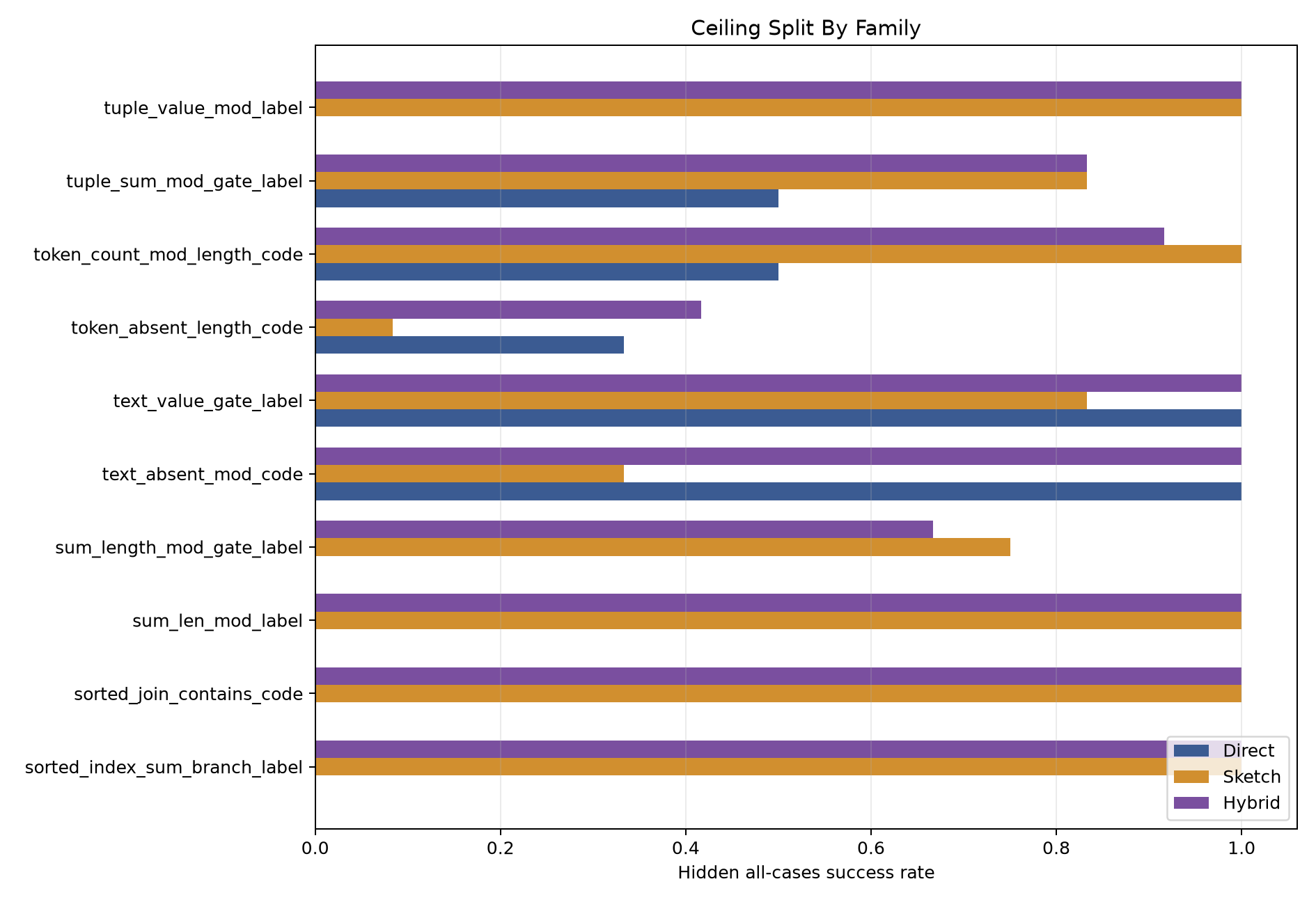
One bar pair per problem type — ten types, twelve problems each; height is how many were solved, taller is better. The two bars compare writing the whole fix directly against the solver filling a template.
Takeaway → The template bar clears whole problem types the direct bar misses entirely, though direct still edges ahead on a couple of text-matching types.
Data table
| ceiling task family | direct program | sketch selected |
|---|---|---|
| sorted_index_sum_branch_label | 0 | 12 |
| sorted_join_contains_code | 0 | 12 |
| sum_len_mod_label | 0 | 12 |
| sum_length_mod_gate_label | 0 | 9 |
| text_absent_mod_code | 12 | 4 |
| text_value_gate_label | 12 | 10 |
| token_absent_length_code | 4 | 1 |
| token_count_mod_length_code | 6 | 12 |
| tuple_sum_mod_gate_label | 6 | 10 |
| tuple_value_mod_label | 0 | 12 |
Technical framing
Ceiling split by task family: direct vs sketch-selected (of 12 each) — Sketch synthesis solves whole families direct generation misses entirely, while direct still wins on a few text-gating families.
In the author’s words from the Report · “Results”
The ceiling split is the important result. Direct program generation solved 40/120 (33.3%). Sketch synthesis selected by visible cases solved 94/120 (78.3%). The conservative hybrid solved 106/120 (88.3%). Hidden-oracle coverage was 120/120 (100.0%), which means the verifier search space contained every target program on the ceiling split.
Overview
This standalone experiment tests whether Qwen/Qwen3.5-4B can improve executable DSL repair by emitting a typed partial program that a bounded symbolic synthesizer completes and verifies on visible execution cases.
The experiment trains two fresh adapters under the same data budget:
program_lora: emits one complete corrected DSL expression.sketch_lora: emits one typed DSL sketch with holes such as?NUM0,?TEXT0, and?PRED0.
The synthesizer fills sketch holes with type-valid expressions built from the input schema, executes each completed candidate on visible cases, and reports hidden-case success plus hidden-oracle coverage inside the candidate set.
Large adapters and checkpoints are intentionally outside this compact directory:
/workspace/large_artifacts/qwen35_4b_typed_sketch_synthesis/
Layout
configs/experiment.json: fixed design and hyperparameters.src/: standalone DSL, data, prompt, model, and typed-sketch utilities.scripts/: dataset generation, training, baseline evaluation, sketch-synthesis evaluation, and report entry points.data/: generated JSONL datasets and manifest.reports/: evaluation JSON files, final report, and generated charts underreports/figures/.logs/andrun_logs/: experiment notebook and command output.large_artifacts_manifest.md: pointers to adapter directories stored outside this compact directory.
Report
Final report path after evaluation:
reports/qwen35_4b_typed_sketch_synthesis_report.md
Report
Rendered from reports/qwen35_4b_typed_sketch_synthesis_report.md
Objective
Test whether Qwen 3.5 4B can produce typed executable sketches that a verifier completes into better DSL repairs than direct program generation.
Method
- Base model:
Qwen/Qwen3.5-4B, revision851bf6e806efd8d0a36b00ddf55e13ccb7b8cd0a. - Training data: 240 records for each adapter.
Adapters:
program_lora: trained to emit complete DSL programs.sketch_lora: trained to emit typed sketches with?NUM,?TEXT,?SEQ, and?PREDholes.
Verifier:
- Completes typed holes from a schema-derived expression bank.
- Runs candidates on visible cases.
- Reports selected hidden success and hidden-oracle coverage.
Final selection rule:
- Keep the direct-program result if it passes every visible case.
- Otherwise use sketch synthesis when it passes every visible case.
- Otherwise choose the candidate with more visible passes.
Iterations
- Deterministic target sketches recovered the target program on all train, IID, support, and ceiling records under the planned caps.
- Initial model-generated sketch synthesis failed on a five-record ceiling smoke test: target synthesis was 0/5 and oracle hidden success was 0/5.
- Added structural abstraction variants such as
(if ?PRED0 high_label low_label)and(format "X{}" ?NUM0), plus deeper numeric and predicate expression-bank entries. - Changed visible-pass tie-breaking to prefer input-dependent, structurally richer candidates instead of shorter programs.
- Fixed candidate tag merging so targeted predicates promote generic candidates already in the bank.
Results
| Split | Direct program | Sketch selected | Sketch oracle | Conservative hybrid |
|---|---|---|---|---|
| IID | 60/60 (100.0%) | 45/60 (75.0%) | 60/60 (100.0%) | 60/60 (100.0%) |
| Support | 117/120 (97.5%) | 70/120 (58.3%) | 120/120 (100.0%) | 118/120 (98.3%) |
| Ceiling | 40/120 (33.3%) | 94/120 (78.3%) | 120/120 (100.0%) | 106/120 (88.3%) |
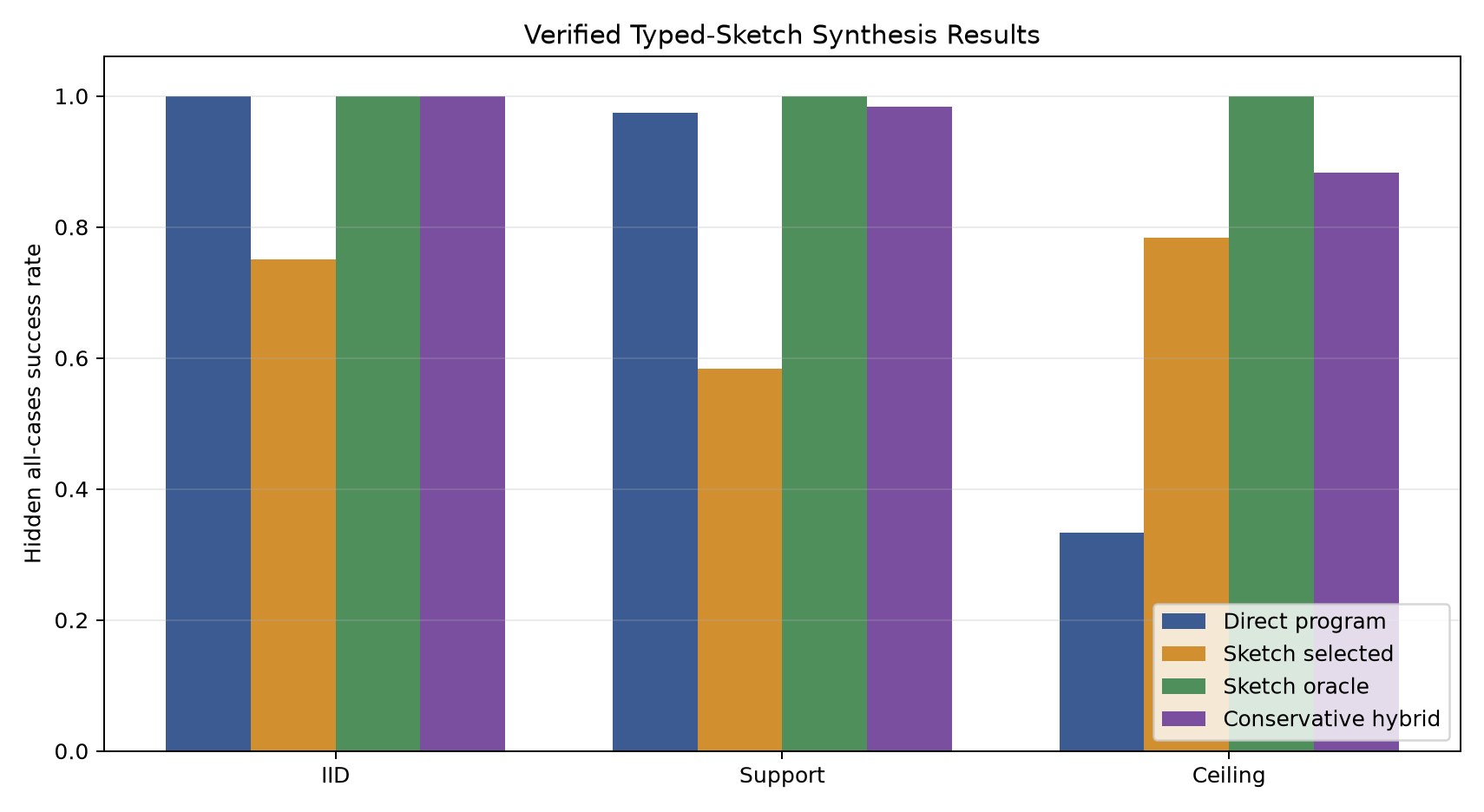
The ceiling split is the important result. Direct program generation solved 40/120 (33.3%). Sketch synthesis selected by visible cases solved 94/120 (78.3%). The conservative hybrid solved 106/120 (88.3%). Hidden-oracle coverage was 120/120 (100.0%), which means the verifier search space contained every target program on the ceiling split.
Ceiling family breakdown:
| Family | Direct | Sketch | Oracle | Hybrid | Avg candidates |
|---|---|---|---|---|---|
| sorted_index_sum_branch_label | 0 | 12 | 12 | 12 | 2123.3 |
| sorted_join_contains_code | 0 | 12 | 12 | 12 | 38.0 |
| sum_len_mod_label | 0 | 12 | 12 | 12 | 833.0 |
| sum_length_mod_gate_label | 0 | 9 | 12 | 8 | 7486.5 |
| text_absent_mod_code | 12 | 4 | 12 | 12 | 8000.0 |
| text_value_gate_label | 12 | 10 | 12 | 12 | 8000.0 |
| token_absent_length_code | 4 | 1 | 12 | 5 | 8000.0 |
| token_count_mod_length_code | 6 | 12 | 12 | 11 | 8000.0 |
| tuple_sum_mod_gate_label | 6 | 10 | 12 | 10 | 8000.0 |
| tuple_value_mod_label | 0 | 12 | 12 | 12 | 6987.0 |
Interpretation
Typed sketch synthesis changed the ceiling result from 40/120 to 94/120 with sketch selection alone and to 106/120 with the conservative hybrid. The oracle result of 120/120 shows that the remaining failures are not expression coverage failures; they are visible-case selection failures.
The experiment did not produce a universal training tweak by itself. It did produce a strong concrete mechanism: use Qwen 3.5 4B to identify output format and coarse control structure, then let a typed verifier search deeper compositions than the model reliably emits token-by-token.
Failure Modes
- Sketch-alone selection is unsafe on easy splits: IID direct generation is 60/60, while sketch-alone is 45/60 because many visible-equivalent candidates exist.
- The conservative hybrid protects solved visible-all direct outputs, but ceiling still has 14 hidden failures versus a 120/120 oracle.
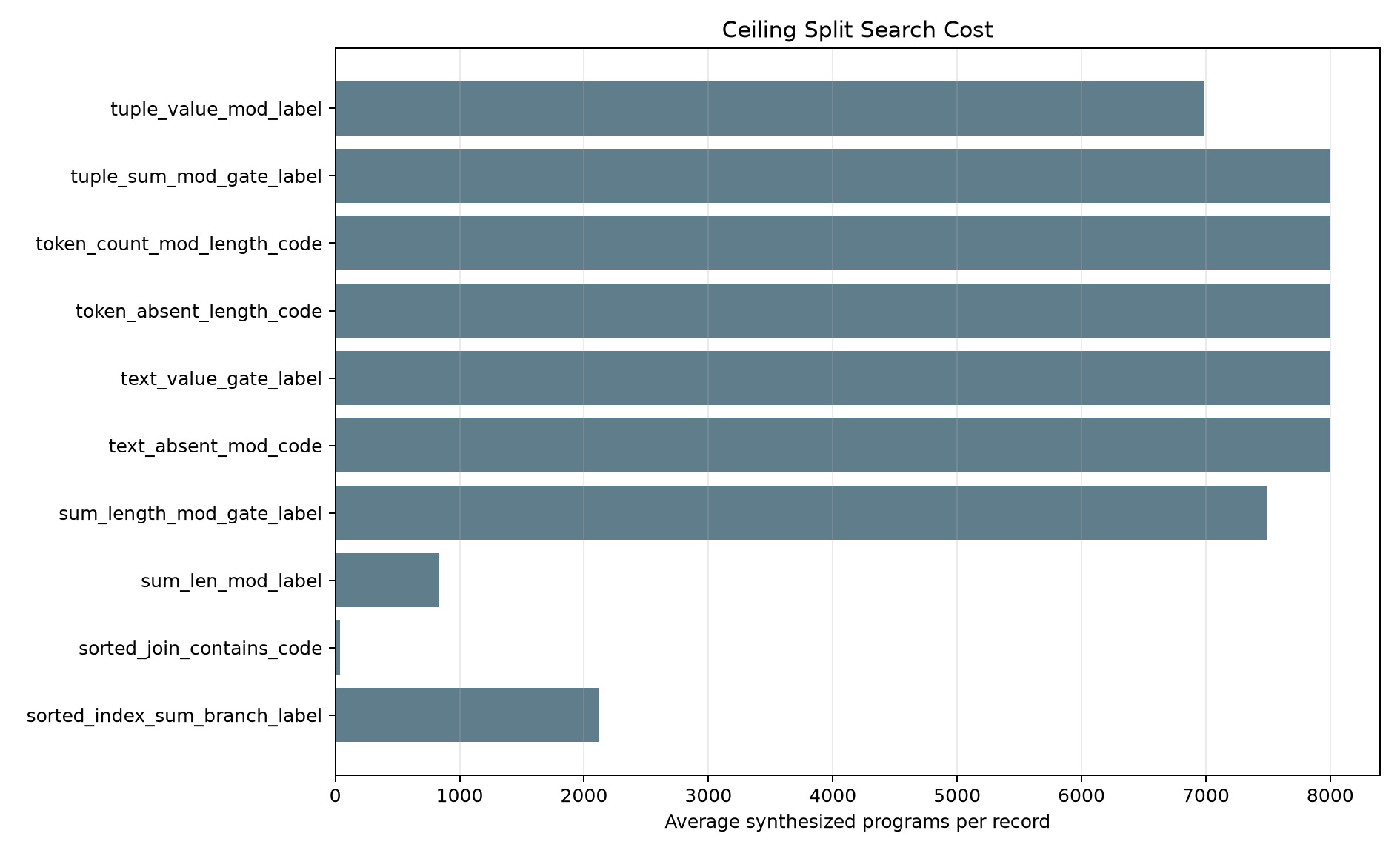
- Several families hit the 8,000-candidate cap, so runtime is still dominated by broad symbolic enumeration.
- The expression bank is manually engineered for this DSL. The result is evidence for the typed-sketch/verifier direction, not for a domain-independent recipe yet.
Next Experiment
The next experiment should make selection adaptive: after sketch synthesis finds many visible-equivalent programs, generate new discriminating visible cases on the fly, rerun the candidates, and train or evaluate the policy on that counterexample-acquisition loop. The MDP framing is direct: state is the candidate set plus visible traces, actions request additional cases or commit to a program, and reward is verified generalization under a fixed case budget.
Artifacts
- Compact experiment directory:
/workspace/experiments/qwen35_4b_typed_sketch_synthesis - Large adapter/checkpoint root:
/workspace/large_artifacts/qwen35_4b_typed_sketch_synthesis - Direct evals:
reports/eval/program_iid.json,reports/eval/program_support.json,reports/eval/program_ceiling.json - Sketch evals:
reports/eval/sketch_iid.json,reports/eval/sketch_support.json,reports/eval/sketch_ceiling.json - Training logs:
run_logs/training_program_lora_console.log,run_logs/training_sketch_lora_console.log
Experiment log 5
Show the running log (5 entries)
Objective
Test whether typed partial-program synthesis can improve held-out executable DSL repair over direct program generation for Qwen 3.5 4B.
Design Commitments
- Use only
Qwen/Qwen3.5-4B. - Train fresh adapters inside this standalone experiment.
- Keep the training budget fixed at 240 records per adapter.
- Keep adapter/checkpoint files outside the compact experiment directory.
- Evaluate direct program generation and typed-sketch synthesis on IID, support, and held-out ceiling splits.
- Report both visible-selected hidden success and hidden-oracle synthesis coverage.
- Generate a final markdown report and charts.
Hypotheses
- Some held-out failures require compositional jumps that local edits cannot generate.
- A model-generated typed sketch can provide enough structure for bounded symbolic completion to find those jumps.
- If hidden-oracle synthesis coverage is much higher than visible-selected synthesis success, the bottleneck is visible-case discrimination.
- If hidden-oracle synthesis coverage remains low, the sketch space or expression bank is still not expressive enough.
Planned Runs
- Build deterministic datasets from seed
20260701. - Add deterministic target sketches to every record.
- Train
program_loraon complete DSL programs. - Train
sketch_loraon typed DSL sketches. - Evaluate
program_loraon IID, support, and ceiling splits. - Evaluate typed-sketch synthesis on IID, support, and ceiling splits.
- Iterate the synthesizer or selector if early checks expose obvious failures.
- Generate charts and final report.
- Audit compact artifact size and large artifact separation.
Step Log
- Initialized standalone experiment directory and large artifact directory.
- Copied stable DSL, data generation, prompt, training, and direct-program evaluator utilities.
- Implemented program-vs-sketch training targets, typed sketch prompts, deterministic target sketch generation, bounded typed synthesis, and sketch evaluation.
- Built datasets with seed
20260701. Target sketch recovery preflight:
data/static_bridge_60/dsl_train.jsonl: 240/240 target programs recovered.data/eval/dsl_eval_iid.jsonl: 60/60 target programs recovered.data/eval/dsl_eval_support.jsonl: 120/120 target programs recovered.data/eval/dsl_eval_ceiling.jsonl: 120/120 target programs recovered.
- Recovery preflight finding: initial ranking over-prioritized label-length numeric features and under-prioritized literal
0for scalar gates. Fixed ranking before any model training. Trained
program_lorain/workspace/large_artifacts/qwen35_4b_typed_sketch_synthesis/models/program_lora.- Final eval loss:
0.0001638. - Train runtime:
857.4seconds.
- Final eval loss:
Trained
sketch_lorain/workspace/large_artifacts/qwen35_4b_typed_sketch_synthesis/models/sketch_lora.- Final eval loss:
0.000158. - Train runtime:
916.7seconds.
- Final eval loss:
Direct program evaluation:
- IID: 60/60 hidden all-cases success.
- Support: 117/120 hidden all-cases success.
- Ceiling: 40/120 hidden all-cases success.
- Initial sketch smoke evaluation on five ceiling records failed: 0/5 target synthesized and 0/5 hidden-oracle success.
Iteration: added structural sketch abstraction variants and deeper typed expression-bank entries.
- Five-record smoke improved to 5/5 target synthesized, 5/5 hidden-oracle success, and 2/5 selected hidden success.
Iteration: changed visible-pass ties to prefer input-dependent and structurally richer candidates.
- Five-record smoke improved to 5/5 target synthesized, 5/5 hidden-oracle success, and 4/5 selected hidden success.
Iteration: reordered abstraction variants first and evaluated greedy-only sketch generation with an 8,000 total-candidate cap.
- Five-record smoke retained 5/5 target synthesized, 5/5 hidden-oracle success, and 4/5 selected hidden success.
Iteration: fixed candidate tag merging so targeted predicate entries can promote generic candidates already present in the expression bank.
- This fixed
sorted_join_contains_codesynthesis.
- This fixed
Final sketch evaluation with greedy sketch generation and 8,000 total-candidate cap:
- IID: 45/60 sketch-selected, 60/60 sketch-oracle, 60/60 conservative hybrid.
- Support: 70/120 sketch-selected, 120/120 sketch-oracle, 118/120 conservative hybrid.
- Ceiling: 94/120 sketch-selected, 120/120 sketch-oracle, 106/120 conservative hybrid.
- Generated final report and figures under
reports/.
Figures 3
Reproduce
Run steps are documented inside the experiment folder (README and scripts).