Real Transform ABI Gate with Counterexamples
The one idea you need
Picture a fixed toolbox of ready-made data-cleaning functions. For each job you try every tool against a few input-output examples and keep whichever fits. The catch: with so few examples a wrong tool can fit by luck, so trick examples are added to unmask those coincidences.
The question
If you match ready-made transformation functions against a handful of input-output examples, do you get the truly correct function, or just one that happens to fit?
What we found
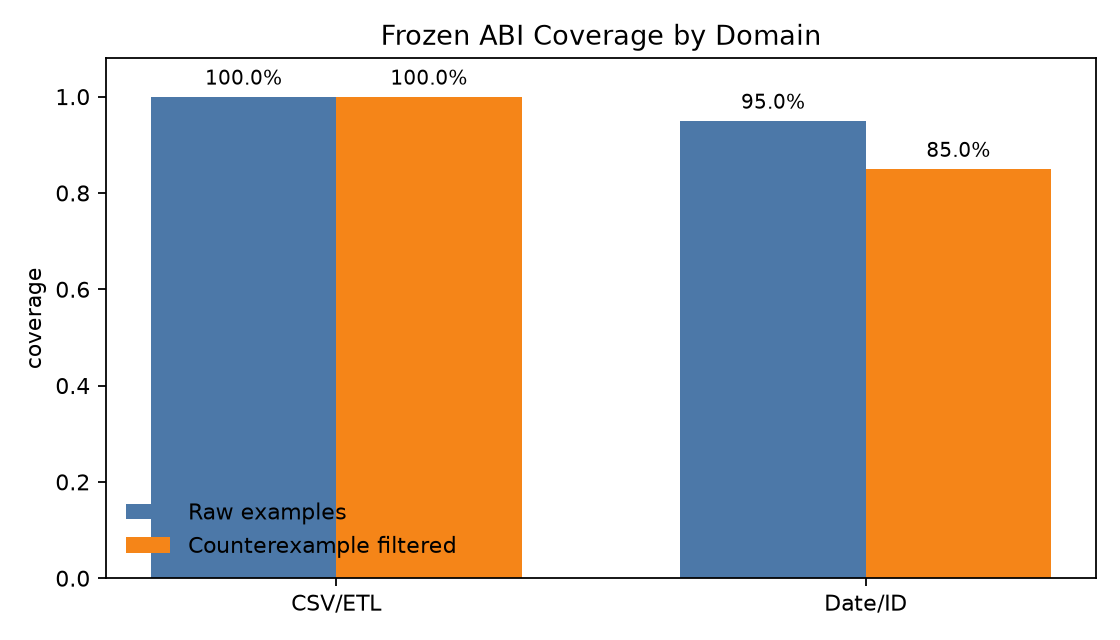
It depends on how messy the data is. For clean, spreadsheet-style pipeline jobs the toolbox covered every one (100%) and held firm even against deliberately tricky examples. For irregular date, ID, and text cleanup, coverage slipped from 95% to 85% once trick examples exposed functions that only looked right. And a wrong function fit the few shown examples about a third of the time.
Why it matters
When auto-picking transformation functions from examples, never trust a match on a few cases: generate adversarial trick examples to catch lucky fits. Expect clean pipelines to work today; messy formatting needs richer functions or a human step.
On this page
Results at a glance 4
How to read
Grouped bars show the share of tasks solved for clean pipelines, messy date/ID work, and overall. Each group pairs coverage from the few shown examples (lighter) against coverage after trick examples are added (darker). Taller is better.
Takeaway → Clean-pipeline bars stay at full height after trick examples while the messy group drops, so the fixed toolbox holds up only on tidy work.
Data table
| Domain | raw coverage | filtered coverage |
|---|---|---|
| CSV/ETL clean pipeline | 100% | 100% |
| Date/ID irregular | 95% | 85% |
| Overall | 97.5% | 92.5% |
Numbers from reports/summary.json (by_domain, overall)
Technical framing
Frozen ABI coverage before and after adversarial counterexamples — Clean pipeline transforms stay fully covered after counterexample filtering; the irregular date/ID domain loses coverage on edge cases.
How to read
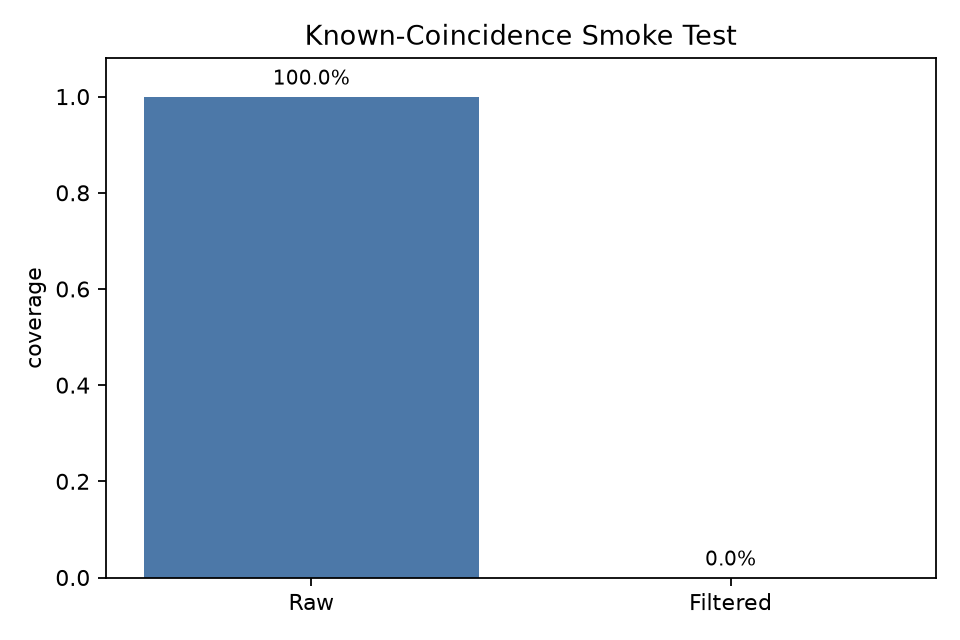
Two bars for the same two deliberately deceptive tasks: coverage using the few shown examples versus coverage after trick examples are added. Here a drop toward zero is the intended, better outcome.
Takeaway → Coverage falls from full to nothing, confirming trick examples removed every planted match that had fit the shown examples for the wrong reason.
Data table
| Condition | raw coverage | filtered coverage |
|---|---|---|
| Known-coincidence smoke tasks (n=2) | 100% | 0% |
Numbers from reports/summary.json (smoke.overall)
Technical framing
Smoke test: counterexamples remove known-wrong raw winners — Both deliberately coincidence-prone tasks passed raw thin tests but were fully removed by adversarial counterexamples, so raw coverage alone is unsafe.
How to read
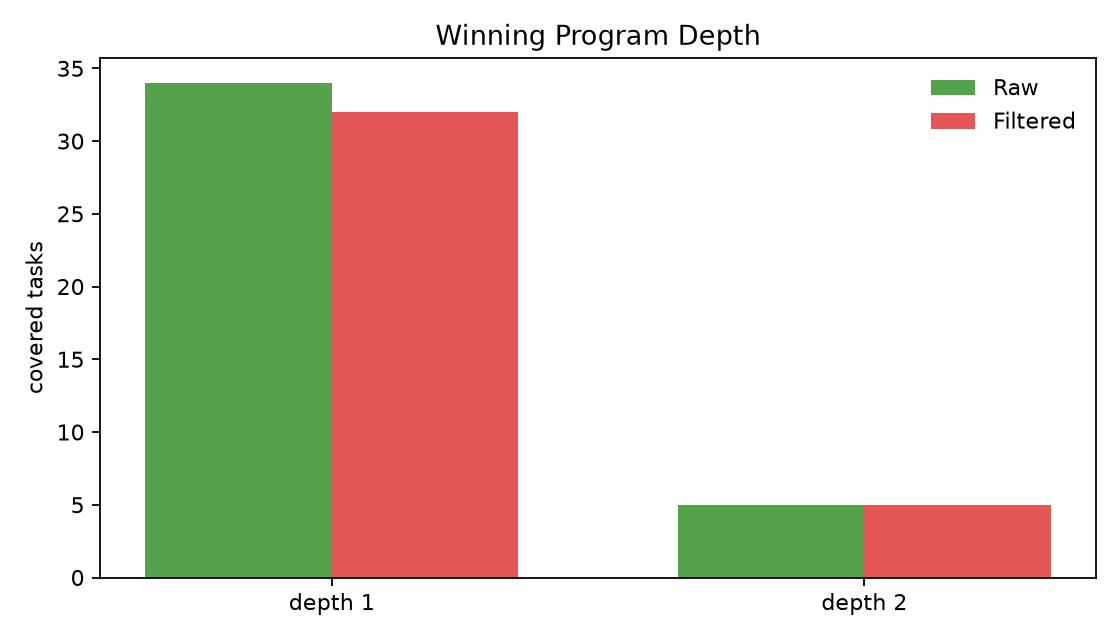
Bars count solved tasks that needed a single tool versus two tools chained together. Lighter bars are before trick examples, darker after; height just shows how common each pattern is, not which is better.
Takeaway → The single-tool bar towers over the two-tool bar, so the toolbox mostly proves it can pick the right one tool, not chain several.
Data table
| Program depth | raw covered | filtered covered |
|---|---|---|
| depth 1 (single primitive) | 34 | 32 |
| depth 2 (composed) | 5 | 5 |
Numbers from reports/summary.json (raw_depth_counts, filtered_depth_counts)
Technical framing
Depth of winning programs among covered tasks — Coverage is dominated by depth-1 single-primitive wins, so the gate validates operation selection more than deep program synthesis.
How to read
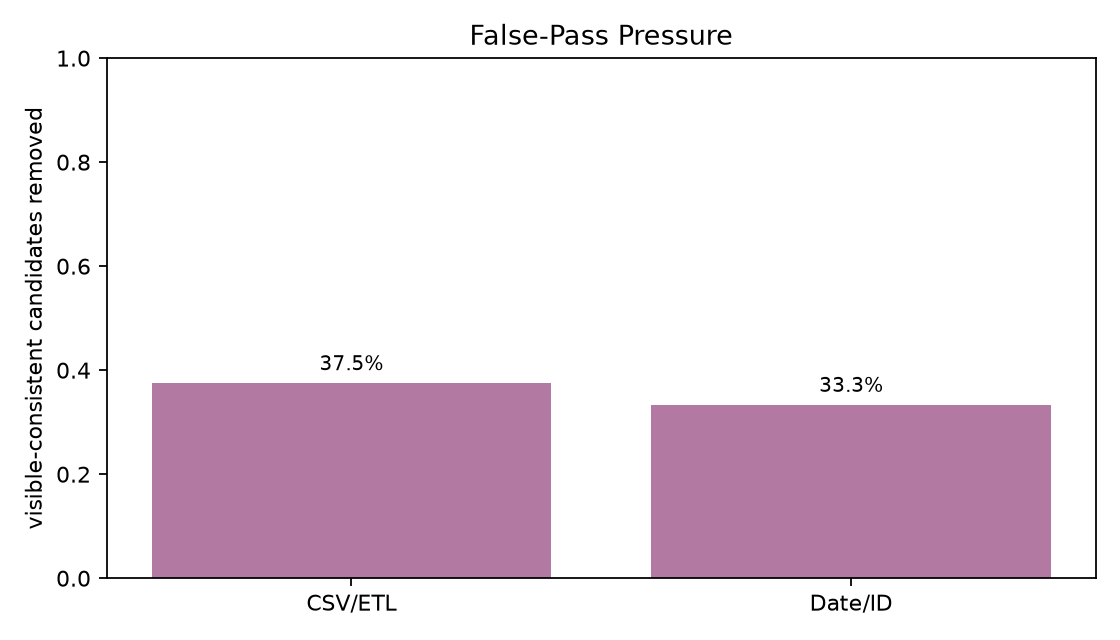
One bar per group (clean pipelines, messy work, overall) showing how often a function that passed the few shown examples still failed hidden checks. Lower is better.
Takeaway → All three bars sit near a third, showing thin visible examples routinely let wrong functions slip through and why the trick examples are needed.
Data table
| Domain | visible-pass candidates wrong on hidden tests |
|---|---|
| CSV/ETL clean pipeline | 37.5% |
| Date/ID irregular | 33.3% |
| Overall | 35.6% |
Numbers from reports/summary.json (visible_hidden_wrong_rate)
Technical framing
Visible false-pass pressure by domain — Roughly a third of candidates that pass visible examples fail hidden tests, showing thin visible tests routinely admit wrong programs.
In the author’s words from the Report · “Summary”
Overall filtered coverage was 37/40 (92.5%). The result supports the narrow claim that a generic ABI is useful for pipeline-shaped transformations, but it does not establish broad coverage of irregular transformation work. The coincidence smoke test worked as intended: both known-wrong raw winners were removed by adversarial examples, so raw coverage alone is not a safe headline metric.
Overview
Standalone no-training experiment for deterministic transformation ABI coverage with counterexample filtering.
The package defines two independently curated transformation domains:
- clean CSV/ETL-style row transformations
- irregular date/ID/string normalization transformations
It freezes a generic ABI before evaluation, measures raw coverage on visible plus standard hidden tests, then applies adversarial counterexample tests generated from the task reference semantics. No model training or checkpoints are produced.
Reproduce
python scripts/run_gate.py --data-dir data --reports-dir reports
python scripts/make_report.py
The main writeup is reports/report.md; figures are in reports/figures/.
Report
Rendered from reports/report.md
Summary
This no-training gate tested whether a frozen, generic transformation ABI covers two held-out-style deterministic transformation domains, and whether additional counterexamples remove thin-test coincidences.
Main result: the clean pipeline domain stayed fully covered after counterexample filtering, while the irregular date/ID/string domain lost coverage on edge cases. Overall filtered coverage was 37/40 (92.5%). The result supports the narrow claim that a generic ABI is useful for pipeline-shaped transformations, but it does not establish broad coverage of irregular transformation work.
The coincidence smoke test worked as intended: both known-wrong raw winners were removed by adversarial examples, so raw coverage alone is not a safe headline metric.
Charts
Method
- The ABI was frozen before evaluating the expanded 40-task suite.
- Coverage was measured twice: raw coverage on visible plus hidden examples, then filtered coverage after extra adversarial examples.
- The suite is curated and self-contained. It is not a public benchmark and should be treated as a gate for whether a larger benchmark build is worth doing.
- Counterexamples can refute a candidate program when expected behavior is available. They do not certify correctness in reference-free deployment.
Domain Results
| Domain | n | Raw coverage | Filtered coverage | Raw removed | Visible false-pass rate |
|---|---|---|---|---|---|
| CSV/ETL clean pipeline | 20 | 20/20 (100.0%) | 20/20 (100.0%) | 0 | 37.5% |
| Date/ID irregular | 20 | 19/20 (95.0%) | 17/20 (85.0%) | 2 | 33.3% |
Program Depth
- Raw covered depth counts:
{'1': 34, '2': 5} - Filtered covered depth counts:
{'1': 32, '2': 5}
Most covered tasks were depth-1 single-primitive programs. Depth-2 coverage appeared mainly in aggregation and parsing transforms. This is useful but limits the composition claim: the gate mainly validates reusable operation selection in clean transformations, not deep program synthesis.
Counterexample Smoke
| Smoke task | Raw | Filtered | Raw winning program |
|---|---|---|---|
| smoke_parentheses | yes | no | {"op": "all_distinct_chars"} |
| smoke_month_30 | yes | no | {"op": "all_distinct_chars"} |
The two smoke tasks were designed so a broad generic predicate can pass thin raw examples for the wrong reason. Counterexamples removed all raw smoke winners.
Filtered Misses
| Task | Domain | Raw | Filtered | Raw winning program | Reason exposed by filter |
|---|---|---|---|---|---|
| id_03 | date_id_irregular | yes | no | {"op": "normalize_phone"} | Raw winner failed adversarial counterexample |
| id_11 | date_id_irregular | yes | no | {"op": "normalize_date_iso"} | Raw winner failed adversarial counterexample |
| id_18 | date_id_irregular | no | no | - | No ABI candidate passed raw examples |
The filtered misses are informative: they are irregular edge cases rather than broad pipeline failures. Examples include phone extensions, full month names, and hyphenated title casing. These are exactly the cases where a fixed generic ABI needs either richer primitives, task-specific logic, or a human/stronger-model expansion step.
Interpretation
The gate gives a positive result for clean CSV/ETL-style transformations: filtered coverage was 100% on the curated clean domain. It gives a narrower result for irregular date/ID/string transformations: raw coverage was high, but counterexamples removed two tasks and one task had no raw ABI solution.
The practical takeaway is to split future work by domain shape:
- Clean row/column/filter/sort/group/normalize pipelines are a plausible target for a compiler-to-ABI system.
- Irregular extraction and formatting tasks need a stronger counterexample suite and a broader ABI before training a compiler would be justified.
- Any future model-training pilot should report depth-1 operation selection separately from depth-2+ composition, because this gate is dominated by single-primitive wins.
Experiment log 1
Show the running log (1 entry, 2026-06-27)
2026-06-27
- Created standalone experiment package.
- Defined a frozen generic transformation ABI and two curated deterministic transformation domains.
- Planned verifier smoke test on coincidence-style false coverage before reading domain coverage.
- Planned headline metrics: raw coverage, counterexample-filtered coverage, depth split, false-pass rate, and coverage by domain.
- Smoke test was tightened before the first accepted run so broad generic predicates can pass thin raw examples and then be removed by adversarial counterexamples.
- Expanded the evaluation suite to 20 CSV/ETL tasks and 20 date/ID/string tasks while keeping the ABI fixed.
- Final run: raw coverage 39/40 (97.5%), counterexample-filtered coverage 37/40 (92.5%).
- CSV/ETL filtered coverage: 20/20 (100.0%). Date/ID/string filtered coverage: 17/20 (85.0%).
- Smoke test: raw coverage 2/2, filtered coverage 0/2, confirming the counterexample filter catches known coincidence-style false coverage.
Figures 4
Data files 1
Result tables and metrics copied from the experiment folder — preview inline or open the raw file.
reports/summary.json5.0 kB
Reproduce
Run steps are documented inside the experiment folder (README and scripts).