Qwen Public PROSE ABI Gate
The one idea you need
Picture a fixed toolbox of preset text-reshaping tools: pull the domain from an email, take the first word, round a number. Freeze it, then hand it an outside pile of formatting jobs, keeping a tool only if it also works on rows it never saw.
The question
If you hand-build a fixed set of text-reshaping recipes, will they handle an independent, outside collection of everyday spreadsheet-cleanup tasks?
What we found
No. The frozen toolkit fully solved only 19% of the 309 outside tasks. In 77% of them no recipe fit even the worked examples, so the toolkit lacked that operation entirely; under 4% overfit. Yet a small four-billion-parameter model, given the same examples, answered a fresh case correctly 73% of the time, and two-thirds right even on tasks the toolkit missed.
Why it matters
Building text normalization from a fixed rule library covers only a fraction of real formats, especially dates and numbers. Prefer letting a small model infer the transformation from examples, or add retrieval to pick domain-specific rules.
On this page
Results at a glance 7
How to read
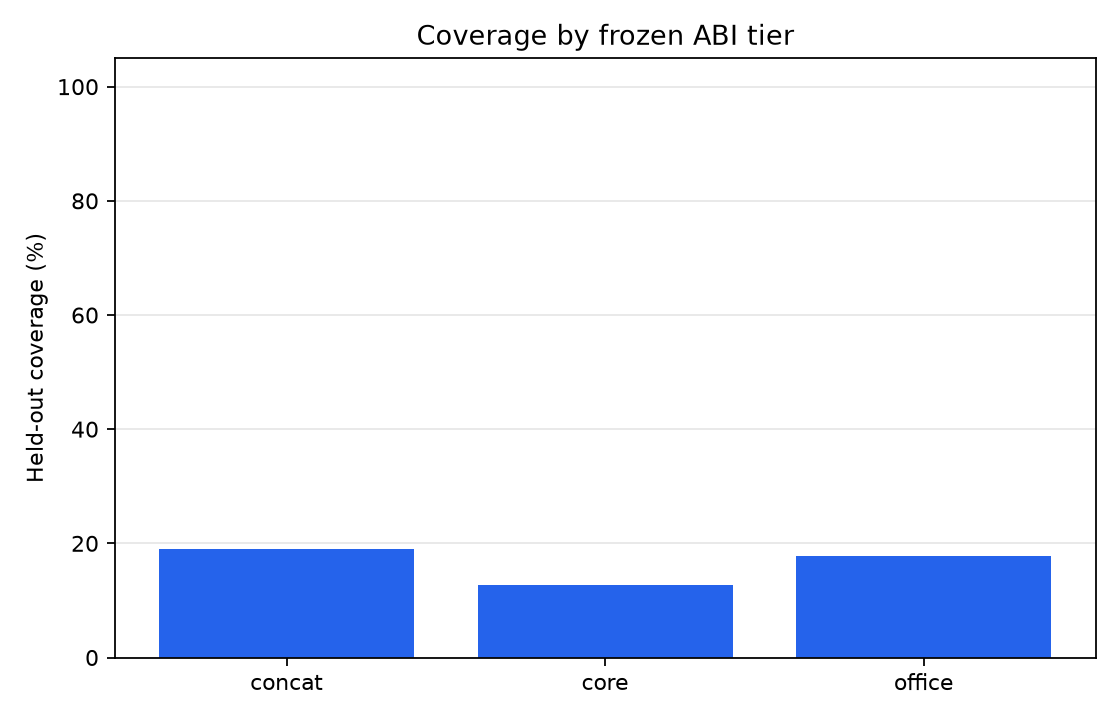
Three toolbox sizes along the bottom, smallest to largest. Each bar splits its tasks into solved-and-verified-on-unseen-rows, a recipe that fit examples only by luck, and no recipe fitting at all. A taller solved slice is better.
Takeaway → The solved slice never clears about a fifth in any toolbox while the 'no recipe fit' band dominates, meaning the tasks are out of reach, not merely overfit.
Data table
| frozen ABI tier | held-out coverage | train-only (coincidence) failures | no train match |
|---|---|---|---|
| core | 12.6% | 2.6% | 84.8% |
| office | 17.8% | 3.2% | 79% |
| concat | 19.1% | 3.6% | 77.3% |
Numbers from analysis/overall_summary.csv
Technical framing
Frozen transformation ABI covers under 20% of public PROSE tasks — Even the richest frozen tier validates only 19% of tasks; most misses are missing primitives, not held-out coincidences.
How to read
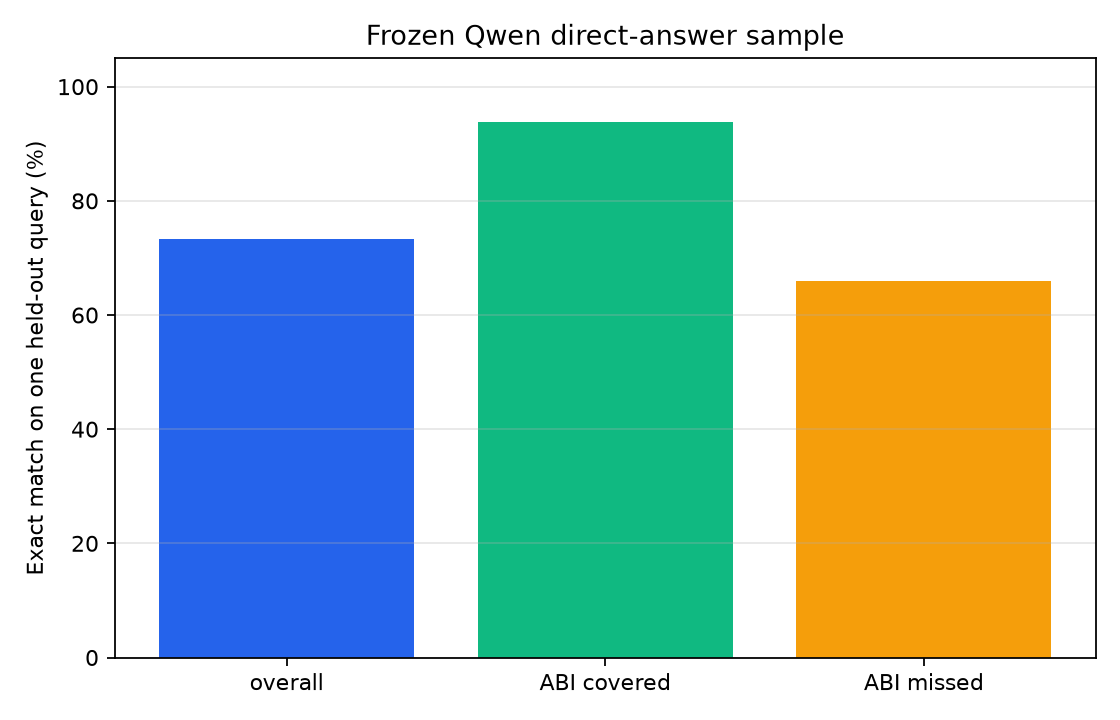
Bars show how often a small model, given a few examples, produced the exact right answer on a fresh case: for all sampled tasks, only tasks the toolbox missed, and only tasks it covered. Taller is better.
Takeaway → The model still nails about two-thirds of the tasks the toolbox misses, showing the shortfall is the fixed recipes, not the transformations being impossible.
Data table
| task slice (60-task sample) | Qwen direct exact match (1 held-out query) |
|---|---|
| all sampled tasks | 73.3% |
| ABI not covered | 65.9% |
| ABI covered | 93.8% |
Numbers from analysis/qwen_direct_summary.csv
Technical framing
Frozen Qwen answers most tasks the ABI cannot cover — The model infers 66% of transformations the frozen ABI misses, so the bottleneck is the ABI's primitives, not the model.
How to read
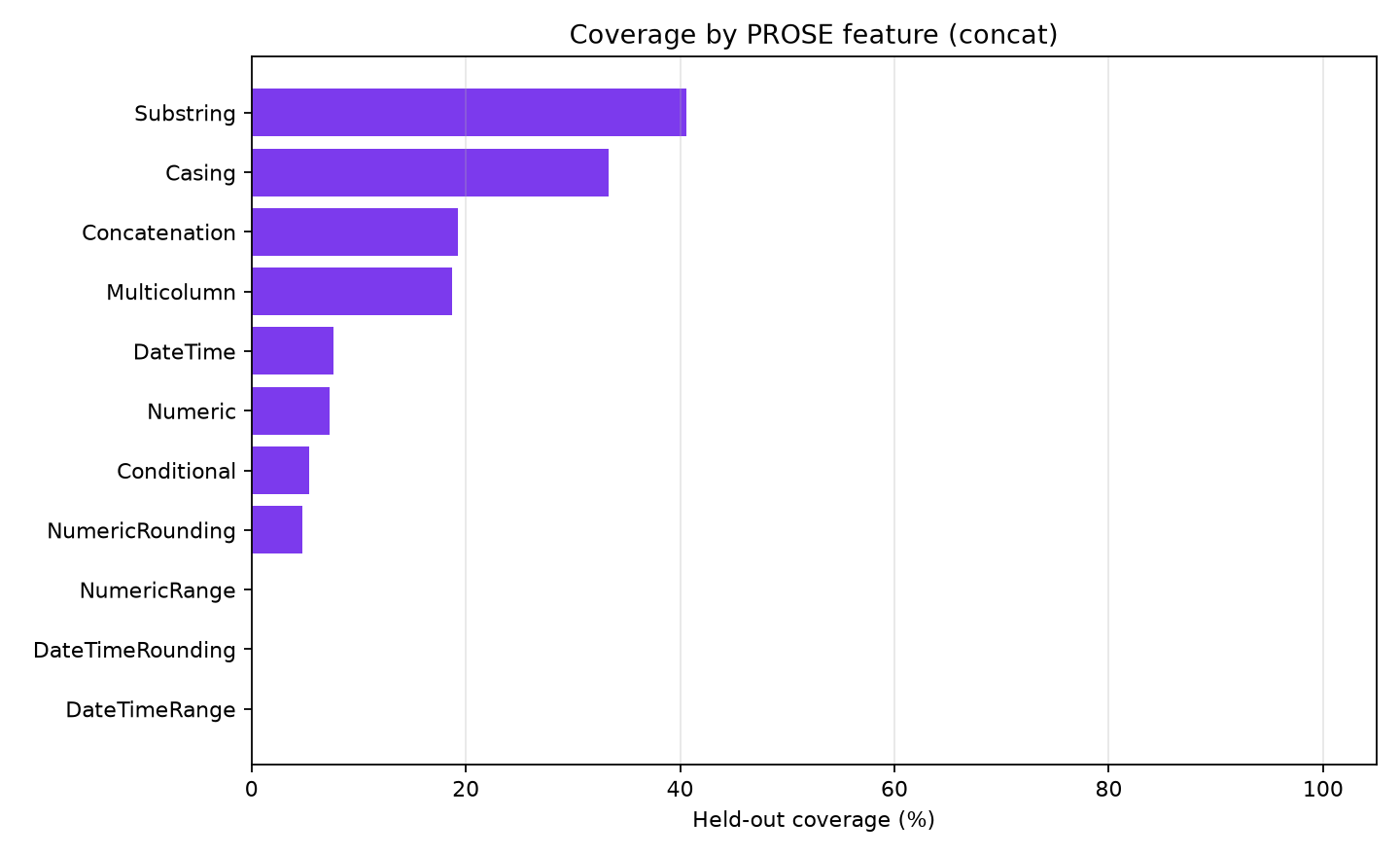
Each bar is a type of text operation; height is the share of those tasks the best toolbox solved. Left bars are simple surface edits, right bars are date and number rounding and ranges. Taller is better.
Takeaway → Coverage falls from about two-in-five for plain substring edits to zero for date rounding and range tasks (number rounding barely clears one-in-twenty), exactly where the toolbox runs out.
Data table
| task feature | held-out coverage (concat tier) |
|---|---|
| Substring | 40.5% |
| Casing | 33.3% |
| Concatenation | 19.2% |
| Multicolumn | 18.8% |
| DateTime | 7.7% |
| Numeric | 7.3% |
| Conditional | 5.4% |
| NumericRounding | 4.8% |
| DateTimeRounding | 0% |
| DateTimeRange | 0% |
Numbers from analysis/feature_summary.csv
Technical framing
Where the ABI fails: coverage by task feature (best tier) — Surface substring/casing tasks are reachable; date-time rounding and range arithmetic are completely outside the frozen ABI.
How to read
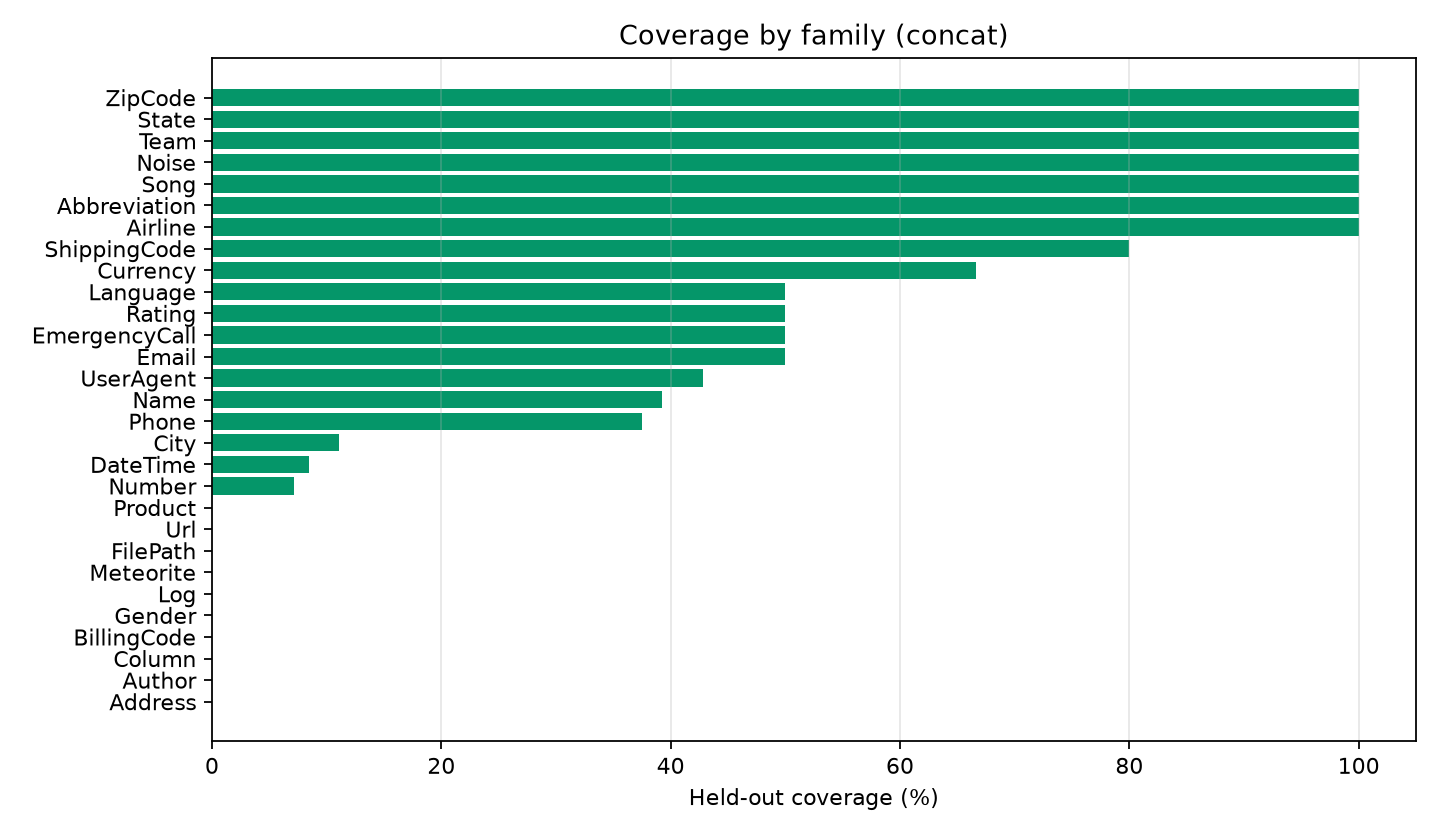
Each bar is a task family such as dates, phone numbers, or emails; height is the share of that family the best toolbox solved. Taller is better.
Takeaway → Tidy families like shipping codes and emails reach half or more, while the two biggest families, dates and numbers, sit near the bottom and drag the total down.
Data table
| Task family | Coverage (concat tier) |
|---|---|
| DateTime | 8.5% |
| Number | 7.1% |
| Name | 39.3% |
| Phone | 37.5% |
| ShippingCode | 80% |
| City | 11.1% |
| UserAgent | 42.9% |
| 50% | |
| Address | 0% |
| BillingCode | 0% |
Numbers from experiments/qwen_public_prose_abi_gate/analysis/family_summary.csv
Technical framing
ABI coverage by task family (best tier), largest families — Semi-structured families like ShippingCode and Email are coverable; the two largest families, DateTime and Number, are nearly uncovered.
How to read
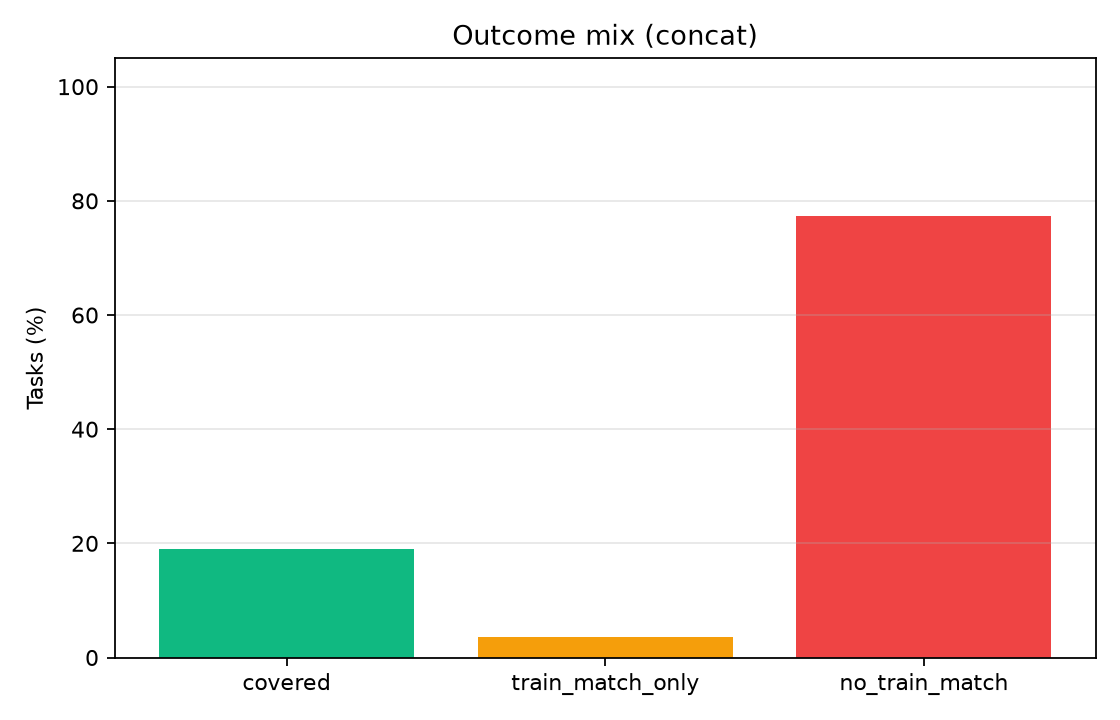
For each toolbox size, the bar splits all tasks into solved, a recipe matching the examples only by coincidence, and no recipe fitting at all. The thin coincidence slice is the point.
Takeaway → The coincidence slice stays near 3% while 'no recipe fit' fills roughly four-fifths, so failures are genuinely missing tools, not overfit guesses.
Data table
| ABI tier | Covered (held-out validated) | Train-only fit (coincidence) | No train match |
|---|---|---|---|
| core | 12.6% | 2.6% | 84.8% |
| office | 17.8% | 3.2% | 79% |
| concat | 19.1% | 3.6% | 77.3% |
Numbers from experiments/qwen_public_prose_abi_gate/analysis/overall_summary.csv
Technical framing
Why the ABI fails: no train fit dominates, coincidental fits are rare — Across all tiers roughly 8 in 10 failures are tasks where no candidate even fits the train rows, not overfit programs failing held-out.
How to read
Each bar is a task family in the sampled set; height is how often the small model gave the exact right answer from examples. Taller is better.
Takeaway → Names and phone numbers hit every case while dates fall to half, the same family where the fixed recipes are weakest.
Data table
| Slice | Qwen3-4B direct answer |
|---|---|
| Overall | 73.3% |
| DateTime | 50% |
| Name | 100% |
| Number | 78.6% |
| Phone | 100% |
Numbers from experiments/qwen_public_prose_abi_gate/analysis/qwen_direct_summary.csv
Technical framing
Frozen Qwen one-query exact match by task family (60-task sample) — Qwen's misses concentrate in DateTime tasks (50% exact) — the same family where the frozen ABI is weakest.
How to read
Each bar is a toolbox size; height is how many candidate recipes it sifts through per task. A taller bar means far more work, not better results.
Takeaway → The largest toolbox searches over 500 times more recipes than the smallest yet lifts tasks solved only from 13% to 19%, so search size is not the bottleneck.
Data table
| ABI tier | Median candidates |
|---|---|
| core | 109 |
| office | 1057 |
| concat | 56.83k |
Numbers from experiments/qwen_public_prose_abi_gate/analysis/overall_summary.csv
Technical framing
Cost of each ABI tier: median candidate programs searched per task — Growing the search space ~500x from core to concat lifts coverage only 12.6% to 19.1% — enumeration size is not the bottleneck.
In the author’s words from the Report · “Abstract”
This standalone experiment evaluates a frozen deterministic transformation ABI on the public Microsoft PROSE Transformation.Text benchmark. A program is selected from train examples and counted only if it also matches held-out examples from the same task.
Overview
Standalone experiment testing whether a frozen deterministic transformation ABI covers public Microsoft PROSE Transformation.Text tasks under within-task held-out validation.
Question
Does the office/transformation ABI cover an independent public benchmark under held-out validation?
Method
- Fetch public benchmark data into
/workspace/large_artifacts/qwen_public_prose_abi_gate/prose-benchmarks. - Freeze a generic transformation-template ABI before evaluating the benchmark.
- For each task with enough examples, split examples into train and held-out rows.
- Select a program only if it fits train examples; count it as covered only if it also matches held-out examples.
- Report train-only fits separately as semantic/coincidence failures.
Artifacts
- Source:
src/qwen_public_prose_abi_gate.py - Reports:
reports/ - Metrics and figures:
analysis/ - Public benchmark checkout:
/workspace/large_artifacts/qwen_public_prose_abi_gate/prose-benchmarks
Report
Rendered from reports/qwen_public_prose_abi_gate_report.md
Abstract
This standalone experiment evaluates a frozen deterministic transformation ABI on the public Microsoft PROSE Transformation.Text benchmark. A program is selected from train examples and counted only if it also matches held-out examples from the same task.
Method
- Dataset: Microsoft PROSE public benchmark suite,
Transformation.Text. - Tasks with too few examples are excluded so every scored task has held-out examples.
- Split: first
4examples, capped by task size, are train examples; up to50following examples are held out. - Frozen ABI tiers:
coresurface extraction/casing,officeadds regex/date/number/domain primitives,concatadds two-part concatenation over ABI expressions. - Train-only fits are counted as failures because they do not validate task semantics on held-out rows.
Run Configuration
- Suite:
main. - Scored tasks:
309. - Public benchmark checkout:
/workspace/large_artifacts/qwen_public_prose_abi_gate/prose-benchmarks.
Primary Results
- Best frozen tier coverage: 19.1% (59/309 tasks).
- Train-only/coincidence failures: 3.6% (11 tasks).
- No-train-match failures: 77.3% (239 tasks).
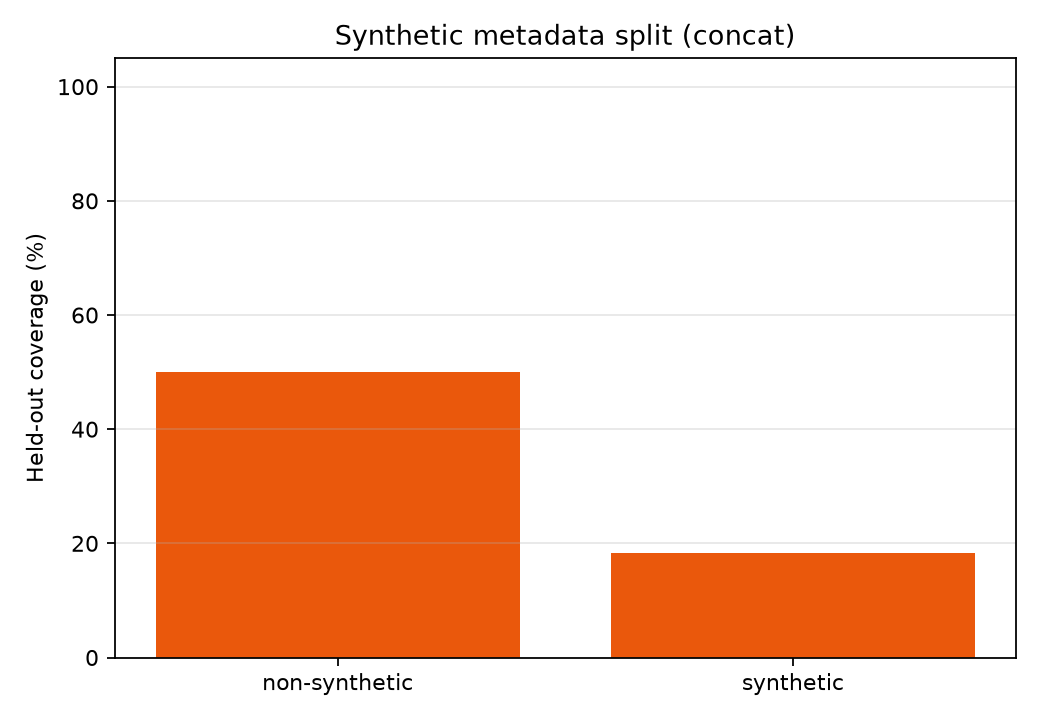
- Synthetic-metadata coverage: 18.3% (55/301 tasks).
- Non-synthetic-metadata coverage: 50.0% (4/8 tasks).
Frozen Qwen Direct-Answer Sample
- Model:
Qwen/Qwen3-4B. - Sample:
60tasks, seed20260627. - Prompt: first
4examples, then one held-out query. - Exact match on that one held-out query: 73.3% (44/60 tasks).
- This is a diagnostic baseline, not the same metric as ABI coverage: it scores one held-out query, while ABI coverage requires one program to match all held-out rows.
| slice | tasks | exact |
|---|---|---|
| overall | 60 | 0.73 |
| abi_covered=False | 44 | 0.66 |
| abi_covered=True | 16 | 0.94 |
| family=DateTime | 22 | 0.50 |
| family=Name | 4 | 1.00 |
| family=Number | 14 | 0.79 |
| family=Phone | 6 | 1.00 |
Qwen Sample Misses
| task_id | family | features | abi_covered | exact | target | prediction |
|---|---|---|---|---|---|---|
| BillingCode.000007 | BillingCode | Concatenation | False | False | 11529] | [11529] |
| DateTime.000006 | DateTime | Concatenation,DateTimeRange,DateTimeRounding,DateTime,Multicolumn | False | False | Fri 8:00-9:00 | Thu 8:00-9:00 |
| DateTime.000014 | DateTime | DateTime | False | False | Friday #1 February 2013 | Saturday #1 February 2013 |
| DateTime.000046 | DateTime | DateTime | False | False | 1952 7 2 | 7/2/1952 2 2 |
| DateTime.000056 | DateTime | DateTimeRange,DateTimeRounding,DateTime | False | False | 11AM-1PM | Noon-2PM |
| DateTime.000065 | DateTime | DateTimeRange,DateTimeRounding,DateTime | False | False | 12:30PM-12:44PM | 12:00PM-12:45PM |
| DateTime.000066 | DateTime | DateTimeRange,DateTimeRounding,DateTime | False | False | 12:40PM-12:49PM | 12:40PM-12:41PM |
| DateTime.000067 | DateTime | DateTimeRange,DateTimeRounding,DateTime | False | False | 12:00PM-1:20PM | 11:30AM-12:50PM |
| DateTime.000088 | DateTime | DateTimeRounding,DateTime | False | False | 4:00PM | 8:00AM |
| DateTime.000093 | DateTime | DateTime | False | False | 1990-03-07 | 1990-11-07 |
| DateTime.000106 | DateTime | DateTime | False | False | Mon | Wed |
| DateTime.000115 | DateTime | DateTimeRange,DateTimeRounding,DateTime | False | False | 40-60 | 0-20 |
| Noise.000001 | Noise | Concatenation,Multicolumn | True | False | %@^zxi**d^gx%i ry!d!!e*grumyr%$$#(k | col0=%@^zxi**d^gx%i ry! col1=d!!e*grumyr%$$#(k |
| Number.000015 | Number | Numeric,NumericRounding | False | False | -22600 | -22500 |
| Number.000031 | Number | Numeric,NumericRounding | False | False | 43.5 | 43.0 |
| Number.000094 | Number | Concatenation,Numeric | False | False | ₹56,343 | ₹5,6343 |
Overall By Tier
| tier | tasks | coverage | train_match_rate | train_only_rate | no_train_match_rate | median_candidates |
|---|---|---|---|---|---|---|
| concat | 309 | 19.1% | 22.7% | 3.6% | 77.3% | 56833.00 |
| core | 309 | 12.6% | 15.2% | 2.6% | 84.8% | 109.00 |
| office | 309 | 17.8% | 21.0% | 3.2% | 79.0% | 1057.00 |
Feature Coverage
| feature | tasks | coverage | train_only_rate |
|---|---|---|---|
| DateTimeRange | 36 | 0.0% | 0.0% |
| DateTimeRounding | 44 | 0.0% | 0.0% |
| NumericRange | 7 | 0.0% | 0.0% |
| NumericRounding | 42 | 4.8% | 2.4% |
| Conditional | 37 | 5.4% | 10.8% |
| Numeric | 82 | 7.3% | 2.4% |
| DateTime | 117 | 7.7% | 4.3% |
| Multicolumn | 16 | 18.8% | 0.0% |
| Concatenation | 52 | 19.2% | 0.0% |
| Casing | 9 | 33.3% | 0.0% |
| Substring | 111 | 40.5% | 3.6% |
Lowest-Coverage Families
| family | tasks | coverage | train_only_rate |
|---|---|---|---|
| Address | 6 | 0.0% | 16.7% |
| Author | 1 | 0.0% | 0.0% |
| BillingCode | 6 | 0.0% | 0.0% |
| Column | 2 | 0.0% | 0.0% |
| FilePath | 1 | 0.0% | 100.0% |
| Gender | 3 | 0.0% | 0.0% |
| Log | 4 | 0.0% | 0.0% |
| Meteorite | 1 | 0.0% | 0.0% |
| Product | 2 | 0.0% | 50.0% |
| Url | 1 | 0.0% | 0.0% |
| Number | 84 | 7.1% | 2.4% |
| DateTime | 106 | 8.5% | 4.7% |
| City | 9 | 11.1% | 0.0% |
| Phone | 16 | 37.5% | 0.0% |
| Name | 28 | 39.3% | 3.6% |
| UserAgent | 7 | 42.9% | 0.0% |
| 6 | 50.0% | 0.0% | |
| EmergencyCall | 2 | 50.0% | 0.0% |
| Language | 2 | 50.0% | 0.0% |
| Rating | 2 | 50.0% | 0.0% |
| Currency | 3 | 66.7% | 0.0% |
| ShippingCode | 10 | 80.0% | 0.0% |
| Abbreviation | 1 | 100.0% | 0.0% |
| Airline | 1 | 100.0% | 0.0% |
| Noise | 1 | 100.0% | 0.0% |
| Song | 1 | 100.0% | 0.0% |
| State | 1 | 100.0% | 0.0% |
| Team | 1 | 100.0% | 0.0% |
| ZipCode | 1 | 100.0% | 0.0% |
Covered Program Examples
| task_id | family | features | num_examples | program_depth | program |
|---|---|---|---|---|---|
| Abbreviation.000001 | Abbreviation | Concatenation,Conditional,Substring | 52 | 1.00 | initials(COL0) |
| Airline.000002 | Airline | Substring | 5 | 1.00 | field,,0 |
| City.000012 | City | Substring | 22 | 1.00 | field,,1 |
| Currency.000003 | Currency | Numeric,Substring | 20 | 1.00 | number_2dp(COL0) |
| Currency.000005 | Currency | Numeric,Substring | 100 | 1.00 | number_2dp(COL0) |
| DateTime.000003 | DateTime | DateTime | 10 | 1.00 | time_hour(COL0) |
| DateTime.000004 | DateTime | Concatenation,DateTime,Multicolumn | 20 | 1.00 | concat' ' |
| DateTime.000013 | DateTime | Conditional,DateTime | 230 | 0.00 | COL0 |
| DateTime.000037 | DateTime | DateTime | 5 | 1.00 | title(COL0) |
| DateTime.000092 | DateTime | DateTime | 32 | 1.00 | time_hour(COL0) |
| DateTime.000102 | DateTime | DateTime | 20 | 1.00 | time_hour(COL0) |
| DateTime.000103 | DateTime | DateTime | 20 | 1.00 | field:,1 |
| DateTime.000104 | DateTime | DateTime | 20 | 1.00 | alpha(COL0) |
| DateTime.000105 | DateTime | DateTime | 20 | 1.00 | field:,2 |
| Email.000010 | Substring | 10 | 1.00 | email_domain(COL0) | |
| Email.000011 | Substring | 10 | 1.00 | field.,0 | |
| Email.000013 | Substring | 100 | 1.00 | email_domain(COL0) | |
| EmergencyCall.000003 | EmergencyCall | Casing,Substring | 12 | 2.00 | title(field;,1) |
| Language.000002 | Language | Multicolumn,Substring | 51 | 1.00 | file_stem(COL1) |
| Name.000008 | Name | Concatenation,Substring | 20 | 1.00 | first_last_initials(COL0) |
| Name.000014 | Name | Substring | 10 | 1.00 | first_word(COL0) |
| Name.000025 | Name | Casing,Concatenation,Substring | 10 | 2.00 | lower(initials_sp(COL0)) |
Train-Only Failures
| task_id | family | features | num_examples | program |
|---|---|---|---|---|
| Address.000012 | Address | Conditional,Substring | 10 | number_int(COL0) |
| DateTime.000012 | DateTime | Conditional,DateTime | 10 | fieldspace,-1 |
| DateTime.000096 | DateTime | DateTime | 20 | field-,4 |
| DateTime.000097 | DateTime | DateTime | 20 | field-,2 |
| DateTime.000099 | DateTime | DateTime | 20 | field-,0 |
| DateTime.000101 | DateTime | DateTime | 20 | field-,0 |
| FilePath.000001 | FilePath | Conditional,Substring | 17 | file_stem(COL0) |
| Name.000037 | Name | Conditional,Substring | 20 | field,,1 |
| Number.000010 | Number | Numeric,NumericRounding | 40 | COL0 |
| Number.000082 | Number | Numeric | 20 | number_int(COL0) |
| Product.000003 | Product | Substring | 5 | concat' ',last_word(COL0)) |
No-Train-Match Failures
| task_id | family | features | num_examples |
|---|---|---|---|
| Address.000002 | Address | Substring | 5 |
| Address.000003 | Address | Substring | 5 |
| Address.000009 | Address | Concatenation,Multicolumn | 10 |
| Address.000013 | Address | Conditional,Substring | 10 |
| Address.000014 | Address | Substring | 29 |
| Author.000001 | Author | Conditional,DateTime | 39 |
| BillingCode.000001 | BillingCode | Concatenation | 11 |
| BillingCode.000002 | BillingCode | Concatenation,Substring | 11 |
| BillingCode.000003 | BillingCode | Concatenation | 5 |
| BillingCode.000004 | BillingCode | Concatenation | 5 |
| BillingCode.000005 | BillingCode | Concatenation,Substring | 5 |
| BillingCode.000007 | BillingCode | Concatenation | 5 |
| City.000004 | City | Conditional | 20 |
| City.000005 | City | Conditional | 14 |
| City.000006 | City | Conditional | 5 |
| City.000007 | City | Conditional | 5 |
| City.000008 | City | Conditional | 5 |
| City.000009 | City | Conditional,Substring | 6 |
| City.000010 | City | Conditional,Numeric | 6 |
| City.000011 | City | Conditional | 7 |
| Column.000001 | Column | Concatenation,Conditional,Substring | 10 |
| Column.000002 | Column | Casing,Concatenation,Conditional,Substring | 10 |
| Currency.000004 | Currency | Numeric,Substring | 20 |
| DateTime.000005 | DateTime | Conditional,DateTime | 27 |
| DateTime.000006 | DateTime | Concatenation,DateTimeRange,DateTimeRounding,DateTime,Multicolumn | 1000 |
| DateTime.000007 | DateTime | DateTime | 25 |
| DateTime.000008 | DateTime | DateTimeRange,DateTimeRounding,DateTime | 20 |
| DateTime.000009 | DateTime | DateTime | 100 |
Interpretation
This public benchmark is a hard gate because task definitions come from an independent repository rather than this experiment's generator. It directly tests whether a frozen transformation ABI covers independent string-transformation tasks under held-out validation. The result is negative for this frozen ABI: the best tier covers only 19.1%, and most misses are no-train-match failures rather than held-out coincidence failures. The ABI is therefore too narrow for the public Transformation.Text suite without substantial primitive expansion or a retrieval step that selects a domain-specific ABI. The frozen-Qwen direct-answer diagnostic points in a different direction: the model often infers these public transformations from examples even when the frozen ABI has no matching program. That suggests the immediate bottleneck is not that the transformations are impossible for the model; it is that the fixed ABI does not expose the right operations for this benchmark. The train-only column is load-bearing. Those tasks are exactly the cases where a plausible expression fits examples but fails held-out rows, so they are excluded from coverage.
Limitations
This run covers Transformation.Text, not Split.Text or Extraction.Text. The ABI is a fixed template library rather than a complete PROSE-style DSL, so misses can reflect missing primitives or bounded search. The benchmark itself contains mostly synthetic data according to its metadata, though it is independent public data rather than generated by this experiment.
Artifacts
- Details:
analysis/details.csv - Overall summary:
analysis/overall_summary.csv - Family summary:
analysis/family_summary.csv - Feature summary:
analysis/feature_summary.csv - Frozen Qwen direct-answer sample:
analysis/qwen_direct_sample.csv - Public benchmark checkout:
/workspace/large_artifacts/qwen_public_prose_abi_gate/prose-benchmarks
Experiment log 5
Show the running log (5 entries)
Setup
- Created fresh experiment directory:
/workspace/experiments/qwen_public_prose_abi_gate - Large artifacts directory:
/workspace/large_artifacts/qwen_public_prose_abi_gate - Downloaded Microsoft PROSE public benchmark suite into the large artifacts directory.
- Core question: whether a frozen transformation ABI covers a less-curated public benchmark under held-out validation.
- Report format: standalone Markdown and HTML with plots.
Run smoke_v1
- Started: 2026-06-27 03:43:06 UTC
- Tasks:
40 - Train examples per task:
3; held-out cap:12 - Completed in 45.4s.
- Primary coverage: 20.0% (8/40 tasks).
- Train-only: 7.5%; no-train-match: 72.5%.
Run pilot_v1
- Started: 2026-06-27 03:44:21 UTC
- Tasks:
120 - Train examples per task:
4; held-out cap:20 - Completed in 179.9s.
- Primary coverage: 8.3% (10/120 tasks).
- Train-only: 5.0%; no-train-match: 86.7%.
Run main_v1
- Started: 2026-06-27 03:47:49 UTC
- Tasks:
309 - Train examples per task:
4; held-out cap:50 - Completed in 511.5s.
- Primary coverage: 19.1% (59/309 tasks).
- Train-only: 3.6%; no-train-match: 77.3%.
Frozen Qwen Direct-Answer Sample
- Model:
Qwen/Qwen3-4B - Sample:
60public tasks, seed20260627; first4examples shown, one held-out query scored. - Exact match: 73.3% (44/60).
- ABI-covered sample exact: 93.8% (15/16); ABI-missed sample exact: 65.9% (29/44).
- This baseline scores one held-out query per task, so it is diagnostic rather than directly comparable to full-task ABI coverage.
Figures 6
Data files 13
Result tables and metrics copied from the experiment folder — preview inline or open the raw file.
analysis/family_summary.csv2.6 kBanalysis/feature_summary.csv1.6 kBanalysis/overall_summary.csv380 Banalysis/qwen_direct_summary.csv211 Bruns/main_v1/family_summary.csv2.6 kBruns/main_v1/feature_summary.csv1.6 kBruns/main_v1/overall_summary.csv380 Bruns/pilot_v1/family_summary.csv944 Bruns/pilot_v1/feature_summary.csv1.1 kBruns/pilot_v1/overall_summary.csv248 Bruns/smoke_v1/family_summary.csv939 Bruns/smoke_v1/feature_summary.csv1.1 kBruns/smoke_v1/overall_summary.csv206 B
Reproduce
This entry is source code or analysis only — there is no separate run to reproduce.