Counterexample Rule Repair Experiment
The one idea you need
Picture a repair worker handed broken code and a defect log: "for input 7 we wanted LOW but got BADL." From a handful of such failure lines the worker must deduce the hidden rule behind them and rewrite the code so it also handles inputs the log never showed.
The question
If you show a code-fixing model concrete examples of how its code got the wrong answer, can it deduce the hidden rule and fix the bug for good?
What we found
Yes, but only for rule shapes it has practiced. Given the failing examples, a small fine-tuned model fixed 91% of bugs on familiar tasks and got unseen inputs right too, versus 0% untrained and near-zero for every version fed no examples or scrambled ones. Strip the real examples out and the same model drops to 0%, proving it truly reads them. Hand it a rule shape never trained on, and nothing works.
Why it matters
When your tests can print concrete input/expected/actual cases, train the model to actually read them, not just the error text: that habit fixes the vast majority of bugs, while its absence fixes almost none. But expect failure on rule shapes absent from training.
On this page
Results at a glance 5
How to read
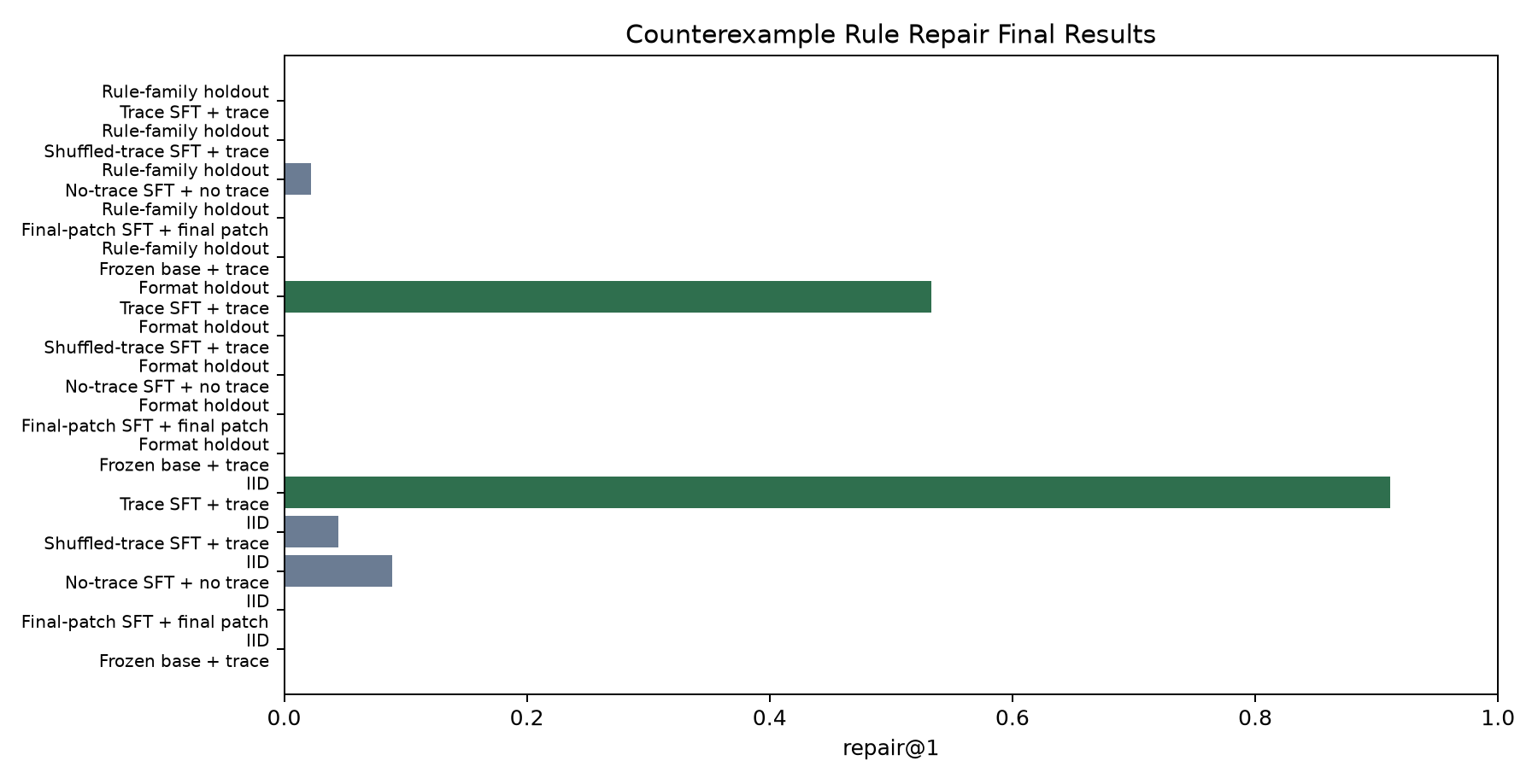
Bars grouped by test set: familiar tasks, familiar rules shown in a new format, and a brand-new rule type. Each colored bar is one training setup; bar height is the share of bugs fully fixed, taller is better.
Takeaway → Only the model trained on real failing examples rises high on familiar tasks and holds about half on the new format; every other setup hugs the floor, and all sit at or near zero on the brand-new rule.
Data table
| Validation split | frozen base + trace | final-patch SFT | no-trace SFT | shuffled-trace SFT + trace | trace SFT + trace |
|---|---|---|---|---|---|
| IID | 0% | 0% | 8.9% | 4.4% | 91.1% |
| Format holdout | 0% | 0% | 0% | 0% | 53.3% |
| Rule-family holdout | 0% | 0% | 2.2% | 0% | 0% |
Numbers from report table (reports/counterexample_rule_repair_paper.md, Final Results); matches reports/final_core_results.csv
Technical framing
Repair success: only trace-trained SFT with real traces repairs the bug — Trace SFT with real counterexample traces hits 91% IID and 53% on format holdout; every control stays near zero, and no condition transfers to the withheld rule family.
How to read
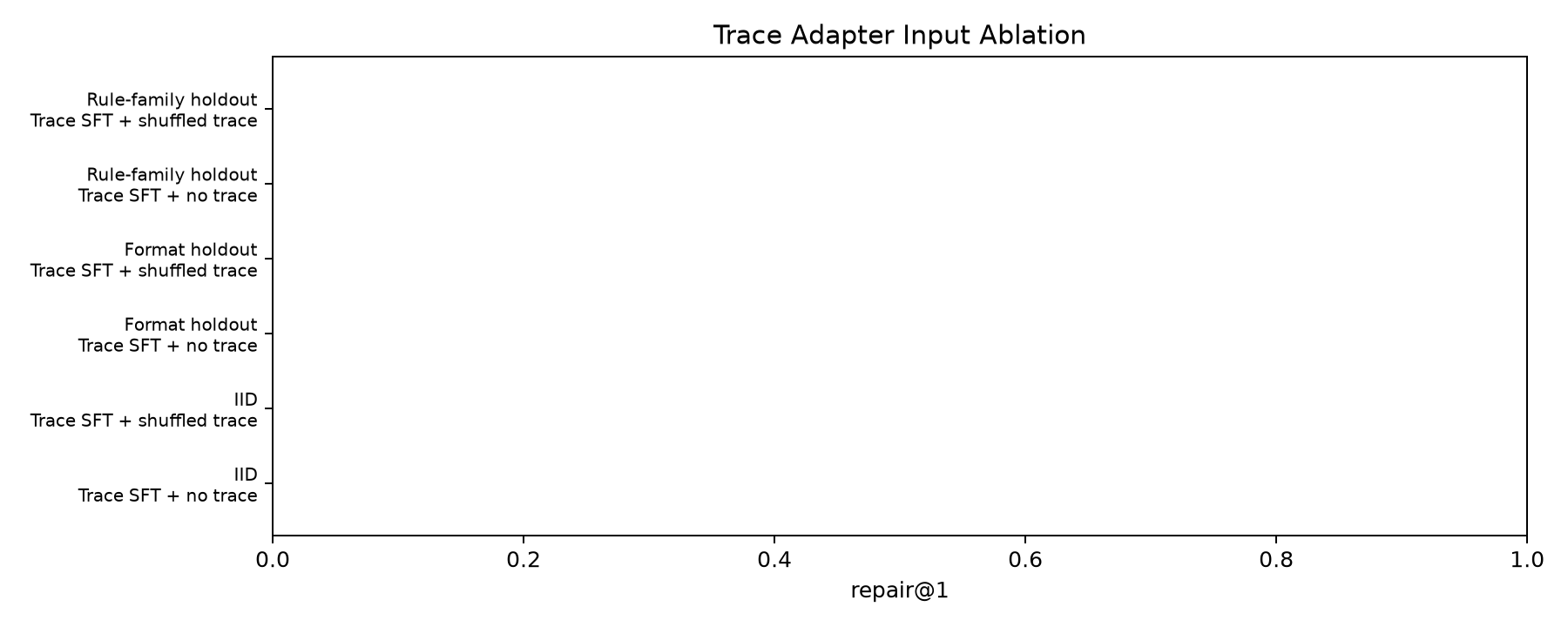
Bars grouped by test set; the three bars are the same trained model given the real failing examples, those examples removed, or those examples scrambled. Height is the share of bugs fixed, taller is better.
Takeaway → Only the real-examples bar has height; removing or scrambling the examples flattens it to zero, so the model is genuinely reading the evidence rather than reciting fixes.
Data table
| Validation split | real trace | trace removed | shuffled trace |
|---|---|---|---|
| IID | 91.1% | 0% | 0% |
| Format holdout | 53.3% | 0% | 0% |
| Rule-family holdout | 0% | 0% | 0% |
Technical framing
Trace adapter ablation: the trace input, not the adapter alone, carries the signal — The same trace-trained adapter drops from 91% to 0% when the failed-test trace is removed or shuffled: it is reading the counterexamples, not memorizing patches.
How to read
Bars grouped by rule type: arithmetic, text-formatting, threshold-labeling. Two colors compare familiar tasks against the same rules shown in a new format; height is the share of bugs fixed, taller is better.
Takeaway → Threshold-labeling rules stay fully fixed in both formats and text-formatting mostly holds, but the arithmetic family collapses from largely fixed to zero once the format changes.
Data table
| Rule family | IID | Format holdout |
|---|---|---|
| affine_int | 73.3% | 0% |
| slug_affix | 100% | 60% |
| threshold_label | 100% | 100% |
Technical framing
Trace SFT repair rate by rule family — Format-holdout transfer varies by family (threshold rules fully transfer, affine ones collapse); the withheld parity_offset family is 0/45 everywhere.
How to read
Paired bars for each training setup on familiar tasks; one color is the share of patches well-formed enough to apply, the other the share that actually fixed the bug. Taller is better for both.
Takeaway → Nearly every trained setup produces applicable patches, but only the model trained on real failing examples turns them into correct fixes; the rest apply cleanly yet fix almost nothing.
Data table
| Condition | Patch apply rate | Repair@1 |
|---|---|---|
| Frozen base + trace | 4.4% | 0% |
| Final-patch SFT | 100% | 0% |
| No-trace SFT | 100% | 8.9% |
| Shuffled-trace SFT | 100% | 4.4% |
| Trace SFT + trace | 100% | 91.1% |
Numbers from experiments/counterexample_rule_repair/reports/final_core_results.csv
Technical framing
Patch format vs actual repair: SFT fixes syntax, only traces fix semantics — Every SFT variant learns to emit perfectly applicable patches, but only trace-trained SFT turns applicable patches into correct repairs.
How to read
One bar per model on a small check set: no training, a small quick training run, then a larger, longer one. Height is the share of bugs fixed, taller is better.
Takeaway → The bar climbs from zero with no training, to just under half with the small run, to most bugs fixed with the larger run, so more data and passes roughly double the rate.
Data table
| Model | Repair@1 |
|---|---|
| Frozen base (6 records) | 0% |
| Pilot trace adapter, rank 16 (20 records) | 45% |
| Full trace adapter, rank 32 (20 records) | 85% |
Numbers from experiments/counterexample_rule_repair/reports/pilot_results.csv
Technical framing
Training budget matters: 90 examples x 1 epoch vs 240 x 3 epochs — A 90-example one-epoch pilot already reaches 45% repair; scaling to 240 examples, 3 epochs, rank 32 nearly doubles it to 85%.
In the author’s words from the Report · “Abstract”
This experiment tests whether a code-repair model can use failed-test counterexamples as evidence for a compact behavioral rule. Each task presents a wrong-patched implementation and visible pytest failures that print concrete input, expected output, and actual output triples. The desired rule is not stated in the issue text. A correct patch must infer the rule from visible counterexamples and pass hidden tests on unseen inputs.
Overview
This directory contains the small, download-friendly artifacts for a standalone counterexample-to-rule repair experiment.
Large generated artifacts such as model adapters and checkpoints are stored separately in:
/workspace/large_artifacts/counterexample_rule_repair/
Contents
configs/: experiment configuration.data/: generated JSONL datasets and dataset manifest.figures/: report figures generated byscripts/make_report.py.logs/: detailed experiment log.reports/: pilot results, final evaluation JSON, CSV summaries, and final paper.scripts/: dataset builder, evaluator, final evaluation runner, and report generator.
Main Report
Read reports/counterexample_rule_repair_paper.md after final report generation.
Large Artifacts
Adapters and checkpoints live in:
/workspace/large_artifacts/counterexample_rule_repair/models/
Do not include that directory when downloading only the small package.
Report
Rendered from reports/counterexample_rule_repair_paper.md
Generated: 2026-06-20 20:16:10 UTC.
Abstract
This experiment tests whether a code-repair model can use failed-test counterexamples as evidence for a compact behavioral rule. Each task presents a wrong-patched implementation and visible pytest failures that print concrete input, expected output, and actual output triples. The desired rule is not stated in the issue text. A correct patch must infer the rule from visible counterexamples and pass hidden tests on unseen inputs.
Artifact Layout
- Small, download-friendly experiment package:
/workspace/experiments/counterexample_rule_repair. - Large adapters and checkpoints:
/workspace/large_artifacts/counterexample_rule_repair. - The small package contains configs, data JSONL files, reports, figures, scripts, and logs.
- The large artifact directory contains LoRA adapters and is excluded from the small package.
Dataset
- Train records:
240. - IID validation records:
45. - Format-holdout validation records:
45. - Rule-family-holdout validation records:
45. - Train families:
affine_int, slug_affix, threshold_label. - Withheld rule families:
parity_offset_holdout. - Dataset seed:
20260620. - Invariants: wrong-patched implementation fails visible counterexamples; target corrective diff applies to the wrong-patched implementation; target implementation passes visible and hidden tests; hidden test inputs do not overlap visible trace inputs; visible expected outputs appear in the failed execution trace.
Each record contains src/repair_target.py, visible tests, hidden tests, the failed trace from the wrong-patched implementation, and the target corrective diff. The visible trace emits COUNTEREXAMPLE input=... expected=... actual=... lines. Hidden cases are disjoint from visible inputs, so copying only the visible cases is insufficient.
Model and Training
- Base model:
Qwen/Qwen2.5-Coder-3B-Instruct. - Revision:
488639f1ff808d1d3d0ba301aef8c11461451ec5. - Training method: QLoRA adapters.
- Final training recipe: 3 epochs, rank 32, alpha 64, dropout 0.05, learning rate 1.5e-4, max length 3072.
- Decoding: deterministic generation with
max_new_tokens=256for final evaluations.
| Adapter | Mode | Shuffled | Rank | Alpha | Dropout | Epochs | LR | Max length | Train records | Eval records |
|---|---|---|---|---|---|---|---|---|---|---|
| final_patch_lora | final_patch | False | 32 | 64 | 0.05 | 3.0 | 0.00015 | 3072 | 240 | 45 |
| no_trace_lora | no_trace | False | 32 | 64 | 0.05 | 3.0 | 0.00015 | 3072 | 240 | 45 |
| pilot_trace_lora | trace | False | 16 | 32 | 0.05 | 1.0 | 0.0002 | 3072 | 90 | 45 |
| shuffled_trace_lora | trace | True | 32 | 64 | 0.05 | 3.0 | 0.00015 | 3072 | 240 | 45 |
| trace_lora | trace | False | 32 | 64 | 0.05 | 3.0 | 0.00015 | 3072 | 240 | 45 |
Conditions
Frozen base + trace: base model with the wrong-patched file and failed trace, no fine-tuning.Trace SFT + trace: adapter trained and evaluated with failed counterexample traces.No-trace SFT + no trace: adapter trained and evaluated without failed trace text.Shuffled-trace SFT + trace: adapter trained on mismatched trace evidence, evaluated with the real trace.Final-patch SFT + final patch: adapter trained to reproduce final diffs from the original buggy state rather than repair from the wrong-patched state.Trace SFT + no traceandTrace SFT + shuffled trace: input ablations for the trace adapter.
Metrics
Repair@1: the generated diff applies and repaired files pass both visible and hidden tests.Visible pass: repaired files pass the visible counterexample tests.Hidden pass: repaired files pass hidden tests on unseen inputs.Patch apply: the generated unified diff applies to the intended file state.Marker match: the diff contains all target rule markers recorded by the dataset builder.Input literal: the diff contains at least one visible input literal, a diagnostic for hardcoding visible cases.
Iteration Log Summary
| Condition | Repair@1 | Visible pass | Hidden pass | Patch apply | Successes |
|---|---|---|---|---|---|
| Frozen base + trace, 6 IID | 0.0% | 0.0% | missing | 16.7% | 0/6 |
| Pilot trace adapter + trace, 20 IID | 45.0% | 45.0% | 65.0% | 100.0% | 9/20 |
| Pilot trace adapter + no trace, 20 IID | 0.0% | 0.0% | 0.0% | 100.0% | 0/20 |
| Pilot trace adapter + shuffled trace, 20 IID | 0.0% | 0.0% | 0.0% | 100.0% | 0/20 |
| Full trace adapter + trace, 20 IID check | 85.0% | 85.0% | 85.0% | 100.0% | 17/20 |
The initial frozen pilot showed near-zero patch application and no successful repairs. A small trace adapter made the task learnable, while no-trace and shuffled-trace prompts remained at zero repair. The full trace adapter then improved the 20-record IID check enough to justify training the full control adapters.
Final Results
| Split | Condition | Repair@1 | Visible pass | Hidden pass | Patch apply | Marker match | Input literal | Successes |
|---|---|---|---|---|---|---|---|---|
| IID | Frozen base + trace | 0.0% | 0.0% | 0.0% | 4.4% | 2.2% | 48.9% | 0/45 |
| IID | Final-patch SFT + final patch | 0.0% | 0.0% | 0.0% | 100.0% | 17.8% | 64.4% | 0/45 |
| IID | No-trace SFT + no trace | 8.9% | 8.9% | 8.9% | 100.0% | 22.2% | 53.3% | 4/45 |
| IID | Shuffled-trace SFT + trace | 4.4% | 4.4% | 4.4% | 100.0% | 17.8% | 53.3% | 2/45 |
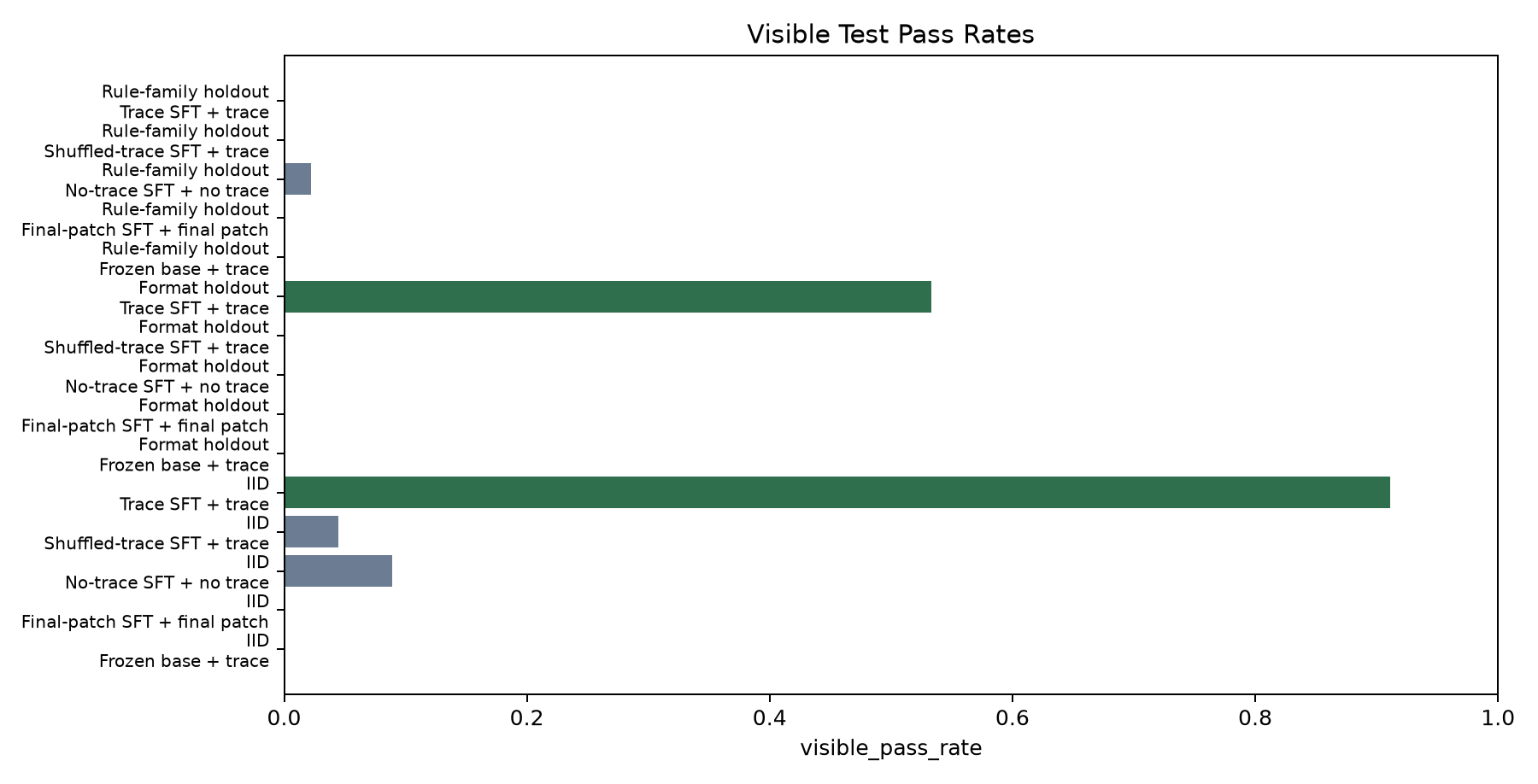
| IID | Trace SFT + trace | 91.1% | 91.1% | 91.1% | 100.0% | 95.6% | 55.6% | 41/45 |
| Format holdout | Frozen base + trace | 0.0% | 0.0% | 0.0% | 0.0% | 0.0% | 48.9% | 0/45 |
| Format holdout | Final-patch SFT + final patch | 0.0% | 0.0% | 0.0% | 100.0% | 0.0% | 42.2% | 0/45 |
| Format holdout | No-trace SFT + no trace | 0.0% | 0.0% | 0.0% | 100.0% | 0.0% | 62.2% | 0/45 |
| Format holdout | Shuffled-trace SFT + trace | 0.0% | 0.0% | 0.0% | 100.0% | 0.0% | 60.0% | 0/45 |
| Format holdout | Trace SFT + trace | 53.3% | 53.3% | 53.3% | 100.0% | 68.9% | 66.7% | 24/45 |
| Rule-family holdout | Frozen base + trace | 0.0% | 0.0% | 0.0% | 0.0% | 0.0% | 100.0% | 0/45 |
| Rule-family holdout | Final-patch SFT + final patch | 0.0% | 0.0% | 0.0% | 100.0% | 0.0% | 100.0% | 0/45 |
| Rule-family holdout | No-trace SFT + no trace | 2.2% | 2.2% | 2.2% | 100.0% | 2.2% | 100.0% | 1/45 |
| Rule-family holdout | Shuffled-trace SFT + trace | 0.0% | 0.0% | 0.0% | 100.0% | 2.2% | 100.0% | 0/45 |
| Rule-family holdout | Trace SFT + trace | 0.0% | 0.0% | 0.0% | 100.0% | 6.7% | 100.0% | 0/45 |
Trace Adapter Ablations
| Split | Condition | Repair@1 | Visible pass | Hidden pass | Patch apply | Marker match | Input literal | Successes |
|---|---|---|---|---|---|---|---|---|
| IID | Trace SFT + no trace | 0.0% | 0.0% | 0.0% | 100.0% | 11.1% | 53.3% | 0/45 |
| IID | Trace SFT + shuffled trace | 0.0% | 0.0% | 0.0% | 100.0% | 8.9% | 53.3% | 0/45 |
| Format holdout | Trace SFT + no trace | 0.0% | 0.0% | 0.0% | 100.0% | 0.0% | 57.8% | 0/45 |
| Format holdout | Trace SFT + shuffled trace | 0.0% | 0.0% | 0.0% | 100.0% | 0.0% | 55.6% | 0/45 |
| Rule-family holdout | Trace SFT + no trace | 0.0% | 0.0% | 0.0% | 100.0% | 0.0% | 100.0% | 0/45 |
| Rule-family holdout | Trace SFT + shuffled trace | 0.0% | 0.0% | 0.0% | 100.0% | 2.2% | 100.0% | 0/45 |
Trace Adapter Family Breakdown
| Condition | Family | Repair@1 | Visible pass | Hidden pass | Successes |
|---|---|---|---|---|---|
| Trace SFT + trace / IID | affine_int | 73.3% | 73.3% | 73.3% | 11/15 |
| Trace SFT + trace / IID | slug_affix | 100.0% | 100.0% | 100.0% | 15/15 |
| Trace SFT + trace / IID | threshold_label | 100.0% | 100.0% | 100.0% | 15/15 |
| Trace SFT + trace / Format holdout | affine_int | 0.0% | 0.0% | 0.0% | 0/15 |
| Trace SFT + trace / Format holdout | slug_affix | 60.0% | 60.0% | 60.0% | 9/15 |
| Trace SFT + trace / Format holdout | threshold_label | 100.0% | 100.0% | 100.0% | 15/15 |
| Trace SFT + trace / Rule-family holdout | parity_offset_holdout | 0.0% | 0.0% | 0.0% | 0/45 |
Figures
Qualitative Examples
Trace-conditioned IID success
- Episode:
val_iid_threshold_0002::counterexample_rule. - Family:
threshold_label. - Outcome: patch_applied=
True, visible_passed=True, hidden_passed=True.
Visible counterexamples:
f"COUNTEREXAMPLE input={value!r} expected={expected!r} actual={actual!r}"
E       AssertionError: COUNTEREXAMPLE input=7 expected='LOW_DYNF' actual='BADL_1KL8'
E         COUNTEREXAMPLE input=8 expected='LOW_DYNF' actual='BADL_1KL8'
E         COUNTEREXAMPLE input=9 expected='HIGH_C68M' actual='BADL_1KL8'
E         COUNTEREXAMPLE input=11 expected='HIGH_C68M' actual='BADH_BTX1'
E       assert not ["COUNTEREXAMPLE input=7 expected='LOW_DYNF' actual='BADL_1KL8'", "COUNTEREXAMPLE input=8 expected='LOW_DYNF' actual='...LE input=9 expected='HIGH_C68M' actual='BADL_1KL8'", "COUNTEREXAMPLE input=11 expected='HIGH_C68M' actual='BADH_BTX1'"]
FAILED tests/test_visible.py::test_visible_counterexamples - AssertionError: COUNTEREXAMPLE input=7 expected='LOW_DYNF' actual='BADL_1KL8'
Generated diff:
--- a/src/repair_target.py
+++ b/src/repair_target.py
@@ -2,6 +2,6 @@


 def apply_rule(value):
-    if value < 11:
-        return "BADL_1KL8"
-    return "BADH_BTX1"
+    if value < 9:
+        return "LOW_DYNF"
+    return "HIGH_C68M"
Trace-conditioned format-holdout success
- Episode:
val_format_holdout_slug_0003::counterexample_rule. - Family:
slug_affix. - Outcome: patch_applied=
True, visible_passed=True, hidden_passed=True.
Visible counterexamples:
f"COUNTEREXAMPLE input={value!r} expected={expected!r} actual={actual!r}"
E       AssertionError: COUNTEREXAMPLE input='  Alpha Beta  ' expected='pre:ckmalpha.beta:doneje' actual='WP_8SSCalpha/beta_WSW7JH'
E         COUNTEREXAMPLE input='MIXED_case Word' expected='pre:ckmmixed.case.word:doneje' actual='WP_8SSCmixed/case/word_WSW7JH'
E         COUNTEREXAMPLE input='two   spaces' expected='pre:ckmtwo.spaces:doneje' actual='WP_8SSCtwo/spaces_WSW7JH'
E       assert not ["COUNTEREXAMPLE input='  Alpha Beta  ' expected='pre:ckmalpha.beta:doneje' actual='WP_8SSCalpha/beta_WSW7JH'", "COUNT..._WSW7JH'", "COUNTEREXAMPLE input='two   spaces' expected='pre:ckmtwo.spaces:doneje' actual='WP_8SSCtwo/spaces_WSW7JH'"]
FAILED tests/test_visible.py::test_visible_counterexamples - AssertionError: COUNTEREXAMPLE input='  Alpha Beta  ' expected='pre:ckmalpha.beta:doneje' actual='WP_8SSCalpha/beta_WSW7JH'
Generated diff:
--- a/src/repair_target.py
+++ b/src/repair_target.py
@@ -4,5 +4,5 @@
 def apply_rule(value):
     text = str(value).strip().lower().replace("_", " ")
     pieces = [piece for piece in text.split() if piece]
-    body = "/".join(pieces)
-    return "WP_8SSC" + body + "_WSW7JH"
+    body = ".".join(pieces)
+    return "pre:ckm" + body + ":doneje"
Withheld-rule-family trace-conditioned example
- Episode:
val_rule_holdout_parity_0027::counterexample_rule. - Family:
parity_offset_holdout. - Outcome: patch_applied=
True, visible_passed=False, hidden_passed=False.
Visible counterexamples:
f"COUNTEREXAMPLE input={value!r} expected={expected!r} actual={actual!r}"
E       AssertionError: COUNTEREXAMPLE input=0 expected=4 actual=2
E         COUNTEREXAMPLE input=1 expected=12 actual=9
E         COUNTEREXAMPLE input=4 expected=8 actual=6
E         COUNTEREXAMPLE input=7 expected=18 actual=15
E       assert not ['COUNTEREXAMPLE input=0 expected=4 actual=2', 'COUNTEREXAMPLE input=1 expected=12 actual=9', 'COUNTEREXAMPLE input=4 expected=8 actual=6', 'COUNTEREXAMPLE input=7 expected=18 actual=15']
FAILED tests/test_visible.py::test_visible_counterexamples - AssertionError: COUNTEREXAMPLE input=0 expected=4 actual=2
Generated diff:
--- a/src/repair_target.py
+++ b/src/repair_target.py
@@ -2,6 +2,6 @@


 def apply_rule(value):
-    if value % 2 == 0:
-        return value + 2
-    return value + 8
+    if value % 2 == 0:
+        return value + 4
+    return value + 6
Trace adapter with trace removed
- Episode:
val_iid_threshold_0002::counterexample_rule. - Family:
threshold_label. - Outcome: patch_applied=
True, visible_passed=False, hidden_passed=False.
Visible counterexamples:
f"COUNTEREXAMPLE input={value!r} expected={expected!r} actual={actual!r}"
E       AssertionError: COUNTEREXAMPLE input=7 expected='LOW_DYNF' actual='BADL_1KL8'
E         COUNTEREXAMPLE input=8 expected='LOW_DYNF' actual='BADL_1KL8'
E         COUNTEREXAMPLE input=9 expected='HIGH_C68M' actual='BADL_1KL8'
E         COUNTEREXAMPLE input=11 expected='HIGH_C68M' actual='BADH_BTX1'
E       assert not ["COUNTEREXAMPLE input=7 expected='LOW_DYNF' actual='BADL_1KL8'", "COUNTEREXAMPLE input=8 expected='LOW_DYNF' actual='...LE input=9 expected='HIGH_C68M' actual='BADL_1KL8'", "COUNTEREXAMPLE input=11 expected='HIGH_C68M' actual='BADH_BTX1'"]
FAILED tests/test_visible.py::test_visible_counterexamples - AssertionError: COUNTEREXAMPLE input=7 expected='LOW_DYNF' actual='BADL_1KL8'
Generated diff:
--- a/src/repair_target.py
+++ b/src/repair_target.py
@@ -2,6 +2,6 @@


 def apply_rule(value):
-    if value < 11:
-        return "BADL_1KL8"
-    return "BADH_BTX1"
+    if value < 7:
+        return "BADL_1KL8"
+    return "BADH_BTX1"
Trace adapter with shuffled trace
- Episode:
val_iid_threshold_0002::counterexample_rule. - Family:
threshold_label. - Outcome: patch_applied=
True, visible_passed=False, hidden_passed=False.
Visible counterexamples:
f"COUNTEREXAMPLE input={value!r} expected={expected!r} actual={actual!r}"
E       AssertionError: COUNTEREXAMPLE input=7 expected='LOW_DYNF' actual='BADL_1KL8'
E         COUNTEREXAMPLE input=8 expected='LOW_DYNF' actual='BADL_1KL8'
E         COUNTEREXAMPLE input=9 expected='HIGH_C68M' actual='BADL_1KL8'
E         COUNTEREXAMPLE input=11 expected='HIGH_C68M' actual='BADH_BTX1'
E       assert not ["COUNTEREXAMPLE input=7 expected='LOW_DYNF' actual='BADL_1KL8'", "COUNTEREXAMPLE input=8 expected='LOW_DYNF' actual='...LE input=9 expected='HIGH_C68M' actual='BADL_1KL8'", "COUNTEREXAMPLE input=11 expected='HIGH_C68M' actual='BADH_BTX1'"]
FAILED tests/test_visible.py::test_visible_counterexamples - AssertionError: COUNTEREXAMPLE input=7 expected='LOW_DYNF' actual='BADL_1KL8'
Generated diff:
--- a/src/repair_target.py
+++ b/src/repair_target.py
@@ -2,6 +2,6 @@


 def apply_rule(value):
-    if value < 11:
-        return "BADL_1KL8"
-    return "BADH_BTX1"
+    if value == '  Alpha Beta  ':
+        return "P_512Talpha+beta_SX05E"
+    return "P_512Ttwo+spaces_SX05E"
Discussion
The core contrast is whether the model can transform failed counterexample traces into a general rule rather than merely producing syntactically plausible diffs. The visible and hidden pass split is important: a patch can sometimes satisfy hidden cases while violating visible counterexamples, so the primary metric requires both. The rule-family holdout is a harder extrapolation test because the parity-offset structure is absent from training.
Limitations
- The tasks are synthetic and intentionally focused on one-file rule repair.
- The experiment measures greedy single-sample repair, not sampling-based pass rates.
- Hidden tests are generated from known templates, so they are controlled probes rather than open-ended software behavior.
- The withheld rule family tests structural transfer to one unseen family only.
Reproducibility
Dataset build:
python experiments/counterexample_rule_repair/scripts/build_counterexample_dataset.py --output-dir experiments/counterexample_rule_repair/data --train-per-family 80 --iid-per-family 15 --format-per-family 15 --rule-holdout 45 --seed 20260620Final evaluations:
python experiments/counterexample_rule_repair/scripts/run_final_evaluations.py --suite all --max-new-tokens 256Report generation:
python experiments/counterexample_rule_repair/scripts/make_report.pyExperiment log 11
Show the running log (11 entries, 2026-06-20)
2026-06-20 Setup
Objective: design and run a standalone counterexample-to-rule repair experiment where the failed execution trace contains concrete examples of the desired behavior, and hidden tests require applying the inferred rule to new inputs.
Directory policy:
- Small, downloadable experiment package:
/workspace/experiments/counterexample_rule_repair/. - Large artifacts excluded from the small package:
/workspace/large_artifacts/counterexample_rule_repair/. - Model adapters and checkpoints go under
large_artifacts/counterexample_rule_repair/models/. - Reports, logs, configs, figures, and compact JSON/JSONL result summaries go under
experiments/counterexample_rule_repair/.
Initial hypothesis:
A repair model trained on wrong patched state + failed execution counterexamples -> corrective diff will outperform no-trace and shuffled-trace controls when the correct fix requires inferring a compact rule from visible counterexamples and then passing hidden tests on unseen inputs.
Design constraints:
- The paper and artifacts must be standalone.
- The expected rule parameters must not appear in the issue text.
- The visible trace must contain enough counterexamples to infer the rule.
- Hidden tests must require generalization beyond the visible counterexamples.
2026-06-20 Dataset Design
Primary task shape:
- Each record contains one production file,
src/repair_target.py, with anapply_rule(value)function. - The issue text says the validator rule is not stated and must be inferred from failed-test counterexamples.
- The wrong-patched implementation is a compact but incorrect rule.
- The failed visible test emits
COUNTEREXAMPLE input=... expected=... actual=...lines. - The target corrective diff patches the implementation into a compact rule.
- Hidden tests use inputs that are not present in the visible trace, so a patch that hardcodes only visible counterexamples should fail.
Train and IID/format-holdout families:
affine_int: infer a linear integer rule from numeric counterexamples.threshold_label: infer a threshold and two output labels from boundary counterexamples.slug_affix: infer string affixes and separator while preserving slug normalization behavior.
Rule-family holdout:
parity_offset_holdout: infer separate offsets for even and odd inputs. This family is withheld from training.
Validation performed by the builder:
- The wrong patch fails visible tests.
- The target corrective diff applies to the wrong-patched implementation.
- The repaired implementation passes visible and hidden tests.
- The repaired implementation compiles.
- Hidden test inputs do not overlap visible trace inputs.
- Visible expected outputs appear in the failed execution trace.
Smoke build:
- A 14-record smoke dataset passed all builder invariants.
- Inspected affine and threshold examples confirmed that visible counterexamples are present in trace output and hidden examples require unseen inputs.
2026-06-20 Full Dataset Build
Command:
python experiments/counterexample_rule_repair/scripts/build_counterexample_dataset.py --output-dir experiments/counterexample_rule_repair/data --train-per-family 80 --iid-per-family 15 --format-per-family 15 --rule-holdout 45 --seed 20260620
Result:
- Train: 240 records.
- IID validation: 45 records.
- Format-holdout validation: 45 records.
- Rule-family-holdout validation: 45 records.
- All records: 375.
- Data directory size: about 4.3 MB.
Validation split composition:
- IID: 15
affine_int, 15threshold_label, 15slug_affix. - Format holdout: 15
affine_int, 15threshold_label, 15slug_affix, with shifted numeric ranges and different string-token formats. - Rule-family holdout: 45
parity_offset_holdoutrecords.
All builder invariants passed.
2026-06-20 Frozen Pilot
Command:
python experiments/counterexample_rule_repair/scripts/eval_counterexample_rule.py --data experiments/counterexample_rule_repair/data/repair_val_iid.jsonl --output experiments/counterexample_rule_repair/reports/frozen_trace_iid_pilot6.json --condition trace --max-records 6 --max-new-tokens 256
Result:
- Model:
Qwen/Qwen2.5-Coder-3B-Instruct, revision488639f1ff808d1d3d0ba301aef8c11461451ec5. - Records: 6 IID validation examples.
- Repair@1: 0/6.
- Visible pass rate: 0/6.
- Patch apply rate: 1/6.
- Target-added-line match rate: 0/6.
Observed failure mode:
- The frozen model often generated diffs against the original placeholder implementation rather than the wrong-patched state.
- When a patch applied, it preserved wrong constants rather than deriving the target rule from counterexamples.
Next step:
- Train a small trace-conditioned pilot adapter on 90 training records for one epoch, then evaluate trace, no-trace, and shuffled-trace behavior.
2026-06-20 Trace Pilot Training and Controls
Training command:
python scripts/train_repair_lora.py --train experiments/counterexample_rule_repair/data/repair_train.jsonl --eval experiments/counterexample_rule_repair/data/repair_val_iid.jsonl --mode trace --model-id Qwen/Qwen2.5-Coder-3B-Instruct --revision 488639f1ff808d1d3d0ba301aef8c11461451ec5 --output-dir large_artifacts/counterexample_rule_repair/models/pilot_trace_lora --max-length 3072 --epochs 1 --lr 2e-4 --rank 16 --alpha 32 --dropout 0.05 --grad-accum 8 --save-steps 20 --eval-steps 20 --max-train-records 90
Training observations:
- Trainable parameters: 29,933,568, about 0.96% of the model.
- Training took about 57 seconds.
- Train loss:
0.09427. - Eval loss on all 45 IID validation records:
0.03152.
Evaluation metric correction:
- Initial pilot inspection showed that hidden-only pass can overstate success when a patch passes unseen hidden inputs but fails visible counterexamples.
- Updated evaluator so
repair@1requires both visible and hidden tests to pass. - Added
hidden_pass_rateas a separate diagnostic.
Pilot evaluations, all on the first 20 IID validation records:
- Frozen base + trace: 0/6 in the earlier smoke pilot.
- Pilot trace adapter + trace: 9/20 repair@1, 20/20 patch apply, 20/20 syntax valid.
- Pilot trace adapter + no trace: 0/20 repair@1, 20/20 patch apply, 20/20 syntax valid.
- Pilot trace adapter + shuffled trace: 0/20 repair@1, 20/20 patch apply, 20/20 syntax valid.
Per-family trace pilot notes:
slug_affix: 4/5 repair@1.threshold_label: 4/8 repair@1; several failures were off-by-one thresholds that passed hidden examples but failed visible counterexamples.affine_int: 1/7 repair@1; arithmetic inference from counterexamples is the hardest family.
Decision:
- The pilot establishes a causal trace contrast but is not saturated.
- Proceed to a stronger full trace adapter first: all 240 train records, 3 epochs, rank 32, alpha 64, max length 3072.
- Train the full control adapters after confirming the stronger trace adapter improves.
2026-06-20 Full Trace Adapter
Training command:
python scripts/train_repair_lora.py --train experiments/counterexample_rule_repair/data/repair_train.jsonl --eval experiments/counterexample_rule_repair/data/repair_val_iid.jsonl --mode trace --model-id Qwen/Qwen2.5-Coder-3B-Instruct --revision 488639f1ff808d1d3d0ba301aef8c11461451ec5 --output-dir large_artifacts/counterexample_rule_repair/models/trace_lora --max-length 3072 --epochs 3 --lr 1.5e-4 --rank 32 --alpha 64 --dropout 0.05 --grad-accum 8 --save-steps 30 --eval-steps 30
Training observations:
- Trainable parameters: 59,867,136, about 1.90% of the model.
- Training took about 422 seconds.
- Final train loss:
0.01636. - Final IID eval loss:
0.004355.
Sanity evaluation command:
python experiments/counterexample_rule_repair/scripts/eval_counterexample_rule.py --data experiments/counterexample_rule_repair/data/repair_val_iid.jsonl --output experiments/counterexample_rule_repair/reports/full_trace_iid20_check.json --condition trace --adapter large_artifacts/counterexample_rule_repair/models/trace_lora --max-records 20 --max-new-tokens 256
Result:
- Records: 20 IID validation examples.
- Repair@1: 17/20.
- Visible pass rate: 17/20.
- Hidden pass rate: 17/20.
- Patch apply rate: 20/20.
- Syntax valid rate: 20/20.
Per-family sanity notes:
slug_affix: 5/5 repair@1.threshold_label: 8/8 repair@1.affine_int: 4/7 repair@1.
Decision:
- The full trace adapter is strong enough to justify the full control suite.
- Use the same model, revision, LoRA rank, alpha, dropout, epochs, learning rate, and max length for the no-trace, shuffled-trace, and final-patch controls.
2026-06-20 Full Control Adapter Training
No-trace training command:
python scripts/train_repair_lora.py --train experiments/counterexample_rule_repair/data/repair_train.jsonl --eval experiments/counterexample_rule_repair/data/repair_val_iid.jsonl --mode no_trace --model-id Qwen/Qwen2.5-Coder-3B-Instruct --revision 488639f1ff808d1d3d0ba301aef8c11461451ec5 --output-dir large_artifacts/counterexample_rule_repair/models/no_trace_lora --max-length 3072 --epochs 3 --lr 1.5e-4 --rank 32 --alpha 64 --dropout 0.05 --grad-accum 8 --save-steps 30 --eval-steps 30
No-trace result:
- Trainable parameters: 59,867,136, about 1.90% of the model.
- Training took about 422 seconds.
- Final train loss:
0.2545. - Final IID eval loss:
0.2151.
Shuffled-trace training command:
python scripts/train_repair_lora.py --train experiments/counterexample_rule_repair/data/repair_train.jsonl --eval experiments/counterexample_rule_repair/data/repair_val_iid.jsonl --mode trace --shuffle-traces --model-id Qwen/Qwen2.5-Coder-3B-Instruct --revision 488639f1ff808d1d3d0ba301aef8c11461451ec5 --output-dir large_artifacts/counterexample_rule_repair/models/shuffled_trace_lora --max-length 3072 --epochs 3 --lr 1.5e-4 --rank 32 --alpha 64 --dropout 0.05 --grad-accum 8 --save-steps 30 --eval-steps 30
Shuffled-trace result:
- Trainable parameters: 59,867,136, about 1.90% of the model.
- Training took about 417 seconds.
- Final train loss:
0.2538. - Final IID eval loss:
0.2106.
Final-patch training command:
python scripts/train_repair_lora.py --train experiments/counterexample_rule_repair/data/repair_train.jsonl --eval experiments/counterexample_rule_repair/data/repair_val_iid.jsonl --mode final_patch --model-id Qwen/Qwen2.5-Coder-3B-Instruct --revision 488639f1ff808d1d3d0ba301aef8c11461451ec5 --output-dir large_artifacts/counterexample_rule_repair/models/final_patch_lora --max-length 3072 --epochs 3 --lr 1.5e-4 --rank 32 --alpha 64 --dropout 0.05 --grad-accum 8 --save-steps 30 --eval-steps 30
Final-patch result:
- Trainable parameters: 59,867,136, about 1.90% of the model.
- Training took about 426 seconds.
- Final train loss:
0.3666. - Final IID eval loss:
0.2827.
Interpretation before final evaluations:
- The trace adapter fit the supervised target much more closely than the no-trace, shuffled-trace, and final-patch controls.
- This does not prove repair success by itself, so the final comparison must use generated patches run against visible and hidden tests.
2026-06-20 Final Evaluation Plan
Evaluation runner:
python experiments/counterexample_rule_repair/scripts/run_final_evaluations.py --suite all --max-new-tokens 256
Planned splits:
- IID validation: 45 records from the training rule families.
- Format holdout: 45 records from the training rule families with shifted numeric ranges and token formats.
- Rule-family holdout: 45
parity_offset_holdoutrecords, with the family absent from training.
Core conditions:
- Frozen base + trace.
- Final-patch SFT + final patch.
- No-trace SFT + no trace.
- Shuffled-trace SFT + trace.
- Trace SFT + trace.
Trace-adapter input ablations:
- Trace SFT + no trace.
- Trace SFT + shuffled trace.
2026-06-20 Final Evaluation Results
Final evaluation command:
python experiments/counterexample_rule_repair/scripts/run_final_evaluations.py --suite all --max-new-tokens 256
Result files:
- 21 final JSON result files were written to
experiments/counterexample_rule_repair/reports/final_*.json. - Each final JSON contains aggregate metrics plus per-record completions, extracted patches, patch-application status, syntax status, visible-test output, and hidden-test output.
Core results:
| Split | Frozen + trace | Final-patch SFT | No-trace SFT | Shuffled-trace SFT | Trace SFT + trace |
|---|---|---|---|---|---|
| IID | 0/45 | 0/45 | 4/45 | 2/45 | 41/45 |
| Format holdout | 0/45 | 0/45 | 0/45 | 0/45 | 24/45 |
| Rule-family holdout | 0/45 | 0/45 | 1/45 | 0/45 | 0/45 |
Trace adapter input ablations:
| Split | Trace SFT + no trace | Trace SFT + shuffled trace |
|---|---|---|
| IID | 0/45 | 0/45 |
| Format holdout | 0/45 | 0/45 |
| Rule-family holdout | 0/45 | 0/45 |
Family breakdown for Trace SFT + trace:
- IID:
affine_int11/15,slug_affix15/15,threshold_label15/15. - Format holdout:
affine_int0/15,slug_affix9/15,threshold_label15/15. - Rule-family holdout:
parity_offset_holdout0/45.
Interpretation:
- The aligned trace condition is the only condition with strong IID and format-holdout repair.
- Valid diff generation alone is not enough: final-patch, no-trace, shuffled-trace, and input-ablation conditions often reached 100% patch application while still failing visible and hidden tests.
- The trace adapter remained dependent on aligned trace evidence at inference time: removing or shuffling the trace reduced repair@1 to 0/45 on every split.
- The withheld
parity_offset_holdoutfamily did not transfer. The trace adapter generated applicable, syntactically valid diffs, but failed every visible and hidden test in that split.
2026-06-20 Report Generation
Report command:
python experiments/counterexample_rule_repair/scripts/make_report.py
Generated small-package report artifacts:
reports/counterexample_rule_repair_paper.mdreports/counterexample_rule_repair_summary.mdreports/final_core_results.csvreports/final_ablation_results.csvreports/final_trace_by_family.csvreports/pilot_results.csvfigures/core_repair_rates.pngfigures/trace_ablation_repair_rates.pngfigures/visible_pass_rates.pnglarge_artifacts_manifest.md
Artifact split:
- Small, download-friendly package:
experiments/counterexample_rule_repair/. - Large adapters/checkpoints:
large_artifacts/counterexample_rule_repair/models/. - The small package intentionally contains no model adapter files.
2026-06-20 Final Verification
Verification commands and outcomes:
- Script compilation passed:
python -m py_compile experiments/counterexample_rule_repair/scripts/build_counterexample_dataset.py experiments/counterexample_rule_repair/scripts/eval_counterexample_rule.py experiments/counterexample_rule_repair/scripts/run_final_evaluations.py experiments/counterexample_rule_repair/scripts/make_report.py scripts/train_repair_lora.py - Final result count: 21
reports/final_*.jsonfiles. Figure files are nonempty:
- Small-package size: about 9.9 MB.
- Large-artifact directory size: about 5.5 GB.
- No files larger than 50 MB were found under
experiments/counterexample_rule_repair/. - No
.safetensors,.bin,.pt, or.pthmodel-weight files were found underexperiments/counterexample_rule_repair/. - No active
train_repair_lora,run_final_evaluations, oreval_counterexample_ruleprocesses remained after the final sweep. - Removed generated
__pycache__and.ipynb_checkpointsdirectories from the small package. - Reference hygiene check found no stale references to unrelated experiment names in the counterexample-rule package.
Figures 3
Data files 3
Result tables and metrics copied from the experiment folder — preview inline or open the raw file.
reports/final_ablation_results.csv8.4 kBreports/final_core_results.csv21 kBreports/pilot_results.csv7.9 kB
Reproduce
Run steps are documented inside the experiment folder (README and scripts).