Qwen3.5-4B Code ABI Compiler Heldout Primitive Pilot
The one idea you need
Think of a fixed box of prebuilt code blocks, tuned so you can snap together solutions to a set of practice coding problems. Before teaching a small model to write programs from that box, first check: do the blocks even fit brand-new problems?
The question
Before training a small model to solve coding tasks by snapping together a fixed kit of prebuilt building blocks, can that kit actually express brand-new problems?
What we found
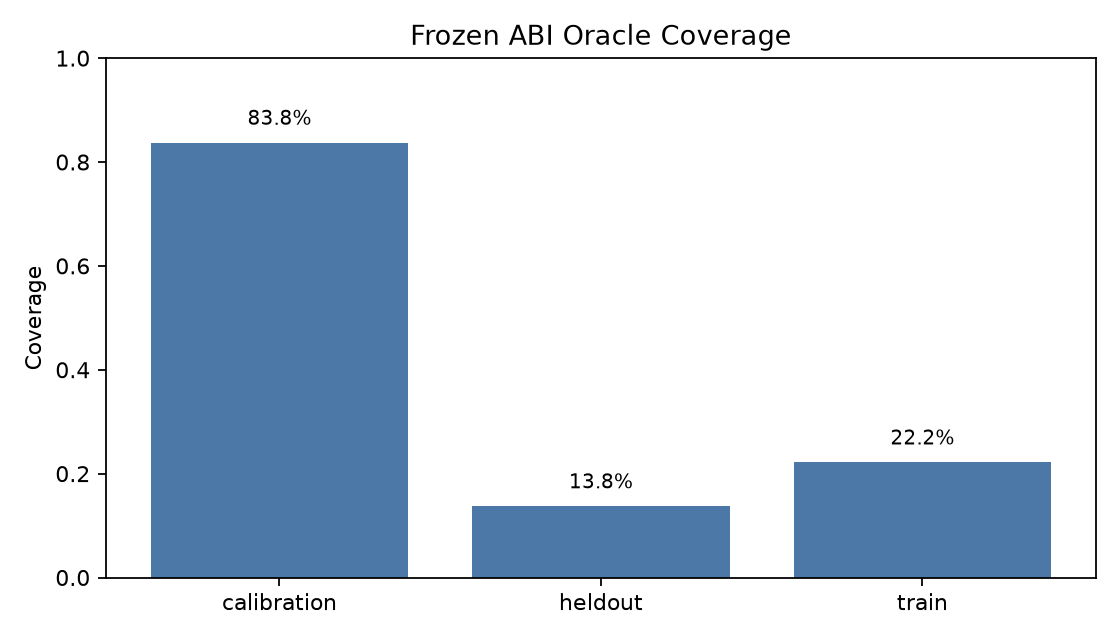
No. The block kit could build a working solution for 84% of the problems it was tuned against, but only 14% of brand-new ones — a 70-point collapse. Three fresh random batches of new problems all landed near 18%, so it wasn't bad luck. The kit was overfit to its own examples, so model training was skipped entirely.
Why it matters
Before spending compute to train a model on a reusable code library, first check how well it covers unseen problems. Build the blocks from a source independent of your test problems, or you will measure memorization dressed up as reuse.
On this page
Results at a glance 3
How to read
Bars group three problem sets: familiar practice, brand-new, and the training pool. First bar per group is the share of problems solved (taller is better); second bar is the share of answers that passed quick checks but were actually wrong (taller is worse).
Takeaway → Solving cliff-drops from a tall familiar bar to a stub on new problems, while the wrong-but-convincing bar leaps up — the kit both covers less and misleads more.
Data table
| MBPP split | oracle coverage | false-pass rate among visible-pass tasks |
|---|---|---|
| calibration | 83.8% | 8.8% |
| held-out | 13.8% | 69.9% |
| train | 22.2% | 57.4% |
Numbers from experiments/qwen35_4b_code_abi_compiler_heldout_primitive_pilot/reports/gate1_summary.json
Technical framing
Frozen-ABI oracle coverage collapses on held-out tasks (Gate 1 failed) — Coverage drops from 83.8% (calibration) to 13.8% (held-out) while false passes soar, so compiler training was not run.
How to read
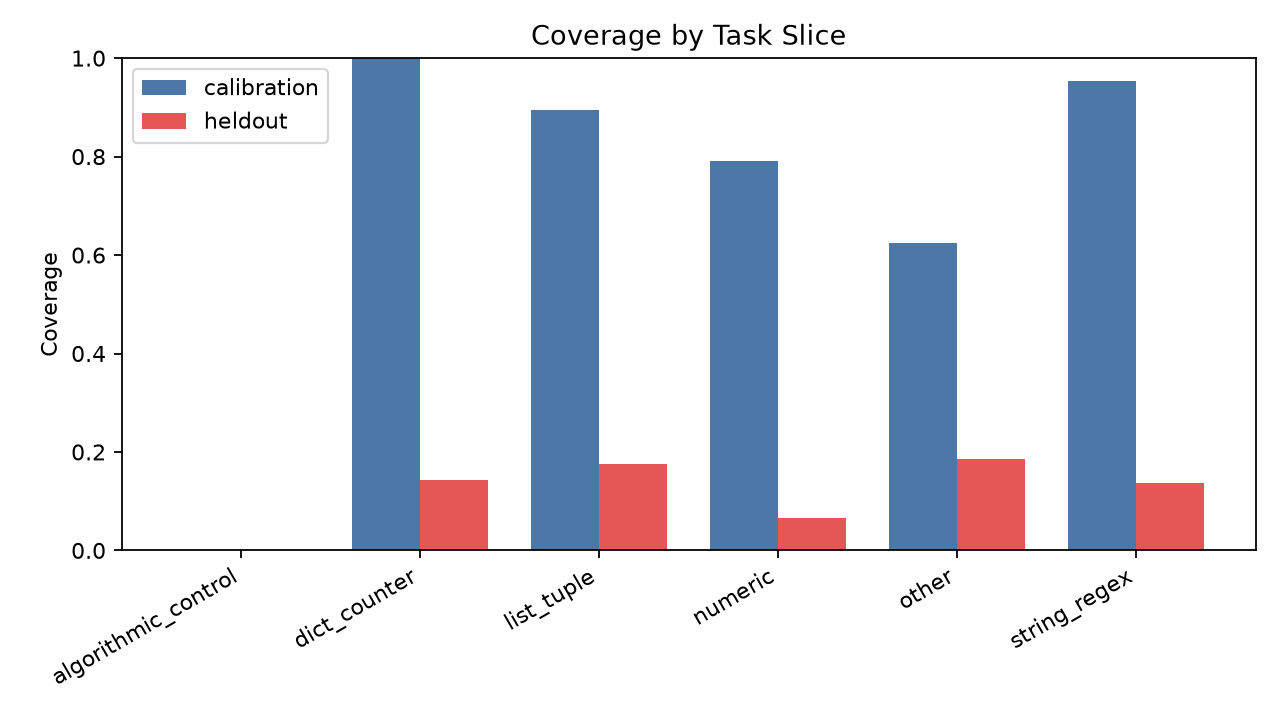
Bars group five task categories (dictionaries, lists, numbers, text patterns, other), each with a familiar-problem bar and a brand-new-problem bar showing the share of problems solved; taller is better. Compare the two bars within each category.
Takeaway → In every category the new-problem bar shrinks to a fraction of the familiar one — even the dictionary category that solved 100% of familiar problems — so no task type escapes.
Data table
| task category | calibration | held-out |
|---|---|---|
| dict/counter | 100% | 14.3% |
| list/tuple | 89.5% | 17.6% |
| numeric | 79.2% | 6.7% |
| string/regex | 95.5% | 13.8% |
| other | 62.5% | 18.5% |
Numbers from experiments/qwen35_4b_code_abi_compiler_heldout_primitive_pilot/reports/gate1_summary.json
Technical framing
Coverage collapse holds across every task category — No category is spared: even dict/counter tasks fall from 100% covered on calibration to 14% on held-out tasks.
How to read
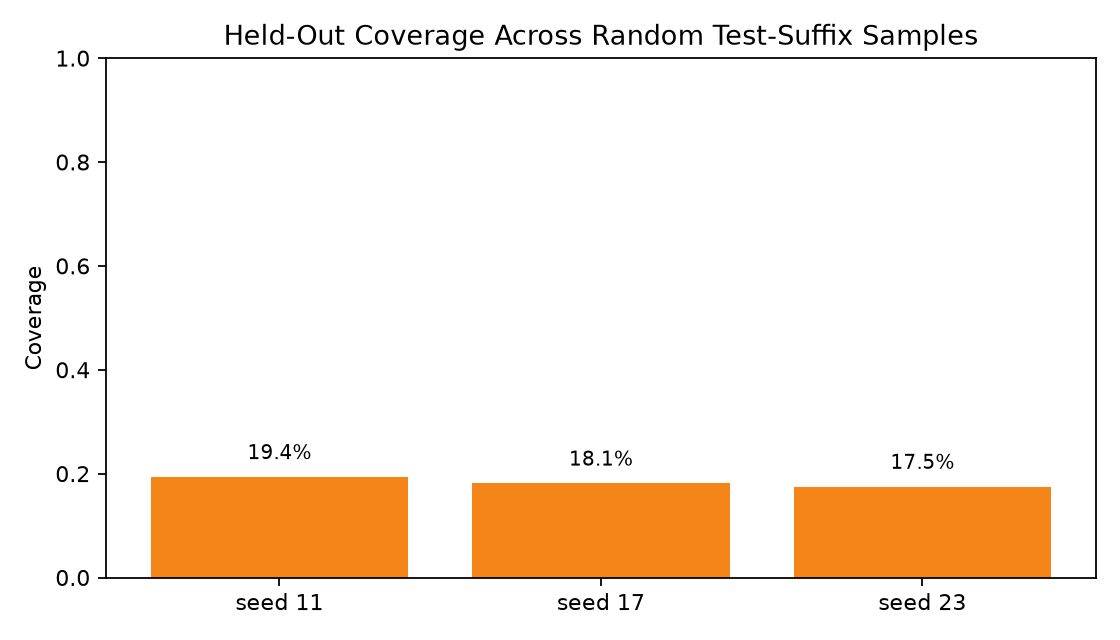
Three bars, one per randomly drawn batch of brand-new problems; bar height is the share the toolbox could solve, where taller is better. A flat, low set of bars means the weak result was not just an unlucky draw.
Takeaway → All three random batches land in a narrow low band near 18%, confirming the collapse was typical rather than a fluke of one unlucky sample.
Data table
| random 160-task held-out sample | frozen-ABI oracle coverage |
|---|---|
| seed 11 | 19.4% |
| seed 17 | 18.1% |
| seed 23 | 17.5% |
Numbers from experiments/qwen35_4b_code_abi_compiler_heldout_primitive_pilot/reports/gate1_split_sweep.json
Technical framing
Random held-out resamples confirm the fixed slice was not unlucky — Three random held-out subsets stay at 17.5-19.4% coverage (mean 18.3%), close to the fixed slice's 13.8%.
In the author’s words from the Overview
Standalone experiment for a frozen code-primitive ABI compiler pilot. The experiment freezes a reusable ABI, measures held-out oracle coverage before training, then trains/evaluates a Qwen3.5-4B QLoRA compiler to emit ABI programs that are executed by a deterministic interpreter.
Overview
Standalone experiment for a frozen code-primitive ABI compiler pilot.
The experiment freezes a reusable ABI, measures held-out oracle coverage before training, then trains/evaluates a Qwen3.5-4B QLoRA compiler to emit ABI programs that are executed by a deterministic interpreter. Checkpoints are stored outside this directory under /workspace/large_artifacts/qwen35_4b_code_abi_compiler_heldout_primitive_pilot/.
Report
Rendered from reports/final_report.md
Purpose
This standalone experiment tests whether a frozen code-primitive ABI remains reusable on held-out MBPP tasks before training a Qwen3.5-4B compiler to emit ABI programs.
The package uses a fixed ABI implementation and does not add kernels after seeing the held-out tasks. The first gate is oracle coverage: if the ABI cannot express held-out tasks, compiler training would not test reusable compilation.
Gate 1 Result
Gate 1 failed. Frozen-ABI oracle coverage dropped from 134/160 (83.8%) on the calibration slice to 22/160 (13.8%) on the held-out slice, a drop of 70.0%.
The train split also has low coverage: 83/374 (22.2%), leaving only 66 compiler-training targets after the deterministic validation split. That is not enough to make a QLoRA compiler result meaningful.
| split | n | oracle-covered | oracle coverage | first-visible correct | visible-any tasks | task false-pass rate | candidate hidden-wrong rate |
|---|---|---|---|---|---|---|---|
| calibration | 160 | 134 | 83.8% | 95 | 147 | 8.8% | 79.2% |
| heldout | 160 | 22 | 13.8% | 8 | 73 | 69.9% | 94.7% |
| train | 374 | 83 | 22.2% | 45 | 195 | 57.4% | 88.0% |
Split-Sweep Check
To check whether the fixed held-out slice was unlucky, the experiment sampled three random 160-task subsets from the test suffix excluded from the calibration slice. Coverage remained low: mean 18.3%, range 17.5%-19.4%.
| seed | n | oracle-covered | oracle coverage | first-visible correct | task false-pass rate |
|---|---|---|---|---|---|
| 11 | 160 | 31 | 19.4% | 15 | 55.1% |
| 17 | 160 | 29 | 18.1% | 15 | 61.3% |
| 23 | 160 | 28 | 17.5% | 13 | 61.6% |
Slice Diagnostics
| slice | calibration coverage | heldout coverage |
|---|---|---|
| algorithmic_control | 0/0 (0.0%) | 0/1 (0.0%) |
| dict_counter | 9/9 (100.0%) | 1/7 (14.3%) |
| list_tuple | 51/57 (89.5%) | 9/51 (17.6%) |
| numeric | 38/48 (79.2%) | 3/45 (6.7%) |
| other | 15/24 (62.5%) | 5/27 (18.5%) |
| string_regex | 21/22 (95.5%) | 4/29 (13.8%) |
Depth Diagnostics
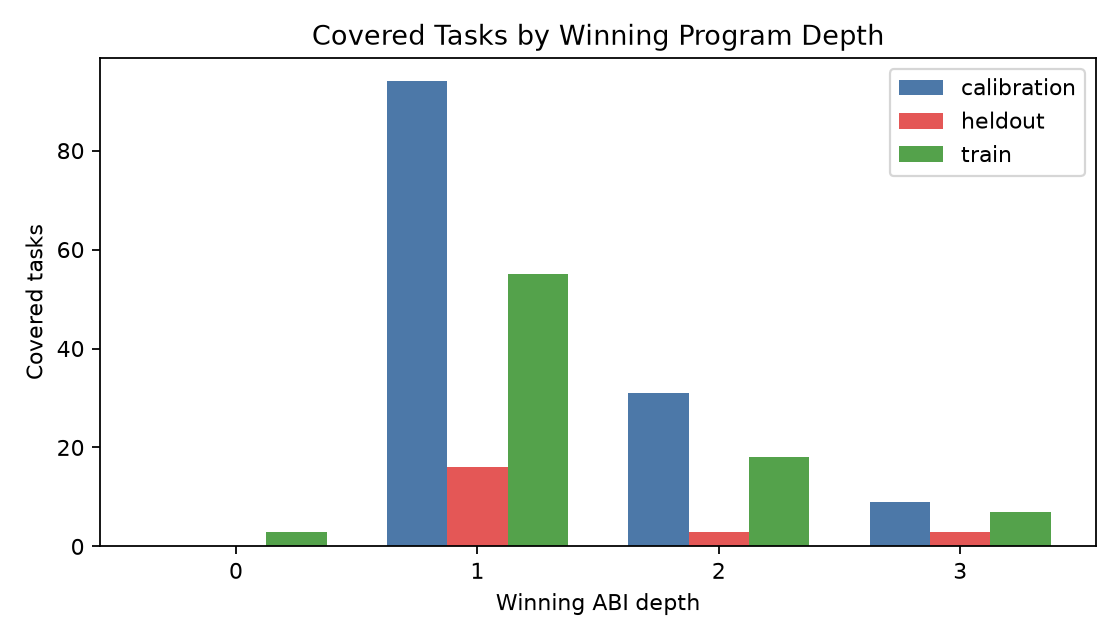
Covered held-out tasks are mostly depth-1 programs: {'1': 16, '2': 3, '3': 3}. There are too few held-out depth-2/3 targets to support a composition-training claim.
Decision
The compiler-training arm was intentionally not run. The precondition for interpreting it did not hold: the frozen ABI was not broadly reusable on held-out tasks. Training Qwen to emit this ABI would mostly measure a small, contaminated target set rather than reusable code compilation.
The next productive step is library curation under a strict protocol: define primitives from a source independent of the evaluation tasks, freeze them, then repeat this held-out coverage gate. Adding kernels after inspecting held-out misses would invalidate the purpose of the gate.
Files
src/abi_oracle.py: frozen ABI oracle implementation.scripts/build_targets.py: calibration, held-out, and train target builder.scripts/gate1_split_sweep.py: random held-out split sweep.reports/gate1_summary.json: primary Gate 1 results.reports/gate1_split_sweep.json: multi-split confirmation.reports/figures/: generated charts.
Experiment log 1
Show the running log (1 entry, 2026-06-27)
2026-06-27
- Created standalone experiment package.
- Copied the frozen ABI implementation into this package so it can be rerun independently.
- Primary gate: held-out frozen-ABI oracle coverage before any compiler training.
- Planned metrics: held-out coverage drop, depth-1 selection vs depth-2/3 composition, parse validity, execution accuracy, confusion patterns, and direct Python sampling on the same held-out records.
- Built calibration, held-out, and train target records using the frozen ABI.
Gate 1 primary result:
- calibration coverage: 134/160 (83.8%)
- held-out coverage: 22/160 (13.8%)
- coverage drop: 70.0 percentage points
- train coverage: 83/374 (22.2%)
- compiler train targets after validation split: 66
Ran a three-seed held-out split sweep over the test suffix excluded from calibration:
- seed 11: 31/160 (19.4%)
- seed 17: 29/160 (18.1%)
- seed 23: 28/160 (17.5%)
- mean coverage: 18.3%
- Decision: compiler training was gated off. Frozen ABI reuse collapsed on held-out tasks, so a QLoRA compiler pilot would not measure reusable code compilation.
- Generated
reports/final_report.mdand figures underreports/figures/.
Figures 4
Data files 1
Result tables and metrics copied from the experiment folder — preview inline or open the raw file.
Reproduce
Run steps are documented inside the experiment folder (README and scripts).