Qwen3.5-4B Learned Active Trace Policy
The one idea you need
Picture Guess Who, but with thousands of candidate programs that all match the examples you have already seen. Each move you run one new input; the best input is the question that splits the survivors evenly, knocking out the most wrong programs at once.
The question
When a small model must choose which extra input to run to narrow thousands of candidate programs, can it learn to pick better than a simple rule?
What we found
It depends. On the main test set a simple even-splitting rule beat the trained picker after one extra input — 91 percent of programs fully correct versus 87 — and the best-possible choice reached 97 percent. The picker did edge ahead on two other test sets. But its inputs ruled out only about 8 wrong candidates on average, versus 20 for the ideal pick.
Why it matters
Choosing an informative test is harder than generating candidates. Before you train a picker model, benchmark a cheap hand-coded splitting rule first — it may already beat your model, and its edge can widen as more tests compound.
On this page
Results at a glance 4
How to read
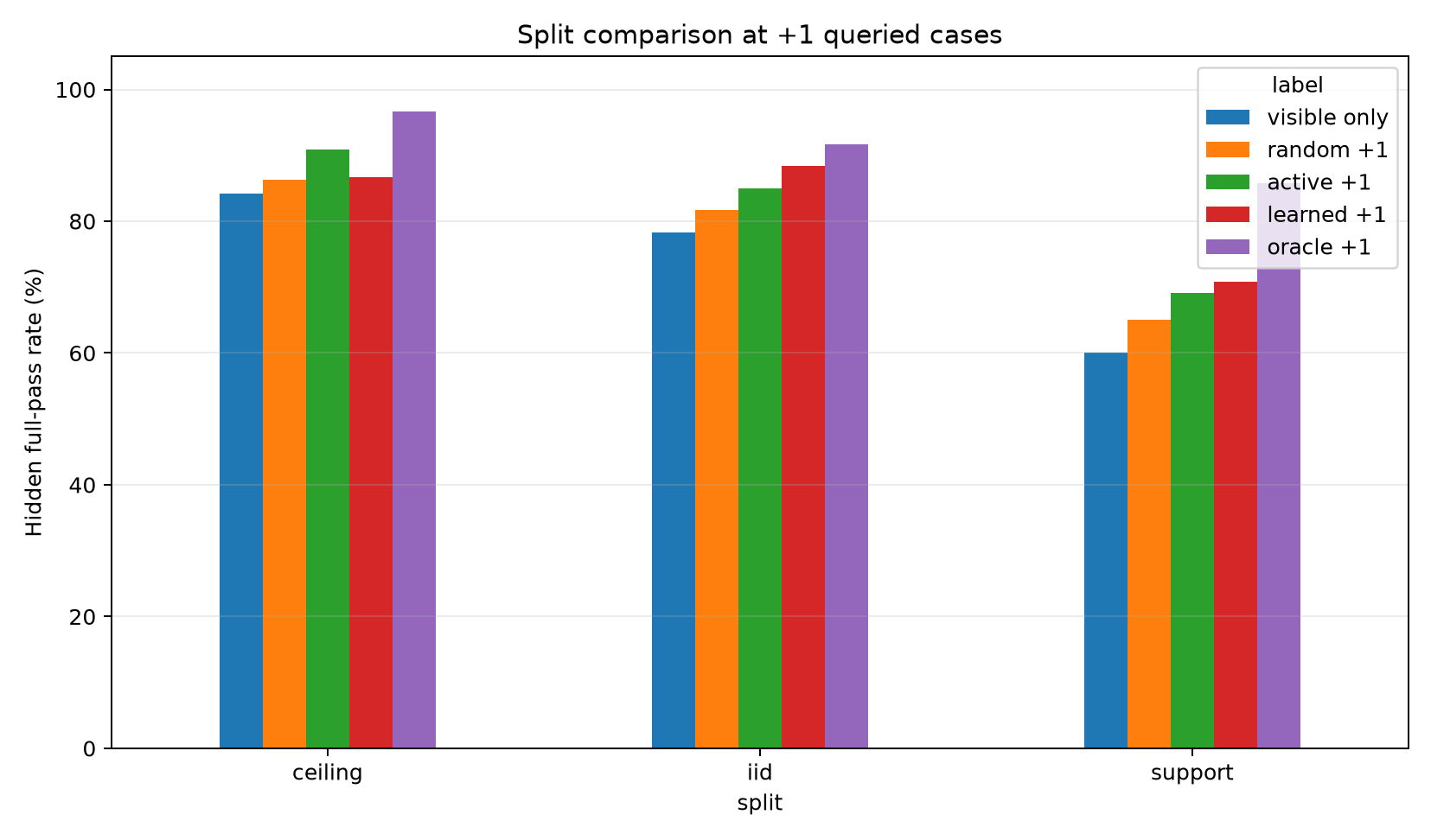
Three groups of bars, one per test set (the main set plus two others). Within each group, four bars compare picking a random input, a simple even-splitting rule, the learned picker, and the best-possible pick. Height is the share of programs fully solved; taller is better.
Takeaway → The learned picker tops the simple rule on the two secondary sets but falls short on the main set; the best-possible pick leads everywhere, showing real headroom.
Data table
| eval split | random extra query | hand-coded max-split | learned Qwen policy | oracle elimination |
|---|---|---|---|---|
| ceiling | 86.2% | 90.8% | 86.7% | 96.7% |
| support | 65% | 69.2% | 70.8% | 85.8% |
| IID | 81.7% | 85% | 88.3% | 91.7% |
Numbers from reports/policy_summary.csv (also report table)
Technical framing
One extra query: learned policy vs baselines, by eval split — With one query the learned policy beats the hand-coded heuristic on support and IID but loses on the primary ceiling split.
How to read
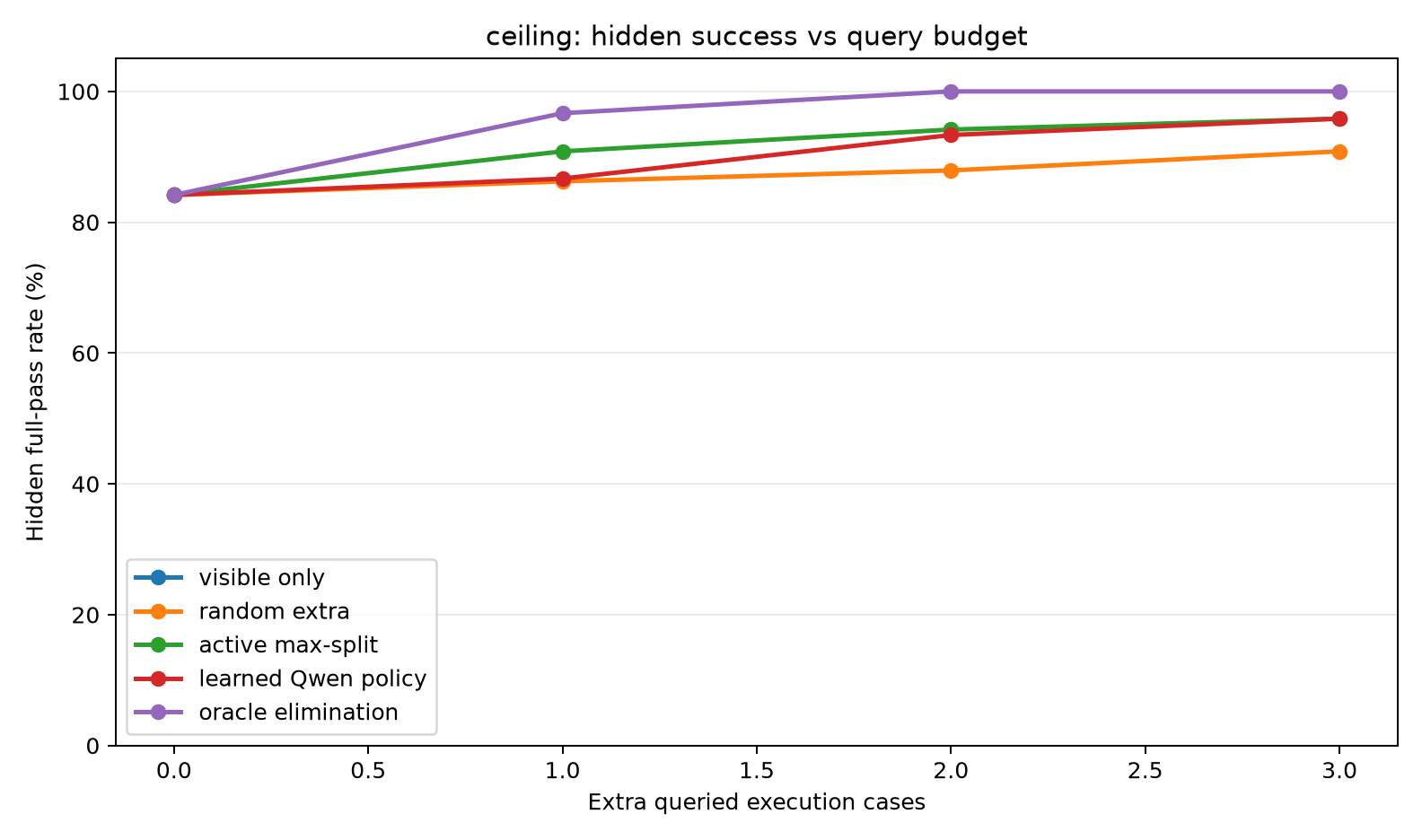
On the main test set, each line tracks the share of programs fully solved as the picker is allowed more extra inputs, from none to three. Four lines compare a random pick, a simple rule, the learned picker, and the best-possible pick. Higher is better.
Takeaway → The learned line starts below the simple rule at one input, then climbs to match it by three; the best-possible line stays clearly above both.
Data table
| extra query budget | random extra query | hand-coded max-split | learned Qwen policy | oracle elimination |
|---|---|---|---|---|
| 0 | 84.2% | 84.2% | 84.2% | 84.2% |
| 1 | 86.2% | 90.8% | 86.7% | 96.7% |
| 2 | 87.9% | 94.2% | 93.3% | 100% |
| 3 | 90.8% | 95.8% | 95.8% | 100% |
Numbers from reports/policy_summary.csv (also report table)
Technical framing
Ceiling split: success vs query budget — On the primary ceiling split the learned policy trails max-split at budget 1, then catches up to match it at budget 3.
How to read
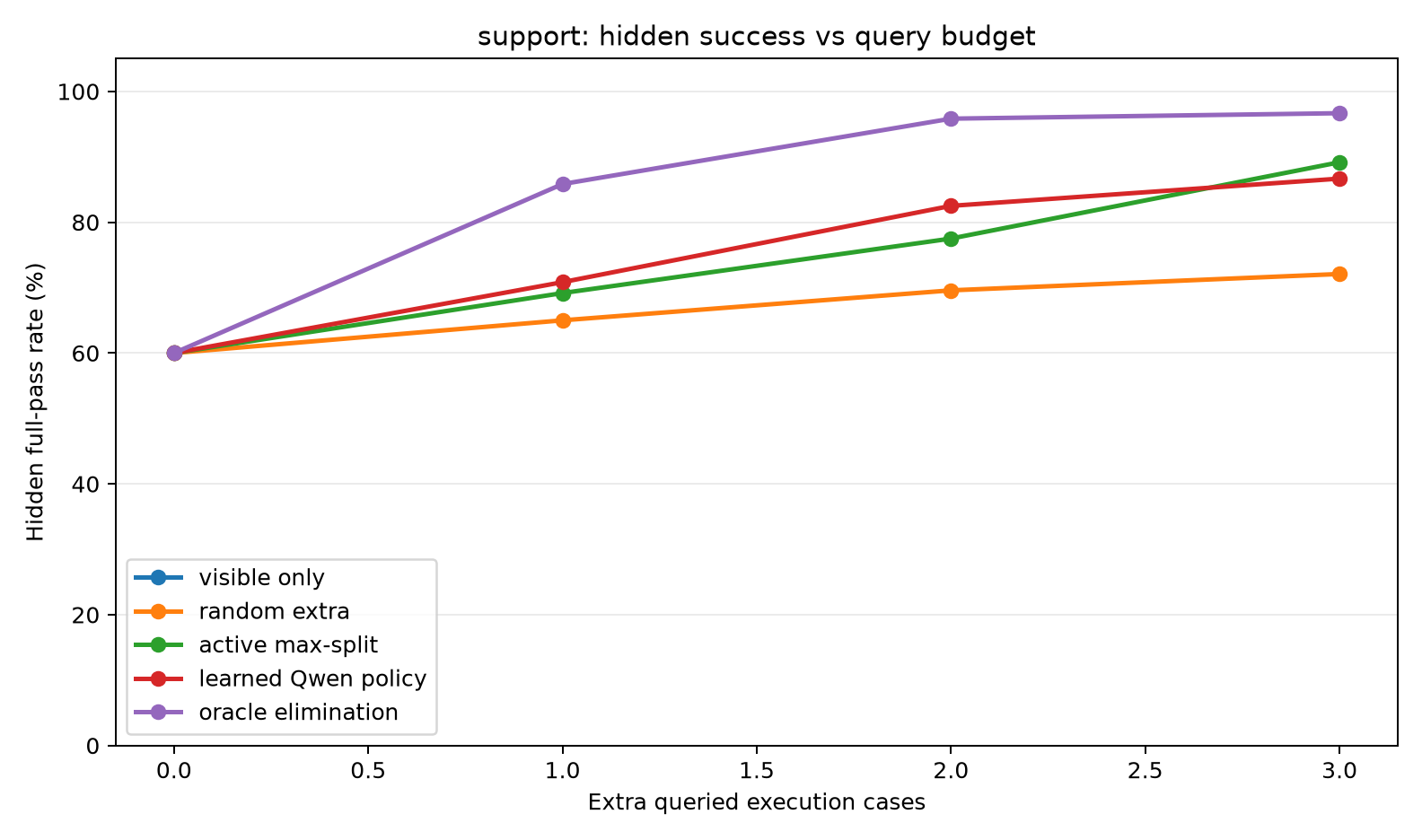
On the hardest test set, each line shows the share of programs fully solved as extra inputs increase from none to three, comparing a random pick, a simple rule, the learned picker, and the best-possible pick. Higher is better.
Takeaway → The learned picker leads the simple rule at one and two inputs, then slips behind it at three; the best-possible pick stays far ahead throughout.
Data table
| extra query budget | random extra query | hand-coded max-split | learned Qwen policy | oracle elimination |
|---|---|---|---|---|
| 0 | 60% | 60% | 60% | 60% |
| 1 | 65% | 69.2% | 70.8% | 85.8% |
| 2 | 69.6% | 77.5% | 82.5% | 95.8% |
| 3 | 72.1% | 89.2% | 86.7% | 96.7% |
Numbers from reports/policy_summary.csv (also report table)
Technical framing
Support split: success vs query budget — On the hard support split the learned policy leads the heuristic at budgets 1-2 but falls behind at budget 3.
How to read
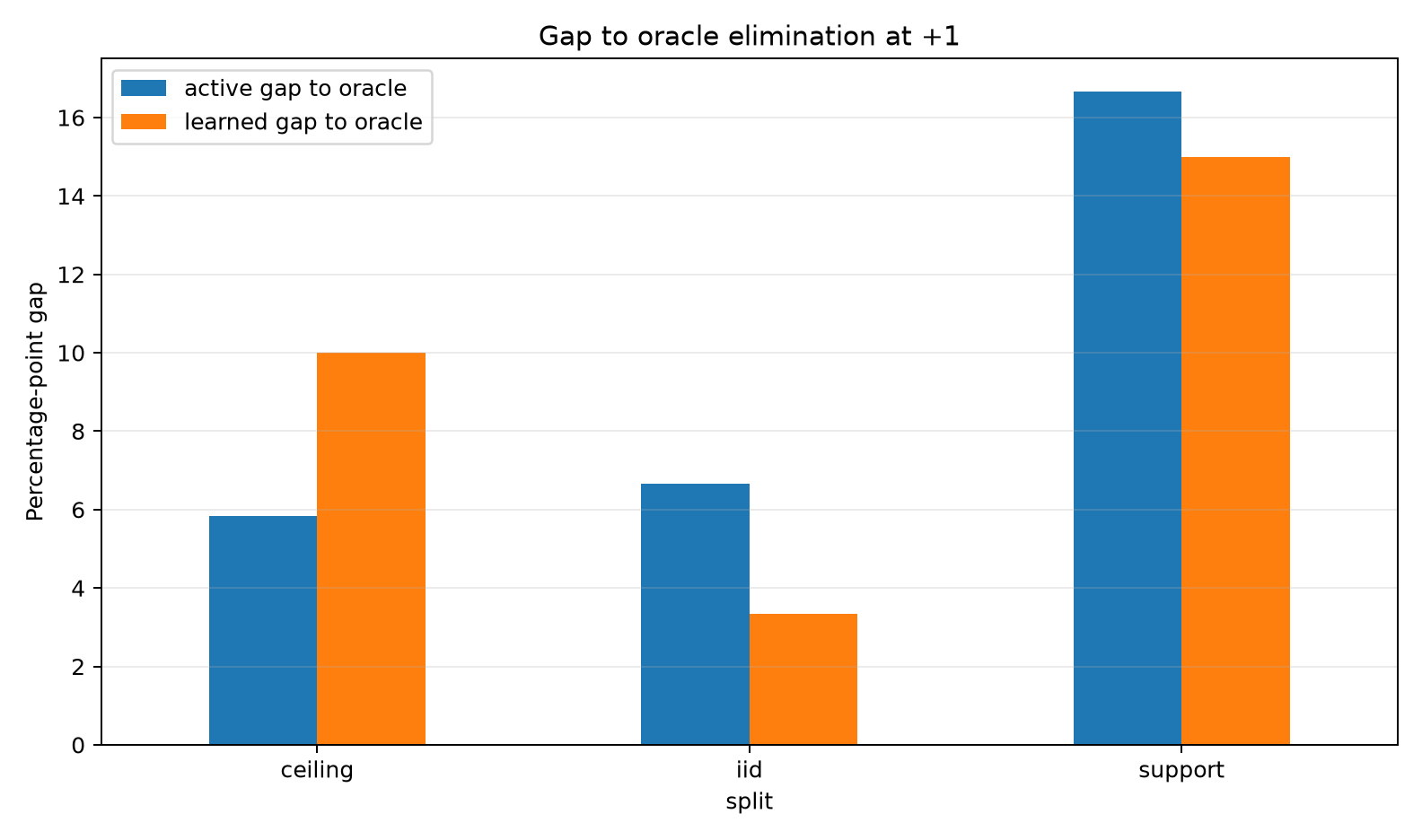
Three pairs of bars, one per test set. Each pair compares the wrong candidates ruled out by a single input: the learned picker's choice versus the best-possible choice. Taller means the chosen input carried more information.
Takeaway → In every test set the learned picker's bar sits under half the best-possible height — a real but only mild signal in its choices.
Data table
| eval split | learned policy's chosen action | oracle best action |
|---|---|---|
| ceiling | 8.37 | 19.9 |
| support | 11.4 | 25.6 |
| IID | 5.71 | 12 |
Numbers from report table (Learned Policy Diagnostics), backed by reports/eval/learned_*.json
Technical framing
Learned choices eliminate far fewer candidates than the oracle action — The learned first-query signal is real but weak: its chosen queries eliminate under half as many wrong candidates as the oracle's.
In the author’s words from the Report · “Summary”
This standalone experiment tests whether a Qwen3.5-4B LoRA can learn a low-budget active trace policy for selecting query inputs after typed-sketch candidate synthesis. The learned controller is trained by oracle-action distillation: each training state displays visible examples and candidate-output buckets for possible query inputs, while the target answer is the displayed query option that eliminates the most wrong candidates. The query prompt does not reveal the held-out expected output for candidate query inputs. The policy must infer which output bucket is likely correct from the visible examples and candidate-output structure.
Overview
Standalone experiment package for training and evaluating a learned active execution-query policy after typed sketch synthesis.
The experiment trains two local Qwen3.5-4B LoRA adapters:
- a sketch adapter that emits typed DSL sketches from visible traces;
- a policy adapter that chooses the next query input from candidate-output bucket summaries.
Large artifacts such as adapters and checkpoints are stored outside this directory under:
/workspace/large_artifacts/qwen35_4b_learned_active_trace_policy
Directory Layout
configs/: experiment configuration.data/: generated JSONL datasets and manifests.logs/: human-readable experiment log.reports/: result JSON, CSV summaries, figures, and final report.run_logs/: command stdout/stderr captures.scripts/: runnable experiment scripts.src/: local DSL, data-generation, sketch, prompt, modeling, and active-policy code.
Main Commands
python scripts/build_dataset.py
python scripts/build_policy_dataset.py --train-data data/static_bridge_80/dsl_train.jsonl --eval-data data/seed/dsl_train.jsonl
python scripts/train_adapter.py --task sketch --target-field target_sketch ...
python scripts/train_policy_adapter.py --train data/policy/policy_train.jsonl --eval data/policy/policy_eval.jsonl ...
python scripts/eval_learned_policy.py --data data/eval/dsl_eval_ceiling.jsonl ...
python scripts/make_report.py
Report
Rendered from reports/qwen35_4b_learned_active_trace_policy_report.md
Summary
This standalone experiment tests whether a Qwen3.5-4B LoRA can learn a low-budget active trace policy for selecting query inputs after typed-sketch candidate synthesis. The learned controller is trained by oracle-action distillation: each training state displays visible examples and candidate-output buckets for possible query inputs, while the target answer is the displayed query option that eliminates the most wrong candidates.
The query prompt does not reveal the held-out expected output for candidate query inputs. The policy must infer which output bucket is likely correct from the visible examples and candidate-output structure.
Key Findings
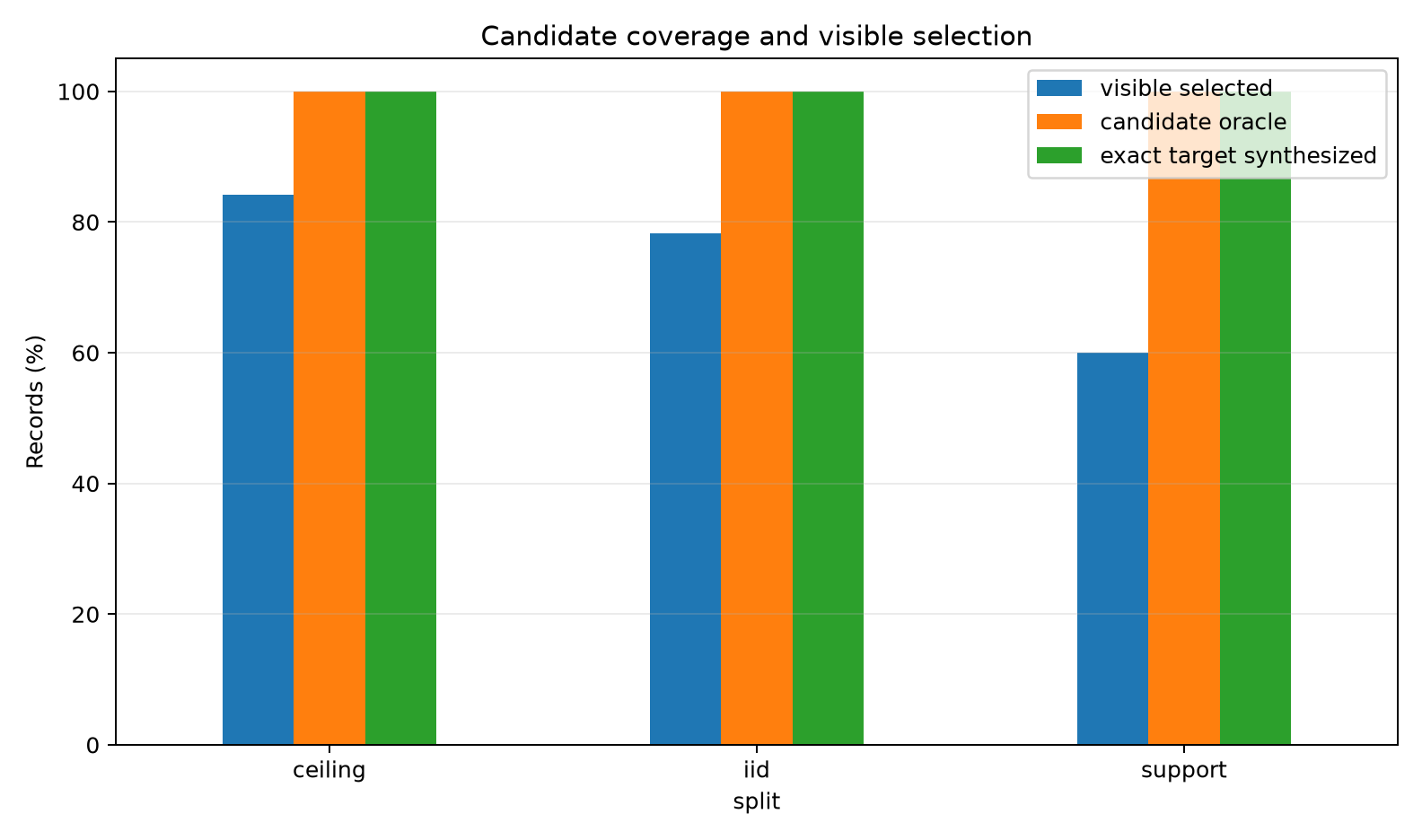
- Candidate coverage was perfect on all splits: candidate oracle and exact target synthesis both reached
100%. Remaining failures are policy/control failures, not synthesis failures. - The learned Qwen policy was mechanically reliable: parse rate was
1.0on ceiling, support, and IID, with no fallback actions. The learned policy improved the single-query regime on support and IID:
- support +1: learned
85/120vs active max-split83/120; - IID +1: learned
53/60vs active max-split51/60.
- support +1: learned
- The learned policy did not improve the primary ceiling +1 regime: learned
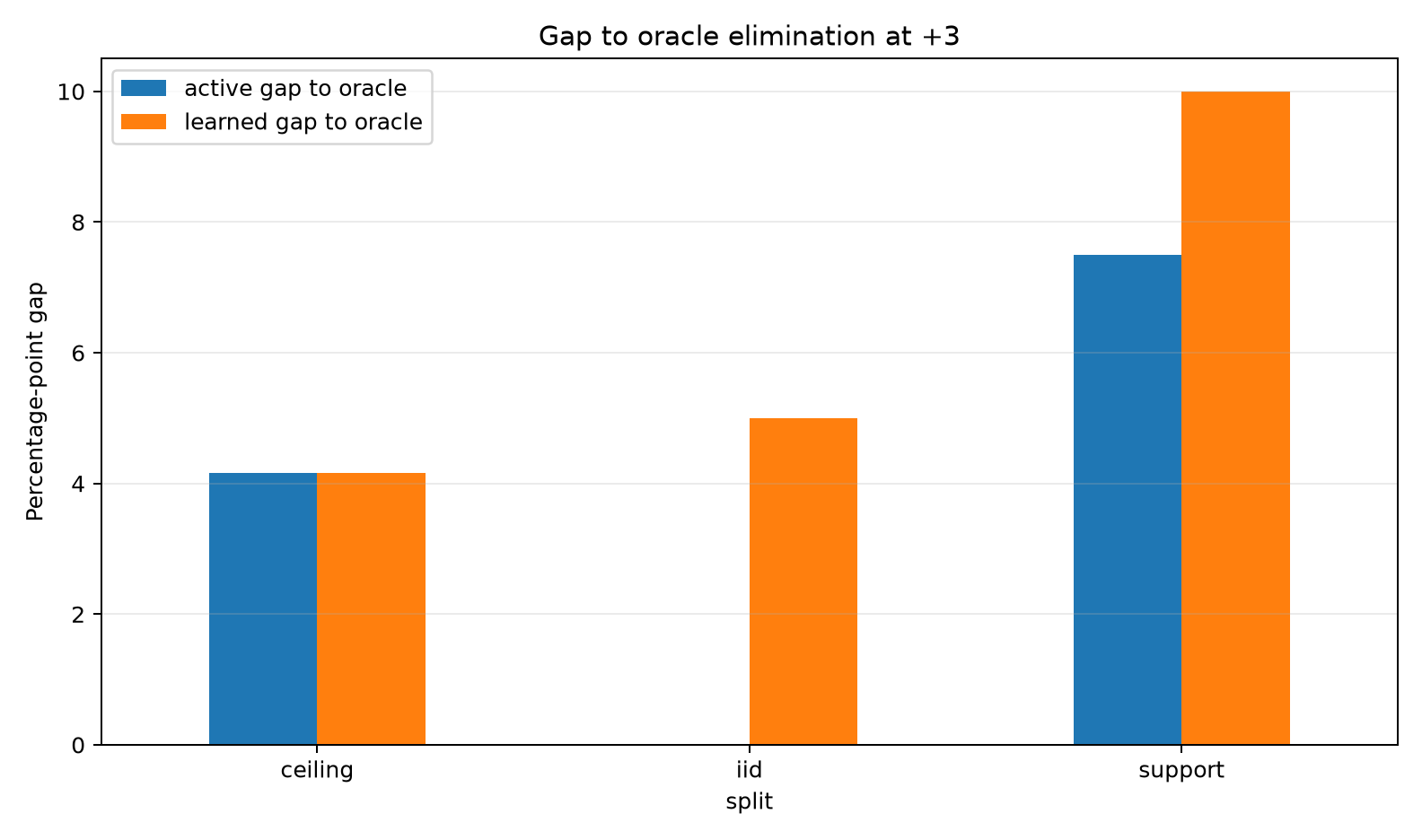
104/120vs active max-split109/120, with oracle elimination at116/120. At larger low budgets, the learned policy was mixed:
- ceiling +3 matched active max-split at
115/120; - support +2 beat active max-split,
99/120vs93/120; - support +3 and IID +2/+3 fell behind active max-split.
- ceiling +3 matched active max-split at
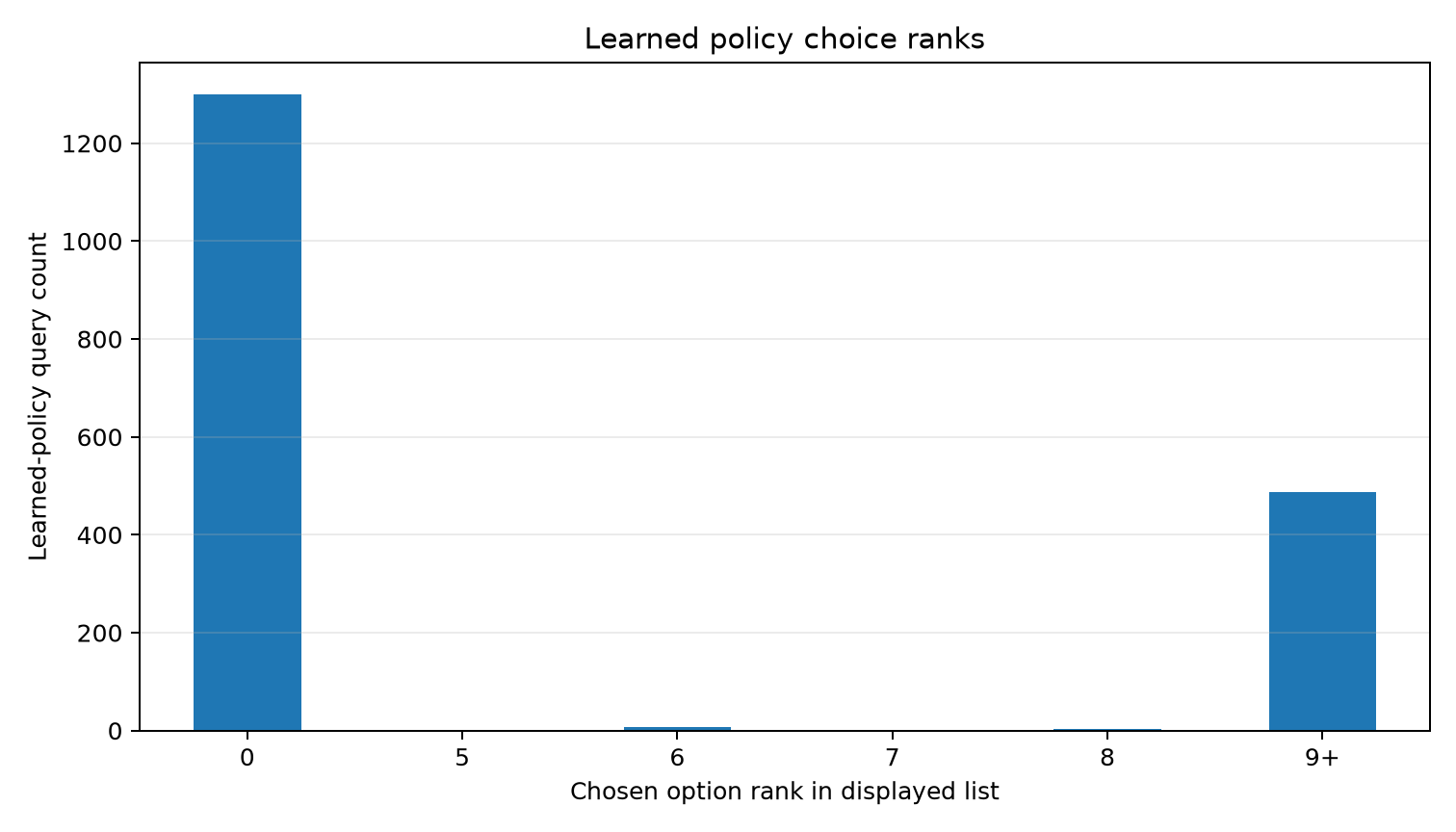
- The learned policy chose nontrivial option ranks, but its chosen actions eliminated far fewer candidates than the oracle action on average. This points to a real learned first-query signal, but weak multi-step state-update robustness.
Bottom line: this run validates the learned-controller formulation and finds a real but incomplete gain. The current supervised policy is not yet the best controller for the primary split; the next iteration should focus on compounding, on-policy state distribution, and value-aware training rather than more sketch synthesis.
Training Notes
- Sketch LoRA: trained for 2 epochs on static bridge sketch targets; final eval loss
0.000829. - Policy LoRA: trained on
481oracle-distilled query states; checkpoint 40 eval loss was0.399913, checkpoint 80 worsened to0.405868, so checkpoint 40 was selected for evaluation. - Policy training examples only covered query steps 1-3, so the full evaluation uses budgets
0,1,2,3.
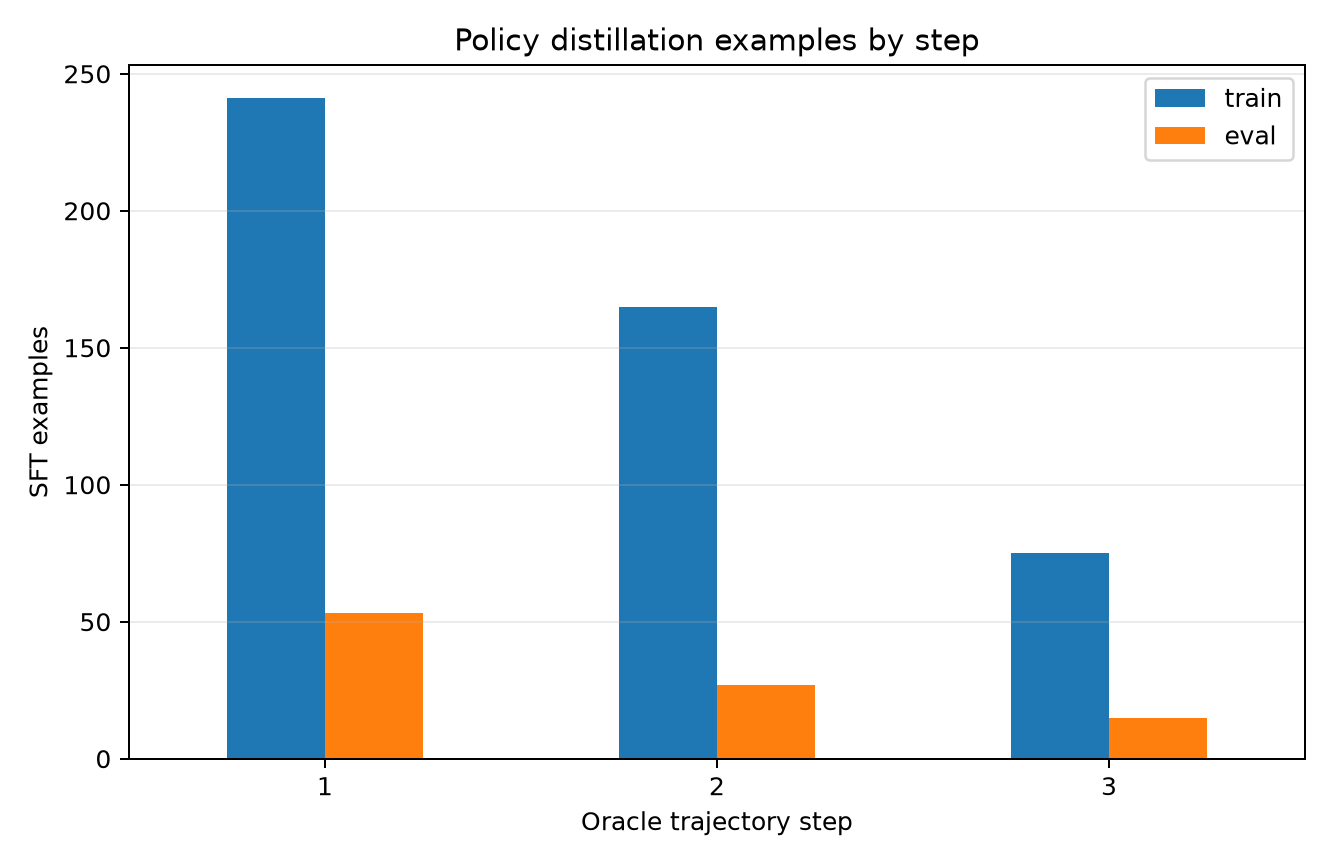
Policy Distillation Data
Train examples: 481. Eval examples: 95.
Candidate Coverage
| split | records | visible_selected_hidden_all_pct | candidate_oracle_hidden_all_pct | target_program_synthesized_pct | avg_synthesized_programs | avg_visible_consistent_candidates |
|---|---|---|---|---|---|---|
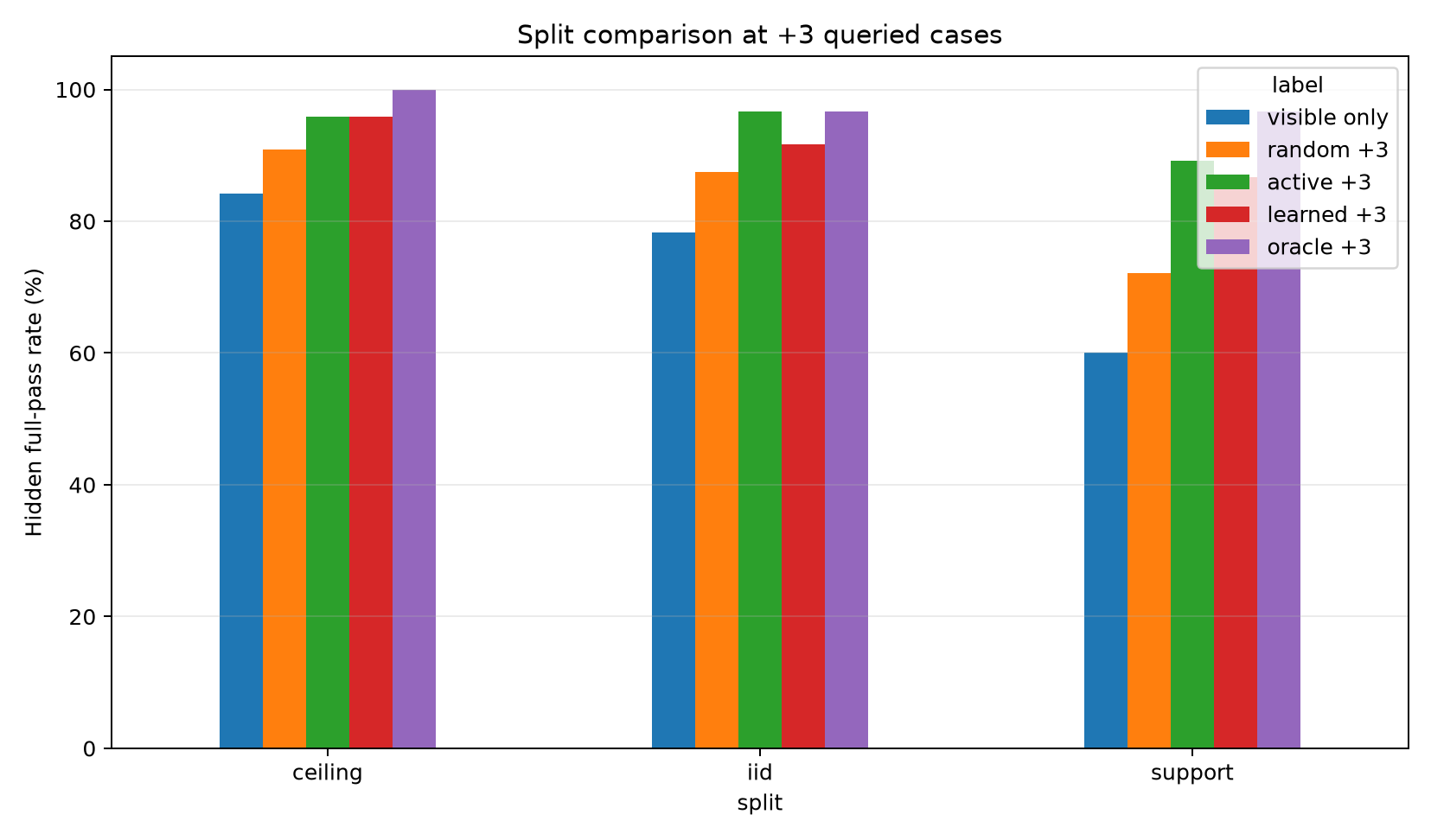
| ceiling | 120 | 84.167 | 100 | 100 | 3114.73 | 388.342 |
| iid | 60 | 78.333 | 100 | 100 | 1104.25 | 58.783 |
| support | 120 | 60 | 100 | 100 | 3311.1 | 353.492 |
Policy Results
| split | policy | budget | rows | hidden_all_pct | observed_all_pct | avg_hidden_passes | avg_queries_used |
|---|---|---|---|---|---|---|---|
| ceiling | active_max_split | 0 | 120 | 84.167 | 100 | 17.583 | 0 |
| ceiling | active_max_split | 1 | 120 | 90.833 | 100 | 17.8 | 1 |
| ceiling | active_max_split | 2 | 120 | 94.167 | 100 | 17.875 | 2 |
| ceiling | active_max_split | 3 | 120 | 95.833 | 100 | 17.892 | 3 |
| ceiling | learned_qwen_policy | 0 | 120 | 84.167 | 100 | 17.583 | 0 |
| ceiling | learned_qwen_policy | 1 | 120 | 86.667 | 100 | 17.683 | 1 |
| ceiling | learned_qwen_policy | 2 | 120 | 93.333 | 100 | 17.875 | 2 |
| ceiling | learned_qwen_policy | 3 | 120 | 95.833 | 100 | 17.933 | 3 |
| ceiling | oracle_elimination | 0 | 120 | 84.167 | 100 | 17.583 | 0 |
| ceiling | oracle_elimination | 1 | 120 | 96.667 | 100 | 17.942 | 1 |
| ceiling | oracle_elimination | 2 | 120 | 100 | 100 | 18 | 2 |
| ceiling | oracle_elimination | 3 | 120 | 100 | 100 | 18 | 3 |
| ceiling | random_extra | 0 | 240 | 84.167 | 100 | 17.583 | 0 |
| ceiling | random_extra | 1 | 240 | 86.25 | 100 | 17.683 | 1 |
| ceiling | random_extra | 2 | 240 | 87.917 | 100 | 17.746 | 2 |
| ceiling | random_extra | 3 | 240 | 90.833 | 100 | 17.837 | 3 |
| ceiling | visible_prior | 0 | 120 | 84.167 | 100 | 17.583 | 0 |
| iid | active_max_split | 0 | 60 | 78.333 | 100 | 17 | 0 |
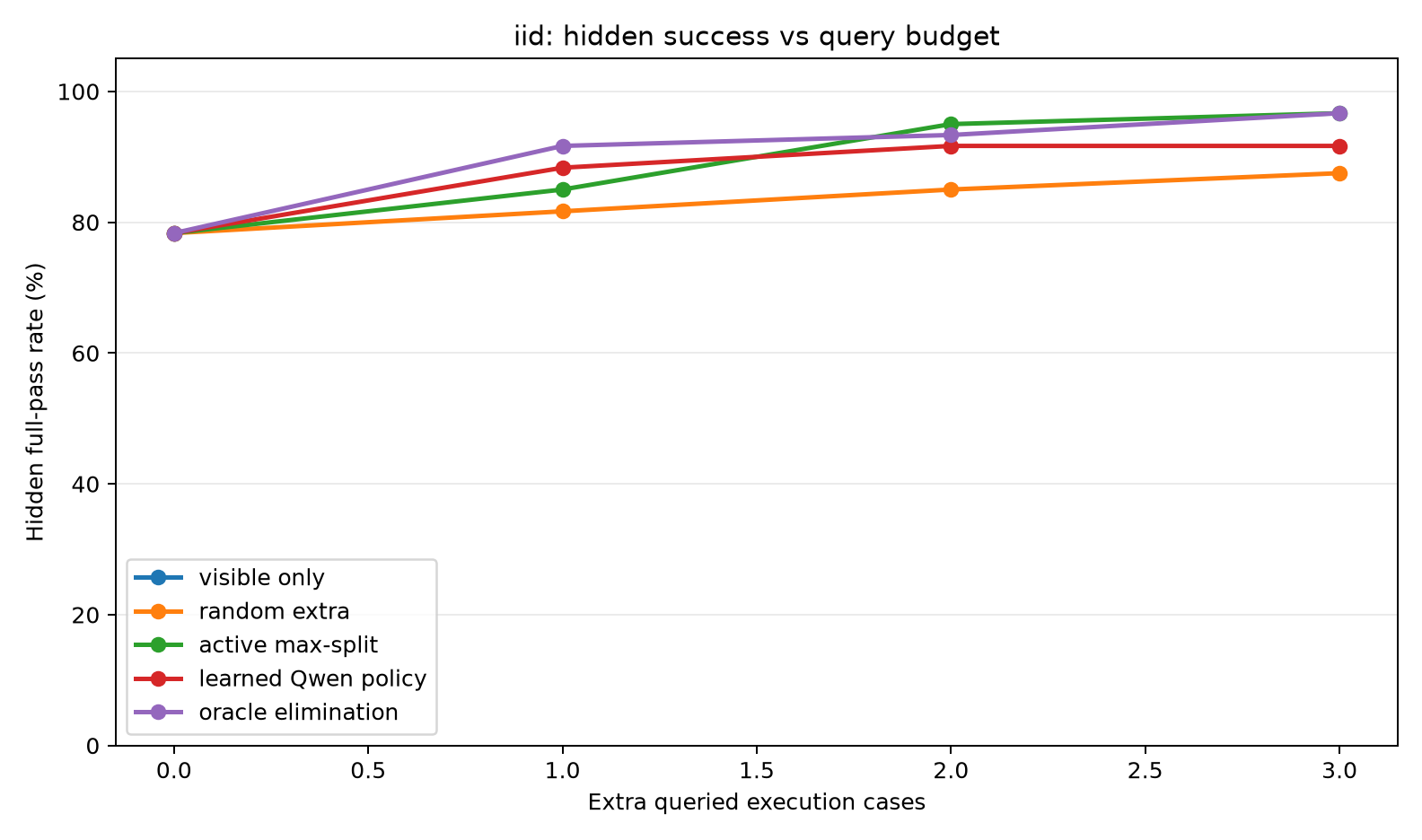
| iid | active_max_split | 1 | 60 | 85 | 100 | 17.533 | 1 |
| iid | active_max_split | 2 | 60 | 95 | 100 | 17.917 | 2 |
| iid | active_max_split | 3 | 60 | 96.667 | 100 | 17.967 | 3 |
| iid | learned_qwen_policy | 0 | 60 | 78.333 | 100 | 17 | 0 |
| iid | learned_qwen_policy | 1 | 60 | 88.333 | 100 | 17.7 | 1 |
| iid | learned_qwen_policy | 2 | 60 | 91.667 | 100 | 17.817 | 2 |
| iid | learned_qwen_policy | 3 | 60 | 91.667 | 100 | 17.817 | 3 |
| iid | oracle_elimination | 0 | 60 | 78.333 | 100 | 17 | 0 |
| iid | oracle_elimination | 1 | 60 | 91.667 | 100 | 17.85 | 1 |
| iid | oracle_elimination | 2 | 60 | 93.333 | 100 | 17.883 | 2 |
| iid | oracle_elimination | 3 | 60 | 96.667 | 100 | 17.967 | 3 |
| iid | random_extra | 0 | 120 | 78.333 | 100 | 17 | 0 |
| iid | random_extra | 1 | 120 | 81.667 | 100 | 17.342 | 1 |
| iid | random_extra | 2 | 120 | 85 | 100 | 17.525 | 2 |
| iid | random_extra | 3 | 120 | 87.5 | 100 | 17.6 | 3 |
| iid | visible_prior | 0 | 60 | 78.333 | 100 | 17 | 0 |
| support | active_max_split | 0 | 120 | 60 | 100 | 16.458 | 0 |
| support | active_max_split | 1 | 120 | 69.167 | 100 | 16.95 | 1 |
| support | active_max_split | 2 | 120 | 77.5 | 100 | 17.358 | 2 |
| support | active_max_split | 3 | 120 | 89.167 | 100 | 17.725 | 3 |
| support | learned_qwen_policy | 0 | 120 | 60 | 100 | 16.458 | 0 |
| support | learned_qwen_policy | 1 | 120 | 70.833 | 100 | 16.942 | 1 |
| support | learned_qwen_policy | 2 | 120 | 82.5 | 100 | 17.442 | 2 |
| support | learned_qwen_policy | 3 | 120 | 86.667 | 100 | 17.633 | 3 |
| support | oracle_elimination | 0 | 120 | 60 | 100 | 16.458 | 0 |
| support | oracle_elimination | 1 | 120 | 85.833 | 100 | 17.633 | 1 |
| support | oracle_elimination | 2 | 120 | 95.833 | 100 | 17.95 | 2 |
| support | oracle_elimination | 3 | 120 | 96.667 | 100 | 17.967 | 3 |
| support | random_extra | 0 | 240 | 60 | 100 | 16.458 | 0 |
| support | random_extra | 1 | 240 | 65 | 100 | 16.8 | 1 |
| support | random_extra | 2 | 240 | 69.583 | 100 | 17.008 | 2 |
| support | random_extra | 3 | 240 | 72.083 | 100 | 17.125 | 3 |
| support | visible_prior | 0 | 120 | 60 | 100 | 16.458 | 0 |
Learned Policy Diagnostics
| split | learned_queries | parse_ok_rate | fallback_rate | avg_chosen_rank | avg_chosen_actual_eliminated | avg_oracle_actual_eliminated |
|---|---|---|---|---|---|---|
| ceiling | 720 | 1 | 0 | 4.233 | 8.372 | 19.915 |
| iid | 360 | 1 | 0 | 3.792 | 5.708 | 12.033 |
| support | 720 | 1 | 0 | 5.343 | 11.429 | 25.608 |
Interpretation
The central test is whether learned query selection closes the low-budget gap between the hand-coded max-split heuristic and oracle elimination. A useful learned controller should improve especially at budgets +1 to +3, where one or two high-value traces matter more than broad random coverage.
Reproducibility
- Config:
configs/experiment.json - Dataset manifest:
data/dataset_manifest.json - Policy dataset manifest:
data/policy/policy_dataset_manifest.json - Eval JSON files:
reports/eval/learned_iid.json,reports/eval/learned_support.json,reports/eval/learned_ceiling.json - Policy summary CSV:
reports/policy_summary.csv - Candidate summary CSV:
reports/candidate_summary.csv - Large artifacts:
/workspace/large_artifacts/qwen35_4b_learned_active_trace_policy
Experiment log 14
Show the running log (14 entries, 2026-06-24)
2026-06-24 05:00 UTC
Initialized a standalone learned active trace policy experiment package.
Design commitments:
- Use
Qwen/Qwen3.5-4B. - Train a fresh sketch LoRA and a fresh policy LoRA for this experiment.
- Keep model adapters and checkpoints under
/workspace/large_artifacts/qwen35_4b_learned_active_trace_policy. - Keep downloadable experiment files under
/workspace/experiments/qwen35_4b_learned_active_trace_policy. - Train the policy by oracle-action distillation from candidate-program ambiguity states.
- Do not reveal query-option expected outputs to the policy prompt; only visible examples and candidate-output buckets are shown.
- Evaluate visible-only, random extra trace, active max-split, learned Qwen policy, and oracle elimination on IID, support, and ceiling splits.
Initial implementation:
- Added
src/active_core.pyfor shared candidate-bank, query-option, prompt, policy, and summary logic. - Added
scripts/build_policy_dataset.pyfor oracle-distilled policy SFT examples. - Added
scripts/train_policy_adapter.pyfor the Qwen policy LoRA. - Added
scripts/eval_learned_policy.pyfor model-in-loop learned-policy evaluation. - Replaced
scripts/make_report.pywith a learned-policy report generator.
Validation:
python -m py_compile scripts/build_dataset.py scripts/build_policy_dataset.py scripts/train_adapter.py scripts/train_policy_adapter.py scripts/eval_learned_policy.py scripts/make_report.py src/*.py- Result: passed.
- Removed generated
__pycache__directories from the experiment tree.
2026-06-24 05:05 UTC
Built the standalone DSL dataset.
Command:
python scripts/build_dataset.py > run_logs/dataset_build_console.log 2>&1Observed:
- Static80 sketch-training records:
240. - Seed/policy-validation records:
240. - IID eval records:
60. - Support eval records:
120. - Ceiling eval records:
120. - Active query pool before policy cap:
384cases per eval record.
Next check: build a small policy-distillation smoke dataset, inspect labels and prompt shape, then build the full policy SFT dataset.
2026-06-24 05:11 UTC
Policy-distillation smoke iteration 1 produced zero examples.
Command:
python scripts/build_policy_dataset.py --train-data data/static_bridge_80/dsl_train.jsonl --eval-data data/seed/dsl_train.jsonl --out-dir data/policy_smoke --max-train-records 12 --max-eval-records 8 --max-steps 3 --max-options 24 --max-policy-candidates 128 --max-query-pool-cases 48 --max-total-programs-per-record 4000 > run_logs/policy_dataset_smoke_console.log 2>&1Cause:
- The first dataset build attached
case_poolonly to eval records. - Policy SFT needs query pools on training records too.
Fix:
- Patched
src/data_gen.pysostatic_bridge_recordsacceptscase_pool_count. - Patched
scripts/build_dataset.pyto attach active case pools to seed, static-base, and bridge training records. - Rebuilt the dataset with
python scripts/build_dataset.py > run_logs/dataset_build_v2_console.log 2>&1.
Verification:
data/static_bridge_80/dsl_train.jsonlfirst record has384query-pool cases.data/seed/dsl_train.jsonlfirst record has384query-pool cases.data/dataset_manifest.jsonrecordstrain_records_include_active_case_pools: true.
2026-06-24 05:23 UTC
Policy-distillation smoke iteration 2 succeeded.
Command:
python scripts/build_policy_dataset.py --train-data data/static_bridge_80/dsl_train.jsonl --eval-data data/seed/dsl_train.jsonl --out-dir data/policy_smoke --max-train-records 12 --max-eval-records 8 --max-steps 3 --max-options 24 --max-policy-candidates 128 --max-query-pool-cases 48 --max-total-programs-per-record 4000 > run_logs/policy_dataset_smoke_v2_console.log 2>&1Observed:
- Train examples:
8. - Eval examples:
2. - First prompt displayed 24 options and hid the query-option expected output.
- First label:
Q00, with2actual candidate eliminations.
Decision:
- Use both static bridge training files for the full policy source to increase supervised states.
- Keep seed records as policy-validation source.
2026-06-24 05:34 UTC
Built the full oracle-distilled policy dataset.
Command:
python scripts/build_policy_dataset.py --train-data data/static_bridge_80/dsl_train.jsonl data/static_bridge_60/dsl_train.jsonl --eval-data data/seed/dsl_train.jsonl --out-dir data/policy --max-eval-records 120 --max-steps 3 --max-options 24 --max-policy-candidates 128 --max-query-pool-cases 48 --max-total-programs-per-record 4000 > run_logs/policy_dataset_full_console.log 2>&1Observed:
- Train source records:
480. - Policy train examples:
481. - Policy eval examples:
95. - Train examples by step:
241at step 1,165at step 2,75at step 3. - Average target actual eliminations:
27.744. - Target action distribution is nontrivial:
Q00occurs204/481, with many labels deeper in the displayed list. - Token length check with the Qwen tokenizer: max
2882, p952673,0examples above4096.
Next step: train a fresh sketch LoRA, then train the policy LoRA.
2026-06-24 05:54 UTC
Sketch LoRA training completed successfully.
Command:
python scripts/train_adapter.py --train data/static_bridge_80/dsl_train.jsonl --eval data/eval/dsl_eval_iid.jsonl --task sketch --target-field target_sketch --prompt-mode trace --output-dir /workspace/large_artifacts/qwen35_4b_learned_active_trace_policy/models/sketch_lora --epochs 2.0 --lr 1.5e-4 --rank 32 --alpha 64 --dropout 0.05 --grad-accum 8 --save-steps 30 --eval-steps 30 > run_logs/training_sketch_lora_console.log 2>&1Observed:
- Trainable parameters:
42,467,328. - Step 30 eval loss:
0.0001971. - Final eval loss at epoch 2:
0.000829. - Adapter/checkpoint tree size:
709M. - Large artifact location:
/workspace/large_artifacts/qwen35_4b_learned_active_trace_policy/models/sketch_lora.
Next step: train the Qwen active-query policy LoRA on data/policy/policy_train.jsonl.
2026-06-24 06:37 UTC
Policy LoRA training was run with checkpointed validation and stopped early after the validation loss stopped improving.
Command:
python scripts/train_policy_adapter.py --train data/policy/policy_train.jsonl --eval data/policy/policy_eval.jsonl --output-dir /workspace/large_artifacts/qwen35_4b_learned_active_trace_policy/models/policy_lora --epochs 3.0 --lr 1.2e-4 --rank 32 --alpha 64 --dropout 0.05 --grad-accum 8 --save-steps 40 --eval-steps 40 --max-eval-records 95 > run_logs/training_policy_lora_console.log 2>&1Observed:
- Trainable parameters:
42,467,328. - Checkpoint 40 eval loss:
0.399913. - Checkpoint 80 eval loss:
0.405868. - Checkpoint 80 was worse than checkpoint 40, so training was intentionally interrupted at step 81 rather than spending another long epoch on likely overfit/noise.
- Selected policy checkpoint for evaluation:
/workspace/large_artifacts/qwen35_4b_learned_active_trace_policy/models/policy_lora/checkpoint-40. - Policy artifact tree size after two checkpoints:
528M.
Next step: run target-sketch smoke evaluation with the selected policy checkpoint to verify parsing/action behavior, then run full model-sketch evaluations.
2026-06-24 06:40 UTC
Target-sketch learned-policy smoke evaluation completed.
Command:
python scripts/eval_learned_policy.py --data data/eval/dsl_eval_ceiling.jsonl --sketch-source target --policy-adapter /workspace/large_artifacts/qwen35_4b_learned_active_trace_policy/models/policy_lora/checkpoint-40 --output reports/eval/_smoke_target_policy_ceiling10.json --max-records 10 --budgets 0,1,2,3 --random-repeats 1 --max-total-programs-per-record 4000 --max-policy-candidates 128 --max-query-pool-cases 48 --policy-max-options 24 > run_logs/eval_smoke_target_policy_ceiling10_console.log 2>&1Observed:
- Candidate oracle:
10/10. - Exact target synthesized:
10/10. - Visible-only:
10/10. - Learned policy parse rate:
1.0. - Learned traces:
60parseable actions,0fallbacks. - The smoke slice was already solved, so it validates mechanics and parsing but not policy advantage.
Next step: run a model-sketch smoke where visible selection is expected to be less saturated.
2026-06-24 06:45 UTC
Full-path model-sketch learned-policy smoke evaluation completed.
Command:
python scripts/eval_learned_policy.py --data data/eval/dsl_eval_ceiling.jsonl --sketch-source model --sketch-adapter /workspace/large_artifacts/qwen35_4b_learned_active_trace_policy/models/sketch_lora --policy-adapter /workspace/large_artifacts/qwen35_4b_learned_active_trace_policy/models/policy_lora/checkpoint-40 --output reports/eval/_smoke_model_policy_ceiling10.json --max-records 10 --budgets 0,1,2,3 --random-repeats 1 --num-samples 3 --max-total-programs-per-record 4000 --max-policy-candidates 128 --max-query-pool-cases 48 --policy-max-options 24 > run_logs/eval_smoke_model_policy_ceiling10_console.log 2>&1Observed:
- Candidate oracle:
10/10. - Exact target synthesized:
10/10. - Visible-only:
10/10. - Learned policy parse rate:
1.0. - Learned traces:
60parseable actions,0fallbacks. - Both Qwen adapters loaded and ran together successfully.
Decision:
- Full eval will use budgets
0,1,2,3. - Reason: the policy SFT data contains oracle trajectories through step 3, and the main experimental question is low-budget learned control.
2026-06-24 07:18 UTC
Full ceiling evaluation completed.
Command:
python scripts/eval_learned_policy.py --data data/eval/dsl_eval_ceiling.jsonl --sketch-source model --sketch-adapter /workspace/large_artifacts/qwen35_4b_learned_active_trace_policy/models/sketch_lora --policy-adapter /workspace/large_artifacts/qwen35_4b_learned_active_trace_policy/models/policy_lora/checkpoint-40 --output reports/eval/learned_ceiling.json --budgets 0,1,2,3 --random-repeats 2 --num-samples 3 --max-total-programs-per-record 4000 --max-policy-candidates 128 --max-query-pool-cases 48 --policy-max-options 24 > run_logs/eval_learned_ceiling_console.log 2>&1Observed:
- Candidate oracle:
120/120. - Exact target synthesized:
120/120. - Visible-only:
101/120. - Active max-split:
109/120at +1,113/120at +2,115/120at +3. - Learned Qwen policy:
104/120at +1,112/120at +2,115/120at +3. - Oracle elimination:
116/120at +1,120/120at +2 and +3. - Learned parse rate:
1.0.
Interpretation before retention checks:
- The learned policy is mechanically reliable and catches up to active max-split by +3.
- It does not beat active max-split in the highest-leverage +1 regime on the primary split.
- The oracle gap remains large at +1, so the policy-learning formulation is still relevant, but the current SFT controller has not solved it.
Next step: run support and IID retention evaluations with the same settings.
2026-06-24 07:50 UTC
Full support evaluation completed.
Command:
python scripts/eval_learned_policy.py --data data/eval/dsl_eval_support.jsonl --sketch-source model --sketch-adapter /workspace/large_artifacts/qwen35_4b_learned_active_trace_policy/models/sketch_lora --policy-adapter /workspace/large_artifacts/qwen35_4b_learned_active_trace_policy/models/policy_lora/checkpoint-40 --output reports/eval/learned_support.json --budgets 0,1,2,3 --random-repeats 2 --num-samples 3 --max-total-programs-per-record 4000 --max-policy-candidates 128 --max-query-pool-cases 48 --policy-max-options 24 > run_logs/eval_learned_support_console.log 2>&1Observed:
- Candidate oracle:
120/120. - Exact target synthesized:
120/120. - Visible-only:
72/120. - Active max-split:
83/120at +1,93/120at +2,107/120at +3. - Learned Qwen policy:
85/120at +1,99/120at +2,104/120at +3. - Oracle elimination:
103/120at +1,115/120at +2,116/120at +3. - Learned parse rate:
1.0.
Interpretation:
- Learned policy beats active max-split at +1 and +2 on support retention.
- Learned policy falls behind active max-split by +3, suggesting the learned policy can choose useful early discriminators but compounds less reliably across multiple queries.
Next step: run IID retention evaluation.
2026-06-24 08:02 UTC
Full IID evaluation completed.
Command:
python scripts/eval_learned_policy.py --data data/eval/dsl_eval_iid.jsonl --sketch-source model --sketch-adapter /workspace/large_artifacts/qwen35_4b_learned_active_trace_policy/models/sketch_lora --policy-adapter /workspace/large_artifacts/qwen35_4b_learned_active_trace_policy/models/policy_lora/checkpoint-40 --output reports/eval/learned_iid.json --budgets 0,1,2,3 --random-repeats 2 --num-samples 3 --max-total-programs-per-record 4000 --max-policy-candidates 128 --max-query-pool-cases 48 --policy-max-options 24 > run_logs/eval_learned_iid_console.log 2>&1Observed:
- Candidate oracle:
60/60. - Exact target synthesized:
60/60. - Visible-only:
47/60. - Active max-split:
51/60at +1,57/60at +2,58/60at +3. - Learned Qwen policy:
53/60at +1,55/60at +2,55/60at +3. - Oracle elimination:
55/60at +1,56/60at +2,58/60at +3. - Learned parse rate:
1.0.
Interpretation:
- Learned policy improves the single-query regime on IID.
- It compounds worse than active max-split after additional queries.
- Across splits, this points to a real learned first-query signal but insufficient recurrent/state-update robustness.
Next step: generate report, plots, and CSV summaries.
2026-06-24 08:04 UTC
Generated report, figures, and CSV summaries.
Command:
python scripts/make_report.py > run_logs/report_generation_console.log 2>&1Artifacts:
- Final report:
reports/qwen35_4b_learned_active_trace_policy_report.md. - Summary CSVs:
reports/policy_summary.csv,reports/candidate_summary.csv,reports/learned_parse_summary.csv,reports/learned_query_trace_summary.csv. Figures:
reports/figures/candidate_coverage.pngreports/figures/ceiling_success_by_budget.pngreports/figures/support_success_by_budget.pngreports/figures/iid_success_by_budget.pngreports/figures/split_comparison_budget1.pngreports/figures/split_comparison_budget3.pngreports/figures/oracle_gap_budget1.pngreports/figures/oracle_gap_budget3.pngreports/figures/learned_choice_rank.pngreports/figures/policy_dataset_examples_by_step.png
Manual report edit after generation:
- Added key findings and training notes to make the writeup reflect the actual result: reliable parsing, real +1 gains on support/IID, no +1 gain on ceiling, and weak multi-step compounding.
2026-06-24 08:10 UTC
Final packaging and audit completed.
Checks:
- Removed generated
__pycache__directories. - Removed an unused copied evaluator script that belonged to a different experiment package.
- Searched the final experiment tree for stale old-experiment references; no matches remained.
- Verified that no file larger than
50Mremains under/workspace/experiments/qwen35_4b_learned_active_trace_policy. - Verified experiment package size:
85M. - Verified large artifact package size:
1.3G. - Verified all 10 generated PNG figures are readable and non-empty.
Final locations:
- Downloadable experiment package:
/workspace/experiments/qwen35_4b_learned_active_trace_policy. - Large adapters/checkpoints:
/workspace/large_artifacts/qwen35_4b_learned_active_trace_policy. - Final report:
reports/qwen35_4b_learned_active_trace_policy_report.md.
Figures 10
Data files 4
Result tables and metrics copied from the experiment folder — preview inline or open the raw file.
reports/candidate_summary.csv590 Breports/learned_parse_summary.csv347 Breports/learned_query_trace_summary.csv143 kBreports/policy_summary.csv4.5 kB
Reproduce
Run steps are documented inside the experiment folder (README and scripts).