Qwen3.5-4B Active Counterexample Trace Selection
The one idea you need
A detective faces hundreds of suspects whose alibis all fit the few known facts. Rather than asking random questions, she asks the one question where their stories diverge most, collapsing the crowd to the single guilty one fastest.
The question
When a small model writes hundreds of programs that all match the examples you already have, how do you find the one that is actually correct?
What we found
Yes, but choose them well. Committing on the visible examples alone left about a quarter of picks secretly wrong, even though every one passed all the examples shown. Requesting six new test cases where the surviving programs disagreed most lifted correctness from 78% to 97%, and beat the same number of random tests at every budget.
Why it matters
When a model emits many candidate programs that all fit your examples, don't trust the fit. Actively probe inputs where the candidates disagree most; a handful of targeted checks catches silent bugs that random testing misses.
On this page
Results at a glance 3
How to read
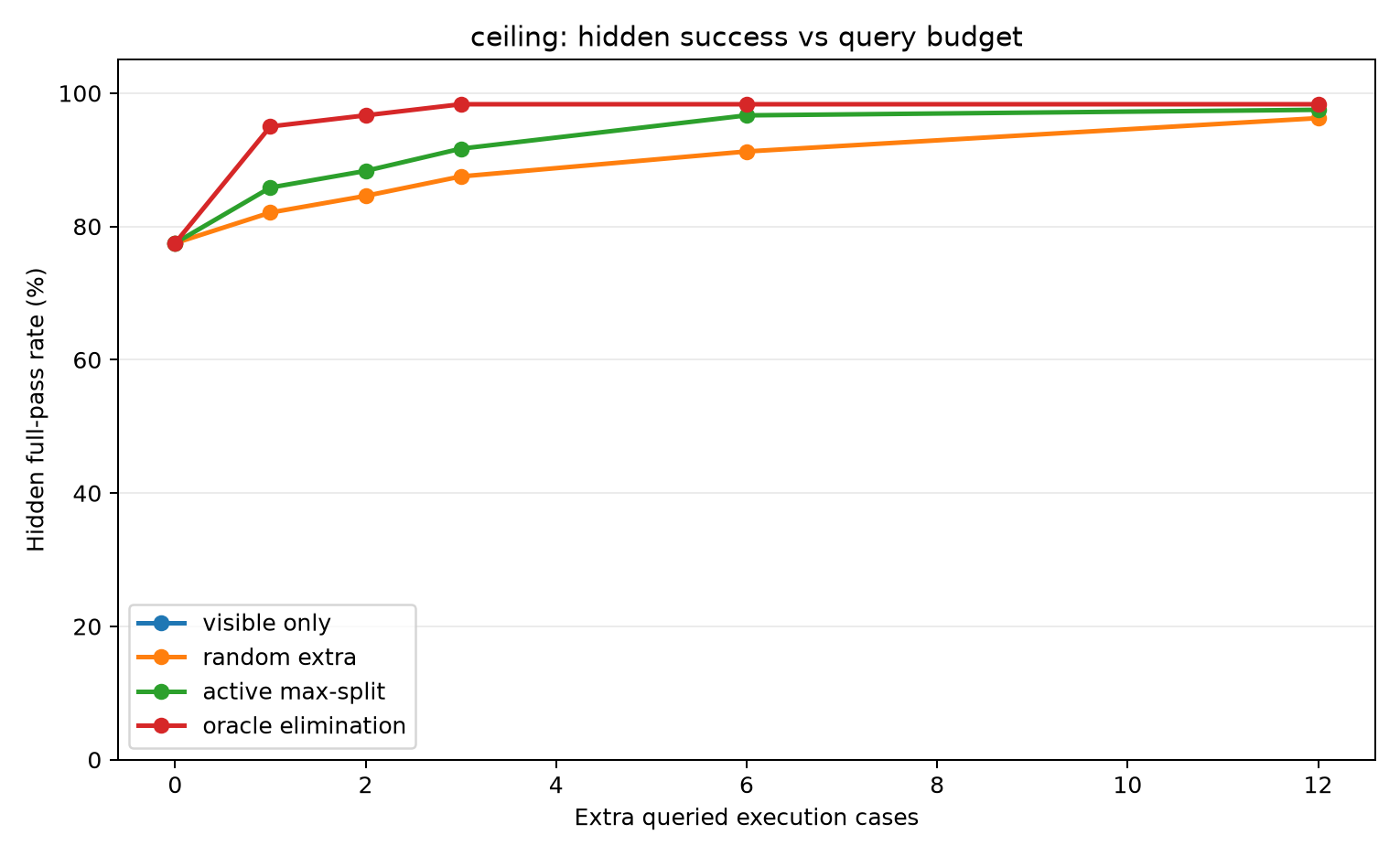
Left to right, more extra test cases are requested; higher means more programs pass every hidden test (better). One line picks the most revealing test each time, one picks at random, and a top line marks the best any chooser could do.
Takeaway → The smart-test line rises well above the random line at every budget, so deliberately chosen tests weed out wrong programs far faster.
Data table
| extra execution cases queried | active max-split | random extra cases | oracle elimination |
|---|---|---|---|
| 0 | 77.5% | 77.5% | 77.5% |
| 1 | 85.8% | 82.1% | 95% |
| 2 | 88.3% | 84.6% | 96.7% |
| 3 | 91.7% | 87.5% | 98.3% |
| 6 | 96.7% | 91.2% | 98.3% |
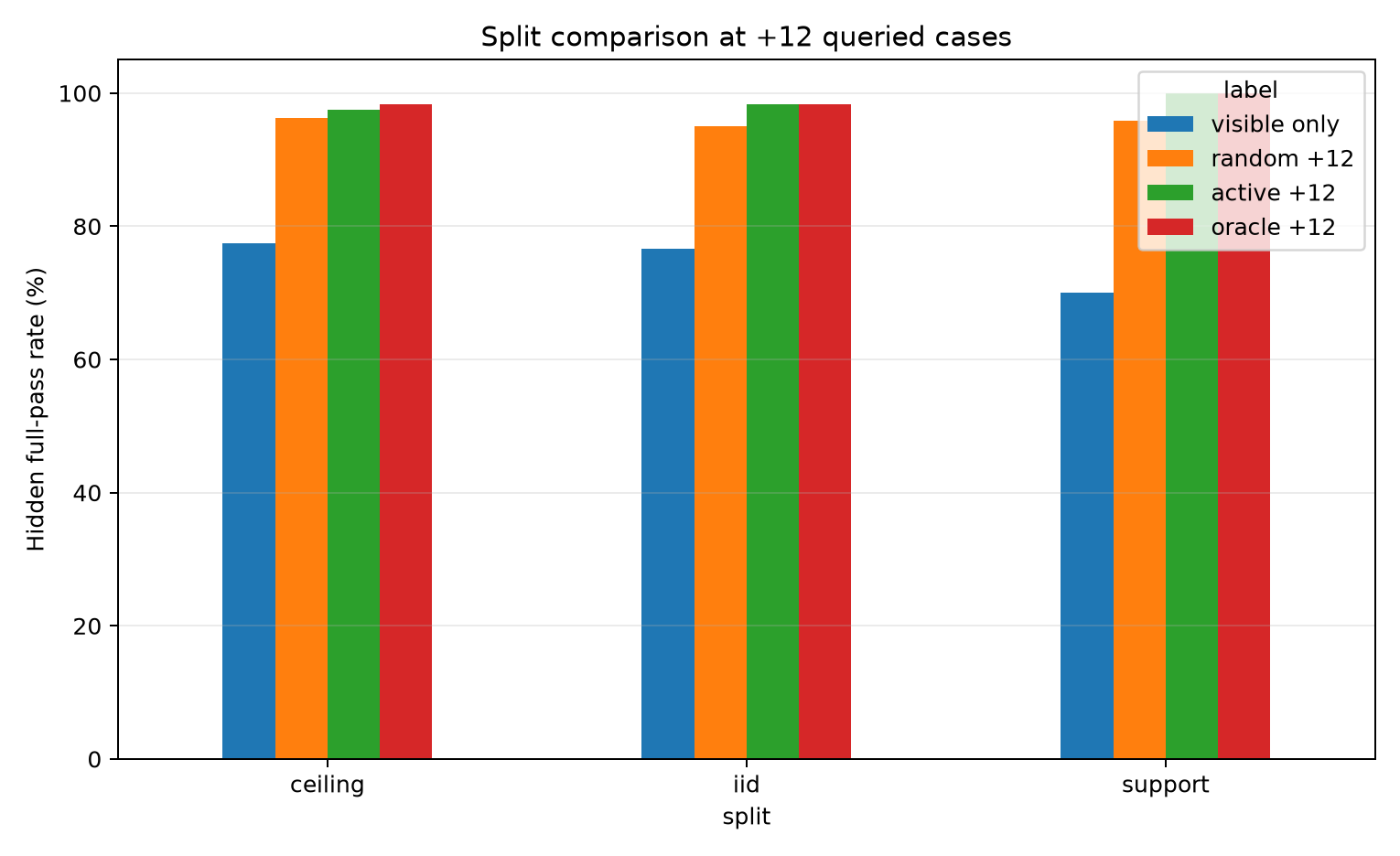
| 12 | 97.5% | 96.2% | 98.3% |
Numbers from experiments/qwen35_4b_active_counterexample_trace_selection/reports/policy_summary.csv
Technical framing
Actively queried counterexamples close the hidden-failure gap (ceiling split) — Visible-only selection passes 77.5% hidden; actively chosen counterexamples reach 97.5% at +12 queries, beating random at every budget.
How to read
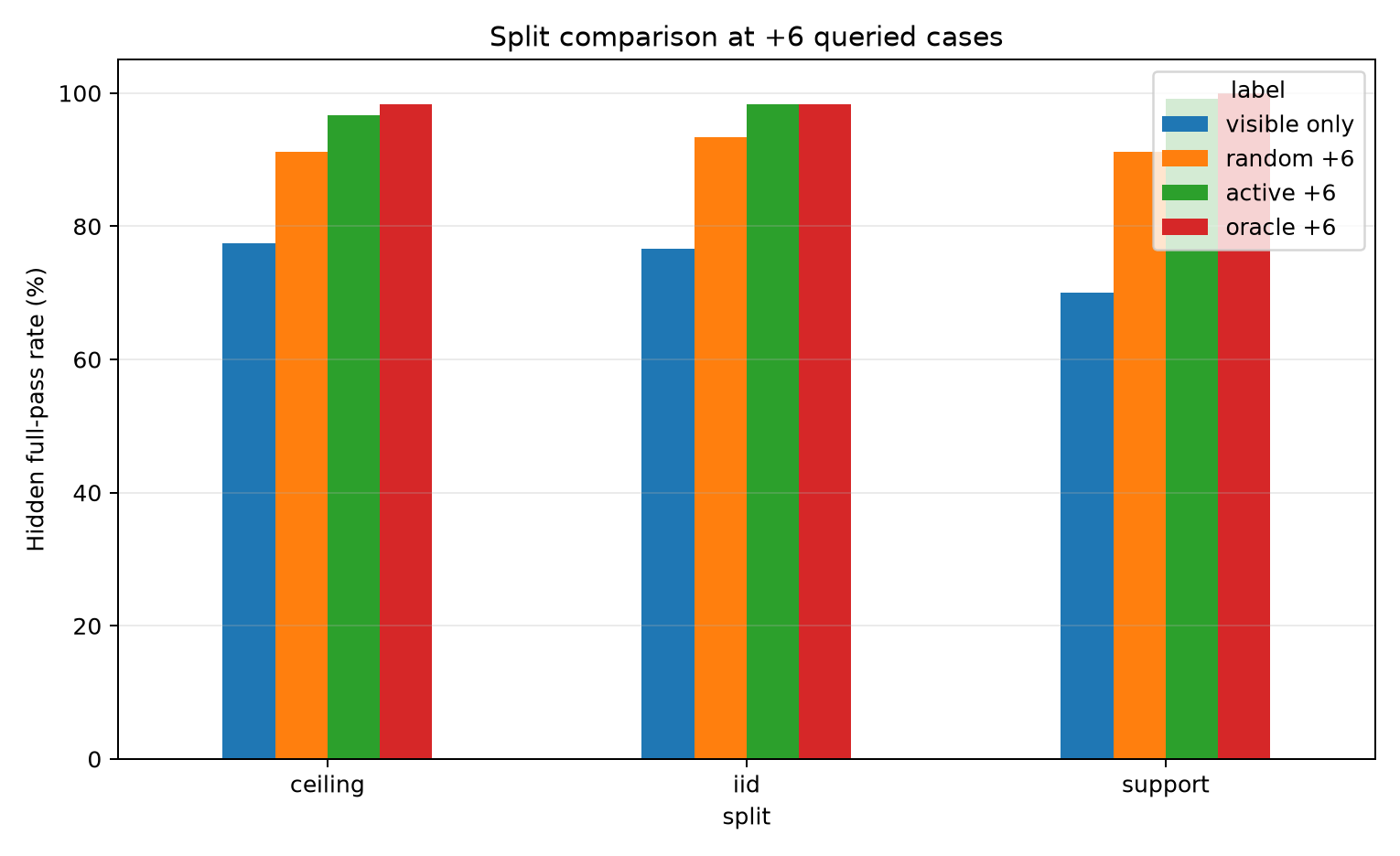
Each group of bars is one batch of problems; taller means more programs pass every hidden test (better). Within a group, bars run from committing with no extra tests, to six random tests, to six smart tests, to the best-possible chooser.
Takeaway → The six-smart-test bar nearly matches the best-possible bar and towers over the random bar on every batch.
Data table
| eval split | visible only (0 queries) | random extra (+6) | active max-split (+6) | oracle elimination (+6) |
|---|---|---|---|---|
| ceiling | 77.5% | 91.2% | 96.7% | 98.3% |
| support | 70% | 91.2% | 99.2% | 100% |
| IID | 76.7% | 93.3% | 98.3% | 98.3% |
Numbers from experiments/qwen35_4b_active_counterexample_trace_selection/reports/policy_summary.csv
Technical framing
Selection policy comparison at a 6-query budget, across splits — Six actively chosen cases recover most of the oracle's gain on all three splits; random queries at the same budget lag well behind.
How to read
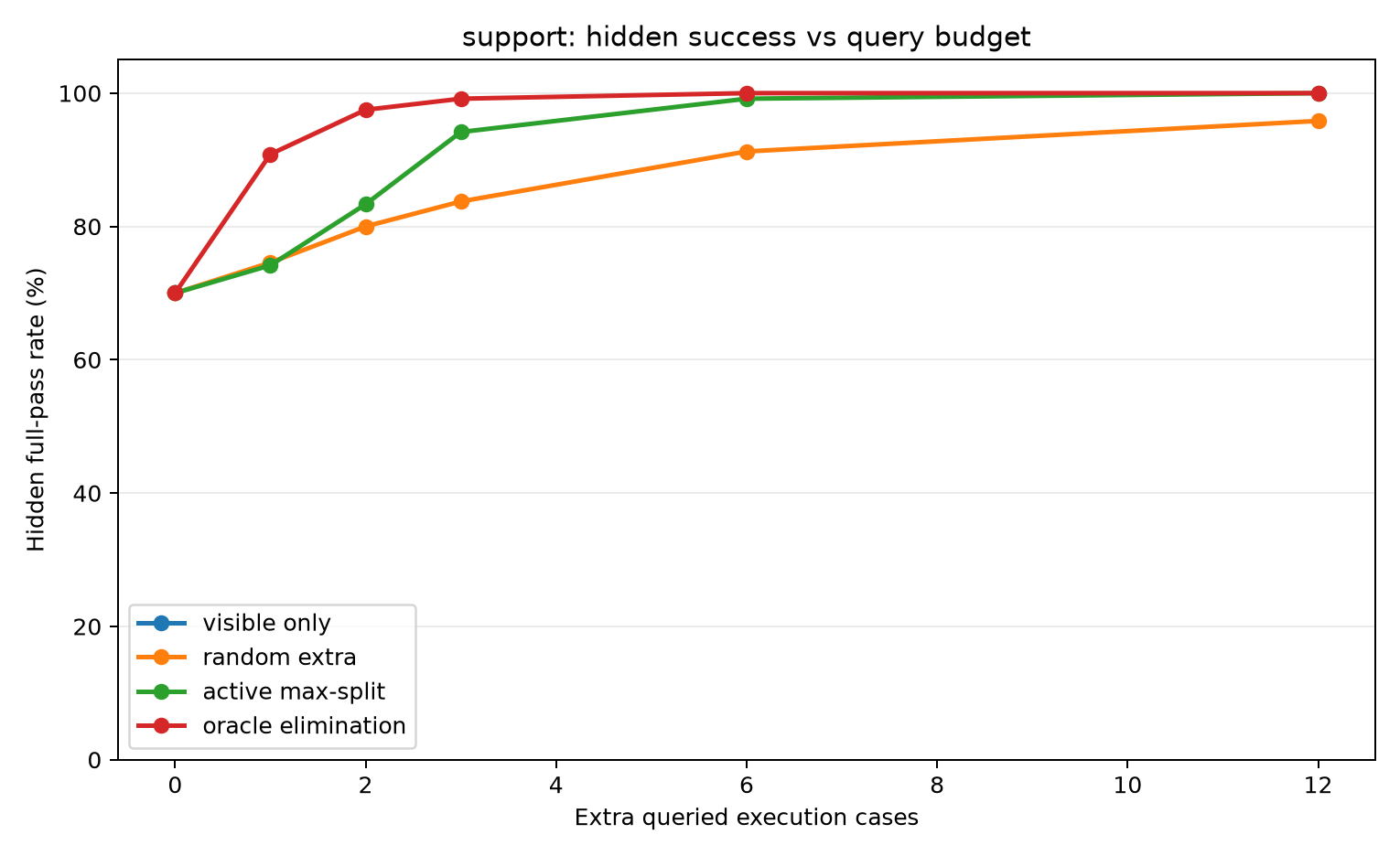
Left to right, more extra test cases are requested; higher means more programs pass every hidden test (better). One line picks the most revealing test each time, one picks at random, and a top line marks the best a chooser could do.
Takeaway → The smart-test line climbs to fully correct by twelve tests, matching the best-possible line, while random tests stall below it.
Data table
| extra execution cases queried | active max-split | random extra cases | oracle elimination |
|---|---|---|---|
| 0 | 70% | 70% | 70% |
| 1 | 74.2% | 74.6% | 90.8% |
| 2 | 83.3% | 80% | 97.5% |
| 3 | 94.2% | 83.8% | 99.2% |
| 6 | 99.2% | 91.2% | 100% |
| 12 | 100% | 95.8% | 100% |
Numbers from experiments/qwen35_4b_active_counterexample_trace_selection/reports/policy_summary.csv
Technical framing
Support split: active selection reaches 100% hidden full-pass at +12 queries — The hardest split for visible-only selection (70%) is fully solved by active querying at +12, matching the oracle upper bound.
In the author’s words from the Report · “Summary”
This standalone experiment tests whether a Qwen3.5-4B typed-sketch generator benefits from actively requested execution traces after candidate synthesis. The verifier first completes model-generated typed sketches into executable programs. Selection policies then choose whether to commit from the original visible trace or query additional cases from a held-out per-record pool. Best active ceiling result: 0.975 hidden full-pass rate at +12 queried cases.
Overview
Standalone experiment package for testing active execution-case acquisition after typed sketch synthesis.
The experiment trains a Qwen3.5-4B LoRA to emit typed DSL sketches, synthesizes executable candidate programs from those sketches, and compares selection policies that either commit from the original visible trace or request additional counterexample traces from a per-record query pool.
Large artifacts such as LoRA adapters and checkpoints are stored outside this directory under:
/workspace/large_artifacts/qwen35_4b_active_counterexample_trace_selection
Directory Layout
configs/: experiment configuration.data/: generated JSONL datasets and manifests.logs/: human-readable experiment log.reports/: result JSON, figures, and final report.run_logs/: command stdout/stderr captures.scripts/: runnable experiment scripts.src/: local DSL, data-generation, sketch, prompt, and modeling code.
Main Commands
python scripts/build_dataset.py
python scripts/train_adapter.py --task sketch --target-field target_sketch ...
python scripts/eval_active_selection.py --data data/eval/dsl_eval_ceiling.jsonl ...
python scripts/make_report.py
Report
Rendered from reports/qwen35_4b_active_counterexample_trace_selection_report.md
Summary
This standalone experiment tests whether a Qwen3.5-4B typed-sketch generator benefits from actively requested execution traces after candidate synthesis. The verifier first completes model-generated typed sketches into executable programs. Selection policies then choose whether to commit from the original visible trace or query additional cases from a held-out per-record pool.
Best active ceiling result: 0.975 hidden full-pass rate at +12 queried cases.
Key Findings
- Candidate coverage was not the bottleneck in this run: the exact target program was synthesized on every evaluated record across ceiling, support, and IID splits.
- Visible-only selection left substantial hidden failures despite passing all observed cases:
77.5%ceiling,70.0%support, and76.7%IID hidden full-pass. - Active max-split counterexample selection closed most of that gap: ceiling reached
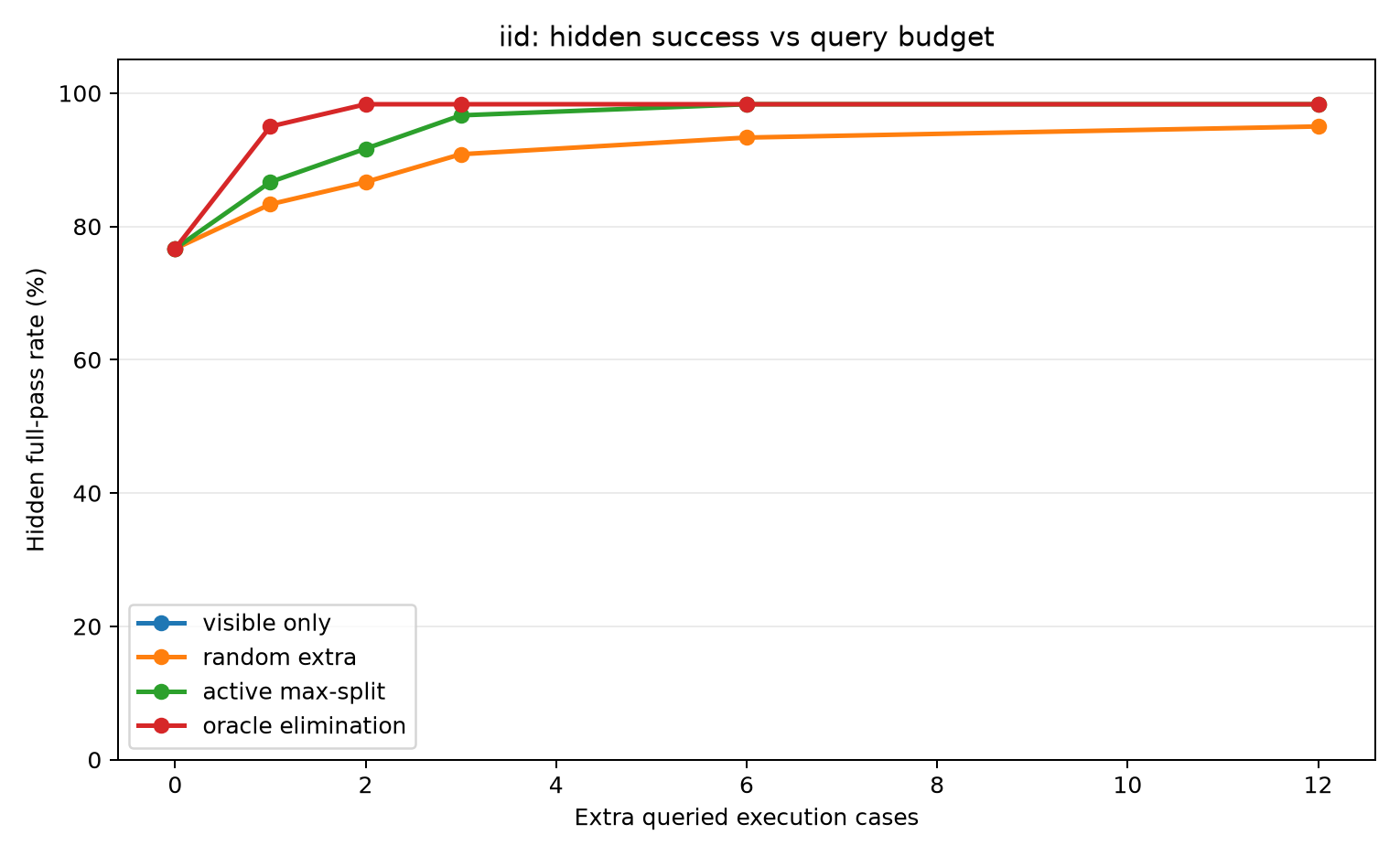
96.7%at+6and97.5%at+12; support reached99.2%at+6and100%at+12; IID reached98.3%at+6. - Active max-split consistently beat random extra cases at the same query budget, especially at low and medium budgets.
- The remaining ceiling gap is a policy-selection gap, not a synthesis-coverage gap: candidate oracle was
100%, while oracle-elimination under the same capped query pool reached98.3%.
Method
Each record provided six visible execution cases, eighteen hidden evaluation cases, and a deterministic active-query pool. Qwen3.5-4B generated typed sketches; the local verifier completed each sketch into executable DSL candidates; selection policies then chose programs after 0, 1, 2, 3, 6, or 12 additional queried execution cases.
Policy definitions:
visible_prior: commit using only the original visible cases.random_extra: query random additional cases, averaged over two repeats.active_max_split: greedily query the case that maximizes output-bucket entropy among currently viable candidates.oracle_elimination: upper-bound policy that greedily chooses the case that eliminates the most currently viable wrong candidates using the case's true expected output.
Candidate Coverage
| split | records | visible_selected_hidden_all_pct | candidate_oracle_hidden_all_pct | target_program_synthesized_pct | avg_synthesized_programs | avg_visible_consistent_candidates |
|---|---|---|---|---|---|---|
| ceiling | 120 | 77.5 | 100 | 100 | 3235.56 | 643.6 |
| iid | 60 | 76.667 | 100 | 100 | 1108.07 | 59.883 |
| support | 120 | 70 | 100 | 100 | 3320.9 | 251.325 |
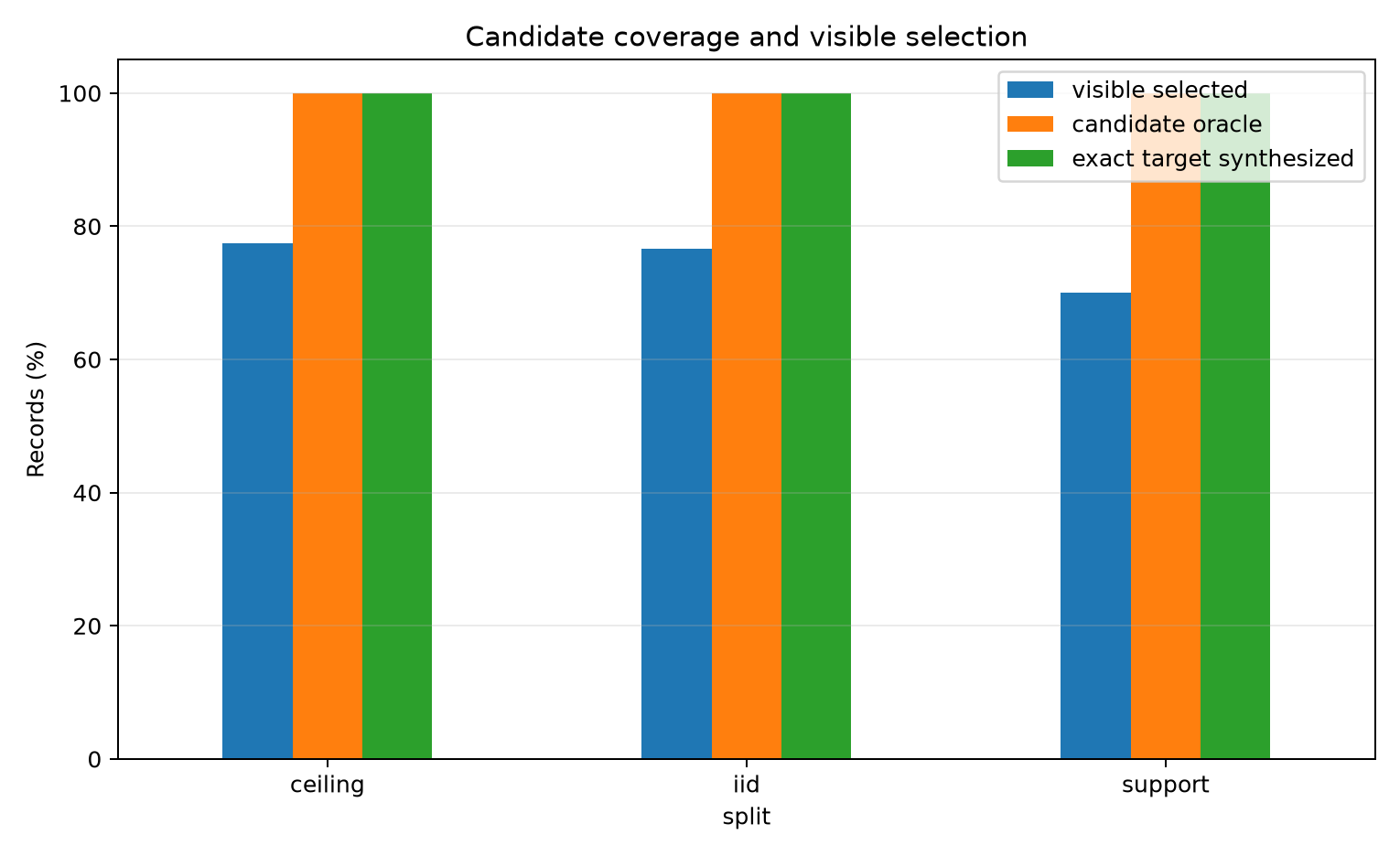
Policy Results
| split | policy | budget | rows | hidden_all_pct | observed_all_pct | avg_hidden_passes | avg_queries_used |
|---|---|---|---|---|---|---|---|
| ceiling | active_max_split | 0 | 120 | 77.5 | 100 | 17.2 | 0 |
| ceiling | active_max_split | 1 | 120 | 85.833 | 100 | 17.483 | 1 |
| ceiling | active_max_split | 2 | 120 | 88.333 | 100 | 17.625 | 2 |
| ceiling | active_max_split | 3 | 120 | 91.667 | 100 | 17.733 | 3 |
| ceiling | active_max_split | 6 | 120 | 96.667 | 100 | 17.908 | 6 |
| ceiling | active_max_split | 12 | 120 | 97.5 | 100 | 17.942 | 12 |
| ceiling | oracle_elimination | 0 | 120 | 77.5 | 100 | 17.2 | 0 |
| ceiling | oracle_elimination | 1 | 120 | 95 | 100 | 17.9 | 1 |
| ceiling | oracle_elimination | 2 | 120 | 96.667 | 100 | 17.958 | 2 |
| ceiling | oracle_elimination | 3 | 120 | 98.333 | 100 | 17.975 | 3 |
| ceiling | oracle_elimination | 6 | 120 | 98.333 | 100 | 17.975 | 6 |
| ceiling | oracle_elimination | 12 | 120 | 98.333 | 100 | 17.975 | 12 |
| ceiling | random_extra | 0 | 240 | 77.5 | 100 | 17.2 | 0 |
| ceiling | random_extra | 1 | 240 | 82.083 | 100 | 17.442 | 1 |
| ceiling | random_extra | 2 | 240 | 84.583 | 100 | 17.579 | 2 |
| ceiling | random_extra | 3 | 240 | 87.5 | 100 | 17.717 | 3 |
| ceiling | random_extra | 6 | 240 | 91.25 | 100 | 17.808 | 6 |
| ceiling | random_extra | 12 | 240 | 96.25 | 100 | 17.933 | 12 |
| ceiling | visible_prior | 0 | 120 | 77.5 | 100 | 17.2 | 0 |
| iid | active_max_split | 0 | 60 | 76.667 | 100 | 17.1 | 0 |
| iid | active_max_split | 1 | 60 | 86.667 | 100 | 17.483 | 1 |
| iid | active_max_split | 2 | 60 | 91.667 | 100 | 17.783 | 2 |
| iid | active_max_split | 3 | 60 | 96.667 | 100 | 17.917 | 3 |
| iid | active_max_split | 6 | 60 | 98.333 | 100 | 17.983 | 6 |
| iid | active_max_split | 12 | 60 | 98.333 | 100 | 17.983 | 12 |
| iid | oracle_elimination | 0 | 60 | 76.667 | 100 | 17.1 | 0 |
| iid | oracle_elimination | 1 | 60 | 95 | 100 | 17.75 | 1 |
| iid | oracle_elimination | 2 | 60 | 98.333 | 100 | 17.983 | 2 |
| iid | oracle_elimination | 3 | 60 | 98.333 | 100 | 17.983 | 3 |
| iid | oracle_elimination | 6 | 60 | 98.333 | 100 | 17.983 | 6 |
| iid | oracle_elimination | 12 | 60 | 98.333 | 100 | 17.983 | 12 |
| iid | random_extra | 0 | 120 | 76.667 | 100 | 17.1 | 0 |
| iid | random_extra | 1 | 120 | 83.333 | 100 | 17.508 | 1 |
| iid | random_extra | 2 | 120 | 86.667 | 100 | 17.642 | 2 |
| iid | random_extra | 3 | 120 | 90.833 | 100 | 17.792 | 3 |
| iid | random_extra | 6 | 120 | 93.333 | 100 | 17.883 | 6 |
| iid | random_extra | 12 | 120 | 95 | 100 | 17.925 | 12 |
| iid | visible_prior | 0 | 60 | 76.667 | 100 | 17.1 | 0 |
| support | active_max_split | 0 | 120 | 70 | 100 | 16.708 | 0 |
| support | active_max_split | 1 | 120 | 74.167 | 100 | 16.892 | 1 |
| support | active_max_split | 2 | 120 | 83.333 | 100 | 17.317 | 2 |
| support | active_max_split | 3 | 120 | 94.167 | 100 | 17.783 | 3 |
| support | active_max_split | 6 | 120 | 99.167 | 100 | 17.958 | 6 |
| support | active_max_split | 12 | 120 | 100 | 100 | 18 | 12 |
| support | oracle_elimination | 0 | 120 | 70 | 100 | 16.708 | 0 |
| support | oracle_elimination | 1 | 120 | 90.833 | 100 | 17.667 | 1 |
| support | oracle_elimination | 2 | 120 | 97.5 | 100 | 17.925 | 2 |
| support | oracle_elimination | 3 | 120 | 99.167 | 100 | 17.967 | 3 |
| support | oracle_elimination | 6 | 120 | 100 | 100 | 18 | 6 |
| support | oracle_elimination | 12 | 120 | 100 | 100 | 18 | 12 |
| support | random_extra | 0 | 240 | 70 | 100 | 16.708 | 0 |
| support | random_extra | 1 | 240 | 74.583 | 100 | 16.95 | 1 |
| support | random_extra | 2 | 240 | 80 | 100 | 17.179 | 2 |
| support | random_extra | 3 | 240 | 83.75 | 100 | 17.35 | 3 |
| support | random_extra | 6 | 240 | 91.25 | 100 | 17.696 | 6 |
| support | random_extra | 12 | 240 | 95.833 | 100 | 17.896 | 12 |
| support | visible_prior | 0 | 120 | 70 | 100 | 16.708 | 0 |
Interpretation
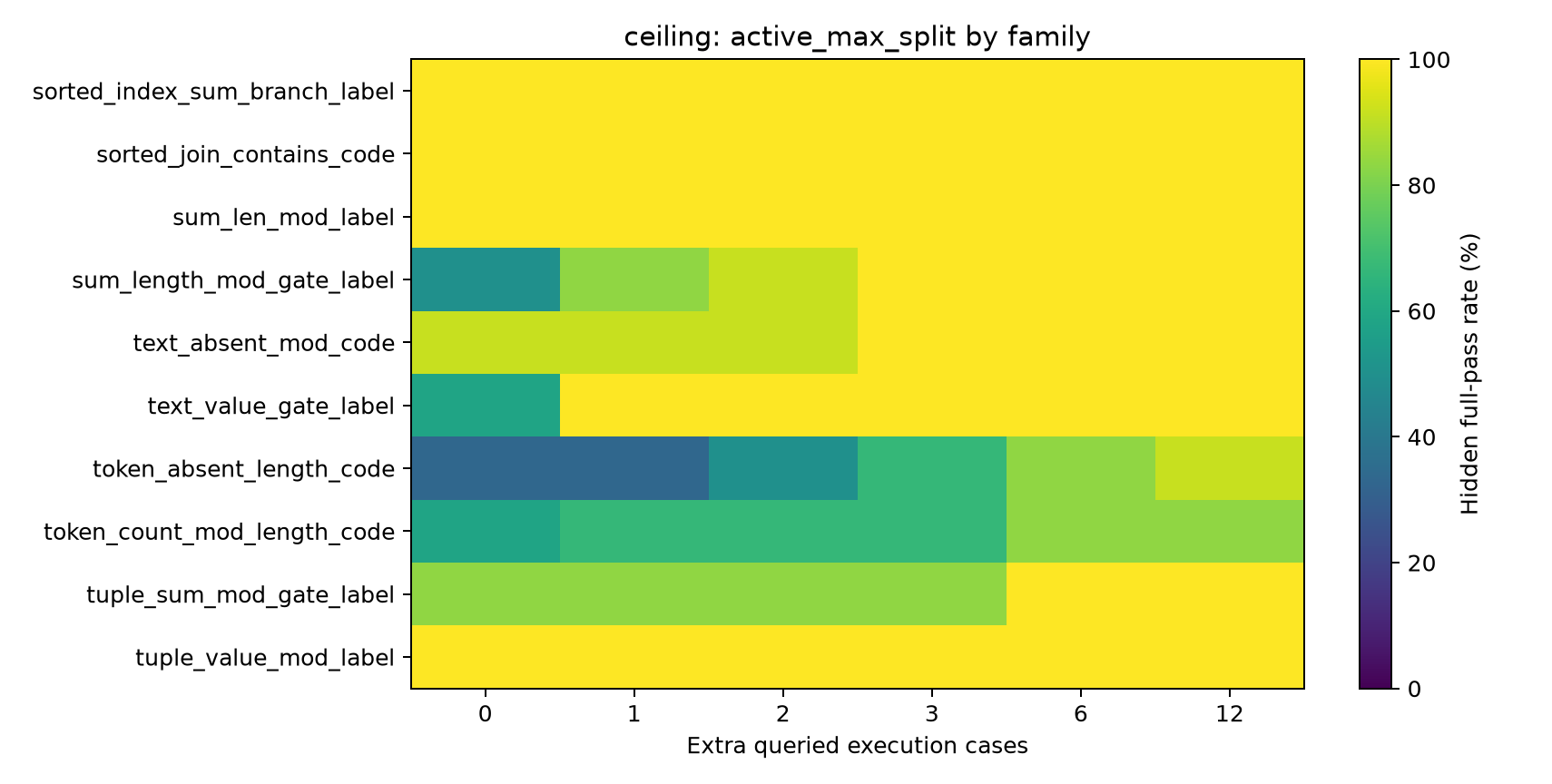
The primary question is whether extra traces close the gap between visible-trace selection and the candidate oracle. A large active improvement with a remaining oracle gap means the policy is useful but still leaves selection work. A small active improvement with a large oracle gap means the split heuristic is not finding the right discriminators. A small oracle gap means candidate synthesis is the current limiting factor.
Reproducibility
- Dataset manifest:
data/dataset_manifest.json - Config:
configs/experiment.json - Eval JSON files:
reports/eval/active_iid.json,reports/eval/active_support.json,reports/eval/active_ceiling.json - Policy summary CSV:
reports/policy_summary.csv - Candidate summary CSV:
reports/candidate_summary.csv - Large artifacts:
/workspace/large_artifacts/qwen35_4b_active_counterexample_trace_selection
Experiment log 12
Show the running log (12 entries, 2026-06-24)
2026-06-24 02:26 UTC
Initialized a standalone active counterexample trace-selection experiment package.
Design commitments:
- Use
Qwen/Qwen3.5-4B. - Train a fresh local sketch LoRA for this experiment instead of depending on another run's adapter.
- Keep checkpoints and adapters under
/workspace/large_artifacts/qwen35_4b_active_counterexample_trace_selection. - Store each eval record with its own deterministic active-query case pool.
- Compare original visible-trace selection against random extra cases, active max-split cases, and an oracle-elimination upper bound.
2026-06-24 02:34 UTC
Implemented:
scripts/build_dataset.py: dataset builder with per-record active query pools.scripts/eval_active_selection.py: Qwen sketch generation, typed-sketch candidate synthesis, and active selection policies.scripts/make_report.py: CSV summaries, plots, and final Markdown report generation.
Next check: syntax/import validation, then a target-sketch smoke run before model training.
2026-06-24 02:36 UTC
Dataset build iteration 1 failed before writing data:
TypeError: base_records() got an unexpected keyword argument 'case_pool_count'Cause: the prior base-family record helper did not expose active query-pool generation.
Fix: patched local src/data_gen.py so base_records accepts case_pool_count and case_mode, passing both through to make_record.
2026-06-24 02:41 UTC
Target-sketch smoke iteration 1 was interrupted after ~74 seconds on record 1.
Cause: the evaluator called raw selection repeatedly, reparsing and reevaluating all programs against hidden cases for every policy snapshot.
Fixes:
- Added
ProgramBankto parse each candidate program once per record. - Cached program outputs by
(program_index, case_key). - Replaced repeated raw selection with cached per-record selection.
2026-06-24 02:45 UTC
Target-sketch smoke iteration 2 still ran too slowly with a 384-case scoring pool.
Fix:
- Added deterministic
--max-query-pool-cases. - All policies now share the same capped per-record query pool.
2026-06-24 02:48 UTC
Target-sketch smoke iteration 3 completed:
- Command:
python scripts/eval_active_selection.py --data data/eval/dsl_eval_ceiling.jsonl --sketch-source target --output reports/eval/_smoke_target_ceiling10.json --max-records 10 --budgets 0,1,2,3,6 --random-repeats 2 --max-total-programs-per-record 4000 --max-policy-candidates 128 --max-query-pool-cases 48 - Result: candidate oracle
10/10; visible-only selected10/10. - Interpretation: smoke validates evaluator mechanics; it is not diagnostic because this first 10-record slice is already solved from visible traces.
Next step: train the experiment-local Qwen3.5-4B sketch LoRA.
2026-06-24 03:07 UTC
Sketch LoRA training completed successfully.
Command:
python scripts/train_adapter.py --train data/static_bridge_80/dsl_train.jsonl --eval data/eval/dsl_eval_iid.jsonl --task sketch --target-field target_sketch --prompt-mode trace --output-dir /workspace/large_artifacts/qwen35_4b_active_counterexample_trace_selection/models/sketch_lora --epochs 2.0 --lr 1.5e-4 --rank 32 --alpha 64 --dropout 0.05 --grad-accum 8 --save-steps 30 --eval-steps 30Observed:
- Trainable parameters:
42,467,328. - Step 30 eval loss:
0.0007196. - Step 60 eval loss:
0.0004834. - Train runtime:
959.9seconds. - Final adapter/checkpoint tree size:
709M. - Large artifact location:
/workspace/large_artifacts/qwen35_4b_active_counterexample_trace_selection/models/sketch_lora.
Next step: model-generated smoke eval on the ceiling split.
2026-06-24 03:12 UTC
Model-generated ceiling smoke completed.
Command:
python scripts/eval_active_selection.py --data data/eval/dsl_eval_ceiling.jsonl --adapter /workspace/large_artifacts/qwen35_4b_active_counterexample_trace_selection/models/sketch_lora --sketch-source model --output reports/eval/_smoke_model_ceiling10.json --max-records 10 --budgets 0,1,2,3,6 --random-repeats 2 --num-samples 3 --max-total-programs-per-record 4000 --max-policy-candidates 128 --max-query-pool-cases 48Observed on the 10-record smoke slice:
- Candidate oracle:
10/10. - Exact target synthesized:
10/10. - Visible-only hidden full-pass:
6/10. - Active max-split +1 query:
10/10. - Random +1 query:
15/20over two repeats.
Interpretation: the full model-in-loop path is working, and the smoke directly exhibits the intended effect: active counterexample traces close a visible-selection ambiguity gap.
Next step: full ceiling eval with the same capped policy settings plus budget 12.
2026-06-24 03:51 UTC
Full ceiling eval completed.
Command:
python scripts/eval_active_selection.py --data data/eval/dsl_eval_ceiling.jsonl --adapter /workspace/large_artifacts/qwen35_4b_active_counterexample_trace_selection/models/sketch_lora --sketch-source model --output reports/eval/active_ceiling.json --budgets 0,1,2,3,6,12 --random-repeats 2 --num-samples 3 --max-total-programs-per-record 4000 --max-policy-candidates 128 --max-query-pool-cases 48Primary results:
- Candidate oracle:
120/120. - Exact target synthesized:
120/120. - Visible-only:
93/120hidden full-pass. - Active max-split +1:
103/120. - Active max-split +3:
110/120. - Active max-split +6:
116/120. - Active max-split +12:
117/120. - Oracle elimination +12:
118/120. - Random +12:
231/240over two repeats.
Interpretation: active counterexample traces substantially close the selection gap on the primary split; the remaining gap is selection-policy quality, not candidate coverage.
Next step: support and IID retention evals with the same settings.
2026-06-24 04:27 UTC
Full support eval completed.
Command:
python scripts/eval_active_selection.py --data data/eval/dsl_eval_support.jsonl --adapter /workspace/large_artifacts/qwen35_4b_active_counterexample_trace_selection/models/sketch_lora --sketch-source model --output reports/eval/active_support.json --budgets 0,1,2,3,6,12 --random-repeats 2 --num-samples 3 --max-total-programs-per-record 4000 --max-policy-candidates 128 --max-query-pool-cases 48Results:
- Candidate oracle:
120/120. - Exact target synthesized:
120/120. - Visible-only:
84/120. - Active max-split +1:
89/120. - Active max-split +3:
113/120. - Active max-split +6:
119/120. - Active max-split +12:
120/120. - Oracle elimination +6/+12:
120/120. - Random +12:
230/240over two repeats.
Interpretation: active selection is not only a ceiling-split effect; it also closes nearly all support-selection ambiguity under the same policy.
Next step: IID retention eval.
2026-06-24 04:38 UTC
Full IID eval completed.
Command:
python scripts/eval_active_selection.py --data data/eval/dsl_eval_iid.jsonl --adapter /workspace/large_artifacts/qwen35_4b_active_counterexample_trace_selection/models/sketch_lora --sketch-source model --output reports/eval/active_iid.json --budgets 0,1,2,3,6,12 --random-repeats 2 --num-samples 3 --max-total-programs-per-record 4000 --max-policy-candidates 128 --max-query-pool-cases 48Results:
- Candidate oracle:
60/60. - Exact target synthesized:
60/60. - Visible-only:
46/60. - Active max-split +1:
52/60. - Active max-split +3:
58/60. - Active max-split +6:
59/60. - Active max-split +12:
59/60. - Oracle elimination +2/+3/+6/+12:
59/60. - Random +12:
114/120over two repeats.
Interpretation: the same active-query selection mechanism improves IID retention too; one record remains unresolved even under the oracle-elimination policy within the capped candidate/pool policy settings.
Next step: generate report, plots, and CSV summaries.
2026-06-24 04:40 UTC
Generated final reports and figures.
Command:
python scripts/make_report.pyArtifacts:
- Final report:
reports/qwen35_4b_active_counterexample_trace_selection_report.md. - Summary CSVs:
reports/policy_summary.csv,reports/candidate_summary.csv. Figures:
reports/figures/candidate_coverage.pngreports/figures/ceiling_success_by_budget.pngreports/figures/support_success_by_budget.pngreports/figures/iid_success_by_budget.pngreports/figures/split_comparison_budget6.pngreports/figures/split_comparison_budget12.pngreports/figures/ceiling_active_family_heatmap.png
Manual post-generation edit: added key findings and method definitions to the report.
Figures 7
Data files 2
Result tables and metrics copied from the experiment folder — preview inline or open the raw file.
Reproduce
Run steps are documented inside the experiment folder (README and scripts).