Qwen Active Crystallizer Public Gate
The one idea you need
Spreadsheets can watch you fill a few cells and infer one rule for the whole column. Here, thousands of candidate rules fit the shown examples, and a small model's yes/no votes on invented rows had to pick the single rule that holds on every future row.
The question
A model can usually reformat one text example correctly. Can its yes/no votes be distilled into a single fixed rule that reliably handles every future row?
What we found
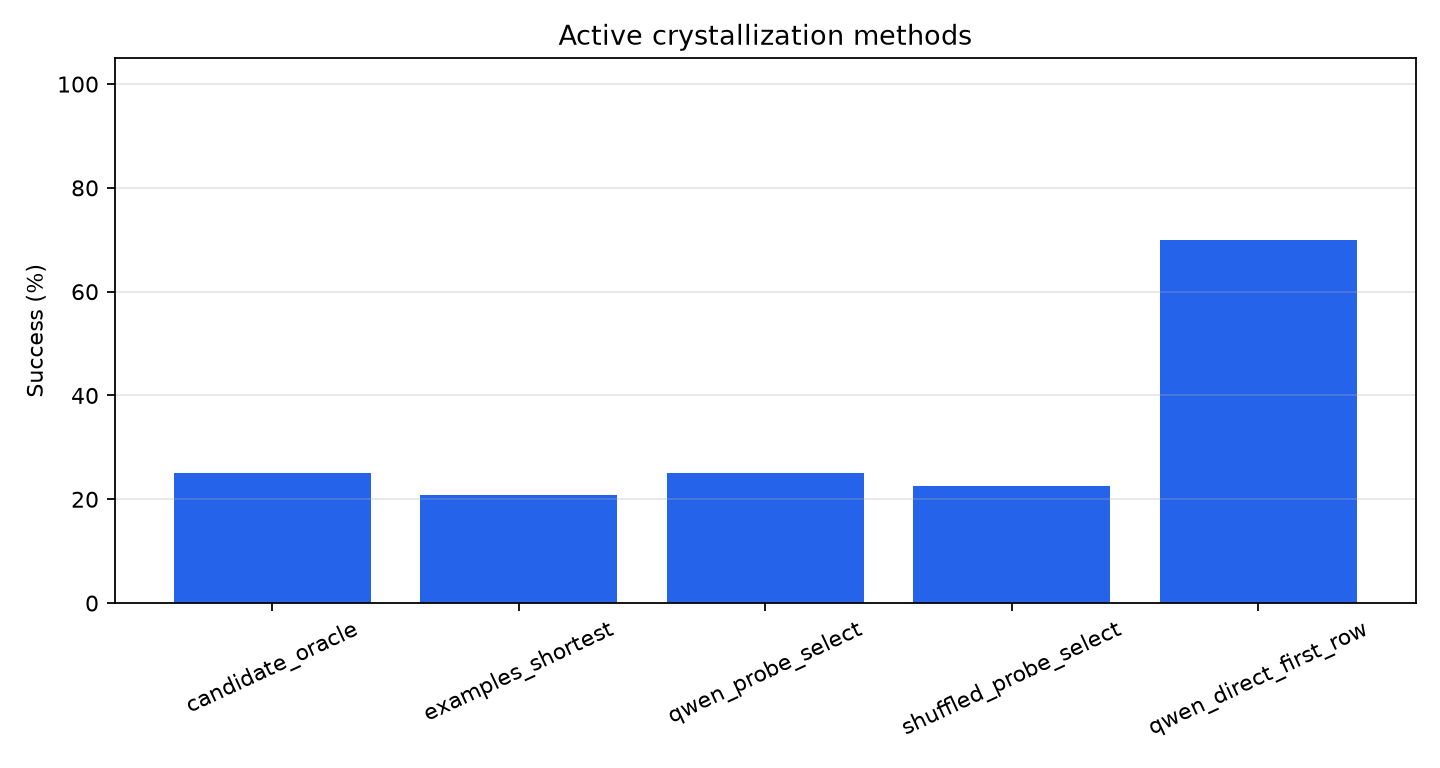
No. Using the model's votes to choose a rule worked on 25% of tasks — barely above the 22.5% you get from scrambled, meaningless votes, and it never beat the best rule the candidate pool could offer. The model answered individual unseen rows correctly about 80% of the time, yet almost never turned that skill into one dependable rule.
Why it matters
A model being right row by row does not mean you can compile it into one reusable rule. If you need a rule that holds on every input, test whole-task consistency, not sampled rows — the per-row skill collapses.
On this page
Results at a glance 6
How to read
Each bar is one method; height is the share of tasks solved on unseen rows, taller is better. Bars cover model votes, scrambled votes, plain shortest-rule picking, the best rule available, and the model answering one row directly.
Takeaway → The model-vote bar sits level with the scrambled-vote bar and the best-available ceiling, all far below the tall direct-answering bar.
Data table
| method | held-out success rate |
|---|---|
| direct Qwen, one held-out row | 70% |
| candidate oracle ceiling | 25% |
| Qwen probe-label selection | 25% |
| shuffled-label control | 22.5% |
| examples-only shortest | 20.8% |
Numbers from analysis/qwen_summary.csv
Technical framing
Program selection vs direct answering on the Qwen-probe subset (120 tasks) — Qwen probe labels reach the 25% oracle ceiling but add only 2.5pp over shuffled labels, far below Qwen's 70% direct row answering.
How to read
Three bars on the same forty tasks; height is exact-match rate, taller is better. Left: model answering single rows; middle: model getting every row of a task right; right: one picked rule getting every row right.
Takeaway → The tall single-row bar collapses when every row must match, and the picked-rule bar collapses furthest, showing consistency is the weak point.
Data table
| metric | exact-match rate |
|---|---|
| direct Qwen, per-row exact | 79.9% |
| direct Qwen, all rows exact | 37.5% |
| selected program, all rows exact | 12.5% |
Numbers from analysis/qwen_direct_full_summary.csv; 12.5% (5/40) from report table
Technical framing
Strict diagnostic: row accuracy vs full-task consistency (same 40 tasks) — Direct Qwen gets 79.9% of rows right but only 37.5% of whole tasks; crystallized programs manage just 12.5% on the same tasks.
How to read
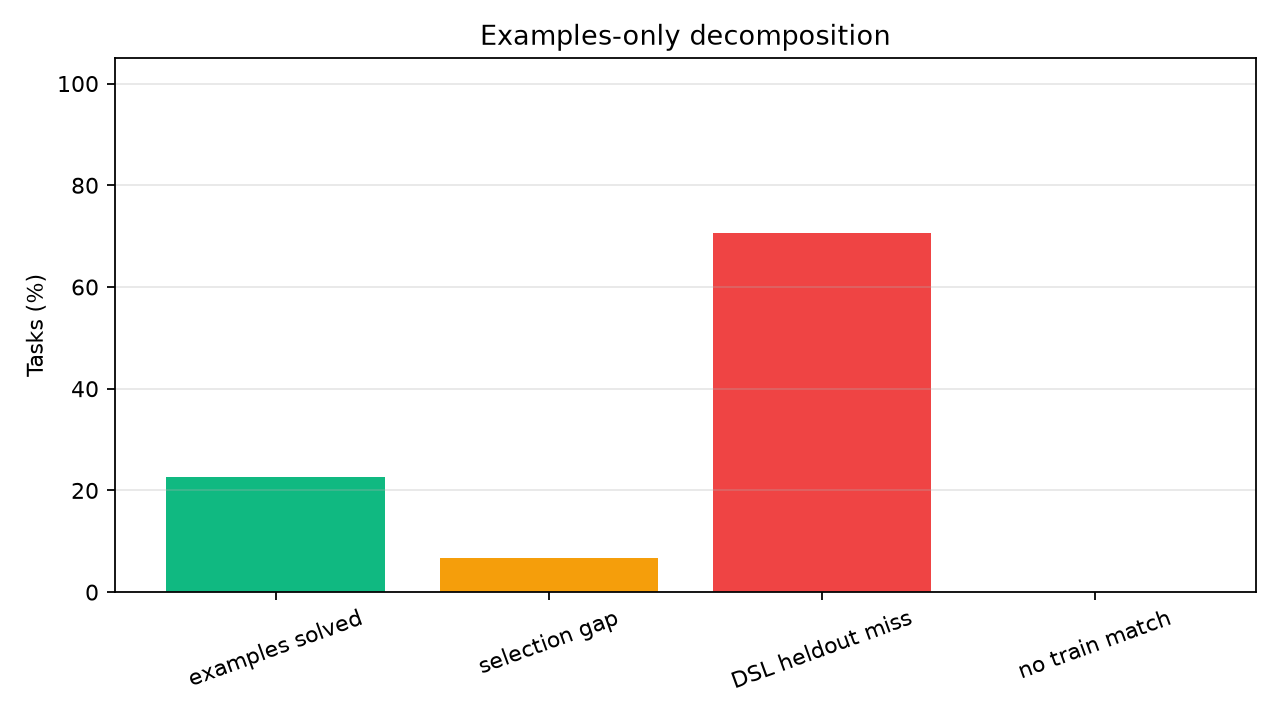
Three bars, height is share of tasks, taller is better. Left: tasks where some rule fits the shown examples; middle: tasks where a fitting rule also handles unseen rows; right: picking the shortest fitting rule.
Takeaway → Every task has a rule fitting the examples, yet only about a third of those rules generalize, so fitting examples is easy but generalizing is not.
Data table
| condition | task rate |
|---|---|
| some program fits train examples | 100% |
| oracle: a train-fitting program is held-out valid | 29.4% |
| examples-only shortest selection | 22.7% |
Numbers from analysis/static_summary.csv
Technical framing
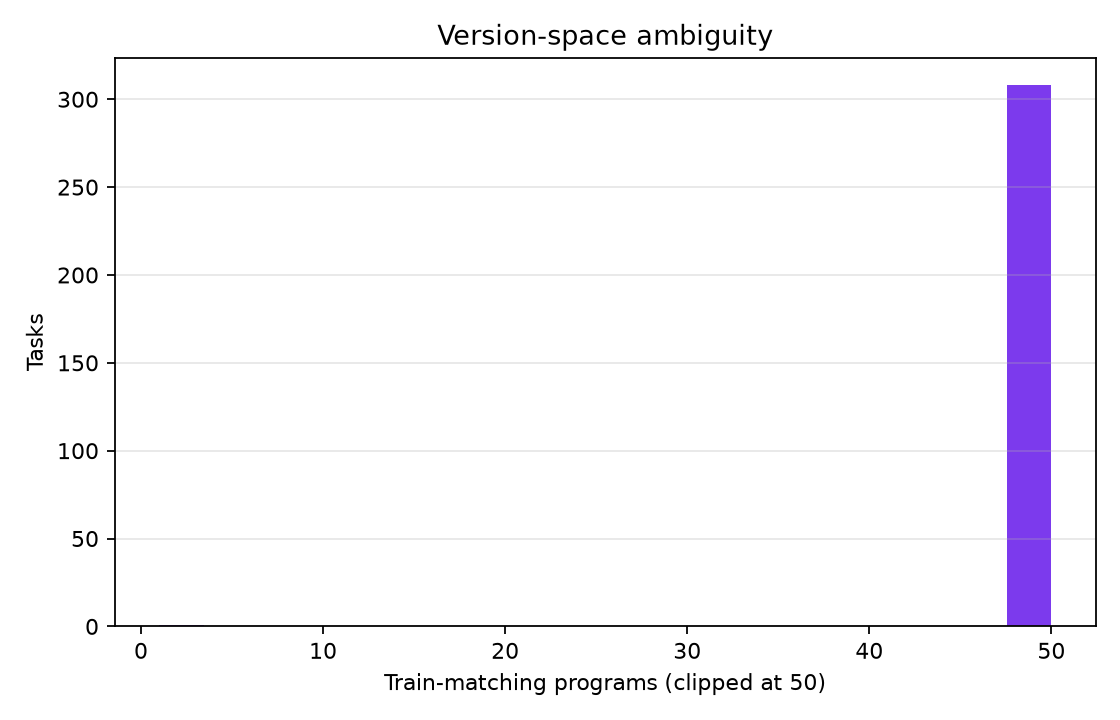
Candidate DSL coverage across all static tasks (309 tasks) — Every task has train-fitting programs, but only 29.4% have one that generalizes: the bottleneck is held-out validity, not train fit.
How to read
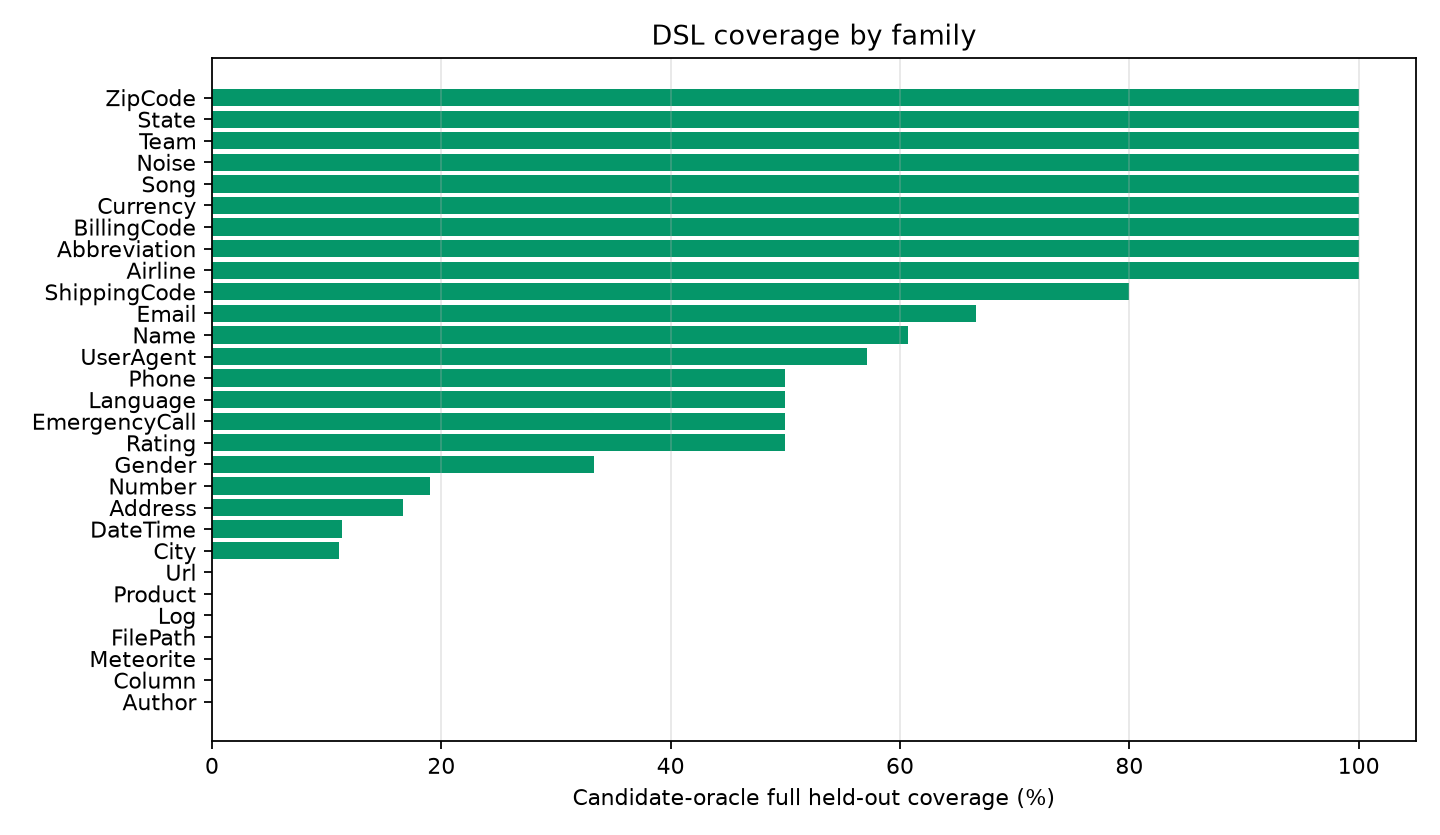
Task kinds along the bottom; paired bars show the best rule available versus the plain shortest-rule pick; taller is better. The two largest kinds, date-and-time and numbers, appear first.
Takeaway → The date-and-time and number bars are lowest despite being the biggest groups, dragging overall rule coverage down below simpler kinds.
Data table
| Task family (10 largest, by task count) | Candidate oracle coverage | Examples-only shortest program |
|---|---|---|
| DateTime (106) | 11% | 9% |
| Number (84) | 19% | 13% |
| Name (28) | 61% | 43% |
| Phone (16) | 50% | 38% |
| ShippingCode (10) | 80% | 70% |
| City (9) | 11% | 0% |
| Email (6) | 67% | 67% |
| BillingCode (6) | 100% | 67% |
| Address (6) | 17% | 0% |
| UserAgent (7) | 57% | 43% |
Numbers from report table (Family Breakdown, reports/qwen_active_crystallizer_public_gate_report.md)
Technical framing
Oracle DSL ceiling vs examples-only selection by task family — The DSL ceiling collapses on the two biggest families, DateTime and Number, so overall coverage is capped well below simpler families.
How to read
Three run sizes along the bottom; grouped bars show each method's share of tasks solved on unseen rows, taller is better. Bars include model votes, scrambled votes, the best rule available, shortest-rule picking, and direct answering.
Takeaway → Across all three sizes the model-vote bars stay pinned near the scrambled-vote and best-available bars, while direct answering stays far higher.
Data table
| Run suite (Qwen-probe tasks) | Candidate oracle | Qwen probe select | Shuffled probe control | Examples shortest | Qwen direct (first row) |
|---|---|---|---|---|---|
| Smoke (12 tasks) | 50% | 33.3% | 25% | 33.3% | 75% |
| Pilot (50 tasks) | 20% | 18% | 18% | 16% | 70% |
| Main (120 tasks) | 25% | 25% | 22.5% | 20.8% | 70% |
Numbers from runs/smoke_v1/qwen_summary.csv, runs/pilot_v1/qwen_summary.csv, runs/main_v1/qwen_summary.csv
Technical framing
Probe-selection methods across smoke, pilot, and main suites — The pattern is stable across suite sizes: probe selection hugs the oracle ceiling with only a thin margin over shuffled labels.
How to read
Three sample sizes along the bottom; paired bars show the best rule available versus the plain shortest-rule pick; taller is better. Only the largest sample gives a stable reading.
Takeaway → The best-available bar swings widely between small samples, so only the full-size run gives a trustworthy estimate of how far rules can reach.
Data table
| Static task sample | Candidate oracle coverage | Examples-only shortest program |
|---|---|---|
| Smoke (35 tasks) | 45.7% | 31.4% |
| Pilot (100 tasks) | 18% | 13% |
| Main (309 tasks) | 29.4% | 22.7% |
Numbers from runs/smoke_v1/static_summary.csv, runs/pilot_v1/static_summary.csv, runs/main_v1/static_summary.csv
Technical framing
DSL oracle ceiling estimate depends on the task sample — Oracle coverage swings from 46% to 18% across samples; only the full 309-task run gives a trustworthy 29% ceiling.
In the author’s words from the Report · “Abstract”
This standalone experiment tests whether frozen Qwen probe labels can select a deterministic transformation program from sparse examples. The model labels synthetic train-like probes; held-out benchmark rows are used only for evaluation.
Overview
Standalone experiment testing whether frozen Qwen probe labels can turn sparse example-level transformation behavior into a deterministic program selected from a broad candidate DSL.
Question
Can a model's direct few-shot transformation behavior be crystallized into a single executable program that generalizes across held-out rows?
Method
- Use public Microsoft PROSE
Transformation.Texttasks. - Split each task into train and held-out rows.
- Generate a broad deterministic candidate DSL from train inputs only.
- Generate synthetic probe inputs from train inputs only.
- Ask frozen
Qwen/Qwen3-4Bto label selected probes. - Select among train-fitting candidate programs using probe-label agreement.
- Compare against examples-only selection, shuffled probe labels, and oracle candidate coverage.
Artifacts
- Source:
src/qwen_active_crystallizer_public_gate.py - Reports:
reports/ - Metrics and figures:
analysis/ - Public benchmark checkout:
/workspace/large_artifacts/qwen_active_crystallizer_public_gate/prose-benchmarks
Report
Rendered from reports/qwen_active_crystallizer_public_gate_report.md
Abstract
This standalone experiment tests whether frozen Qwen probe labels can select a deterministic transformation program from sparse examples. The model labels synthetic train-like probes; held-out benchmark rows are used only for evaluation.
Method
- Dataset: public Microsoft PROSE
Transformation.Texttasks. - Split: first
4examples are train examples; up to50following examples are held out. - Candidate DSL: extraction, casing, regex groups, date/time/number utilities, affixes, two-part concatenation, and small finite maps.
- Candidate oracle: whether any train-fitting candidate also matches all held-out rows.
- Examples-only selector: shortest train-fitting candidate.
- Active crystallizer: Qwen labels synthetic train-like probes chosen to maximize candidate disagreement; the selected program is then evaluated on all held-out rows.
- Shuffled-label control: same probes, but labels are rotated before program selection.
- Direct Qwen baseline: one held-out query per sampled task, not a full-task program-consistency metric.
Run Configuration
- Suite:
main. - Static candidate tasks:
309. - Qwen-probe tasks:
120. - Qwen model:
Qwen/Qwen3-4B. - Max candidates per task:
40000. - Max Qwen probes per task:
4.
Primary Results
Static Candidate Coverage
| method | tasks | score |
|---|---|---|
| candidate_oracle | 309 | 29.4% |
| examples_shortest | 309 | 22.7% |
| has_train_match | 309 | 100.0% |
Qwen-Probe Subset
| method | tasks | score |
|---|---|---|
| candidate_oracle | 120 | 25.0% |
| examples_shortest | 120 | 20.8% |
| qwen_probe_select | 120 | 25.0% |
| shuffled_probe_select | 120 | 22.5% |
| qwen_direct_first_row | 120 | 70.0% |
Strict Direct-Qwen Full-Heldout Diagnostic
This diagnostic uses the same train examples and asks frozen Qwen to answer every held-out row for a capped task subset. A task counts only if every held-out row is exact.
| metric | tasks | rows | score |
|---|---|---|---|
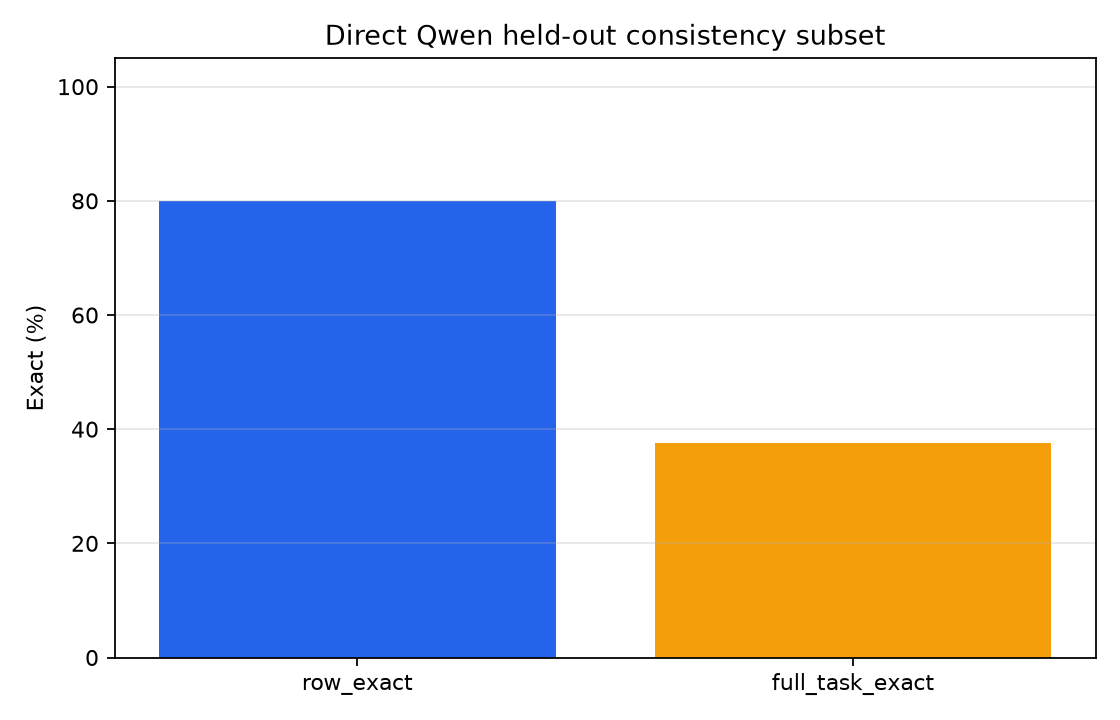
| row_exact | 40 | 458 | 79.9% |
| full_task_exact | 40 | 458 | 37.5% |
- On the same
40tasks, active selected-program full-task exact is 12.5% (5/40). - Direct Qwen full-task exact is 37.5% (15/40).
Family Breakdown
| family | tasks | oracle_coverage | examples_score | train_match_rate |
|---|---|---|---|---|
| Author | 1 | 0.00 | 0.00 | 100.0% |
| Column | 2 | 0.00 | 0.00 | 100.0% |
| Meteorite | 1 | 0.00 | 0.00 | 100.0% |
| FilePath | 1 | 0.00 | 0.00 | 100.0% |
| Log | 4 | 0.00 | 0.00 | 100.0% |
| Product | 2 | 0.00 | 0.00 | 100.0% |
| Url | 1 | 0.00 | 0.00 | 100.0% |
| City | 9 | 0.11 | 0.00 | 100.0% |
| DateTime | 106 | 0.11 | 0.09 | 100.0% |
| Address | 6 | 0.17 | 0.00 | 100.0% |
| Number | 84 | 0.19 | 0.13 | 100.0% |
| Gender | 3 | 0.33 | 0.33 | 100.0% |
| Rating | 2 | 0.50 | 0.50 | 100.0% |
| EmergencyCall | 2 | 0.50 | 0.00 | 100.0% |
| Language | 2 | 0.50 | 0.50 | 100.0% |
| Phone | 16 | 0.50 | 0.38 | 100.0% |
| UserAgent | 7 | 0.57 | 0.43 | 100.0% |
| Name | 28 | 0.61 | 0.43 | 100.0% |
| 6 | 0.67 | 0.67 | 100.0% | |
| ShippingCode | 10 | 0.80 | 0.70 | 100.0% |
| Airline | 1 | 1.00 | 1.00 | 100.0% |
| Abbreviation | 1 | 1.00 | 1.00 | 100.0% |
| BillingCode | 6 | 1.00 | 0.67 | 100.0% |
| Currency | 3 | 1.00 | 1.00 | 100.0% |
| Song | 1 | 1.00 | 1.00 | 100.0% |
| Noise | 1 | 1.00 | 1.00 | 100.0% |
| Team | 1 | 1.00 | 1.00 | 100.0% |
| State | 1 | 1.00 | 1.00 | 100.0% |
| ZipCode | 1 | 1.00 | 1.00 | 100.0% |
Qwen-Probe Task Examples
| task_id | family | features | oracle_covered | examples_full_exact | qwen_probe_full_exact | shuffled_probe_full_exact | qwen_direct_first_exact | probe_count | qwen_program |
|---|---|---|---|---|---|---|---|---|---|
| Abbreviation.000001 | Abbreviation | Concatenation,Conditional,Substring | True | True | True | True | True | 4 | initials(COL0) |
| BillingCode.000007 | BillingCode | Concatenation | True | True | True | True | False | 4 | affix['',']'](COL0) |
| DateTime.000003 | DateTime | DateTime | True | True | True | True | True | 4 | number_int(COL0) |
| DateTime.000004 | DateTime | Concatenation,DateTime,Multicolumn | True | True | True | True | True | 4 | concat' ' |
| DateTime.000013 | DateTime | Conditional,DateTime | True | True | True | True | True | 4 | COL0 |
| DateTime.000103 | DateTime | DateTime | True | True | True | True | True | 0 | word4 |
| DateTime.000104 | DateTime | DateTime | True | True | True | True | True | 4 | title(alpha(COL0)) |
| DateTime.000107 | DateTime | DateTime | True | True | True | True | True | 4 | word2 |
| EmergencyCall.000003 | EmergencyCall | Casing,Substring | True | False | True | True | True | 4 | title(field;,1) |
| Gender.000003 | Gender | Conditional | True | True | True | True | True | 1 | mapl->0,m->1,k->2) |
| Language.000002 | Language | Multicolumn,Substring | True | True | True | True | True | 4 | word3 |
| Name.000017 | Name | Substring | True | True | True | True | False | 4 | title(slice0:4) |
| Name.000027 | Name | Substring | True | True | True | True | True | 4 | alpha(COL0) |
| Name.000028 | Name | Substring | True | True | True | True | True | 4 | word0 |
| Name.000029 | Name | Concatenation,Substring | True | False | True | True | True | 4 | concat', ',word0) |
| Name.000038 | Name | Casing,Concatenation,Substring | True | False | True | True | True | 4 | affix'','@')) |
| Number.000007 | Number | Numeric,NumericRounding | True | False | True | True | True | 4 | affix'','0') |
| Number.000029 | Number | Numeric,NumericRounding | True | True | True | True | True | 4 | number_round10(COL0) |
| Number.000044 | Number | Numeric | True | True | True | True | True | 4 | number_int(COL0) |
| Number.000049 | Number | Numeric,NumericRounding | True | True | True | False | False | 4 | number_round100(COL0) |
| Number.000051 | Number | Numeric,NumericRounding | True | True | True | True | True | 4 | number_round100(COL0) |
| Number.000077 | Number | Numeric,NumericRounding | True | False | True | False | False | 4 | affix'','0') |
| Number.000078 | Number | Numeric,NumericRounding | True | True | True | True | True | 4 | number_round10(COL0) |
| Phone.000011 | Phone | Concatenation,Substring | True | True | True | True | True | 4 | title(COL0) |
Qwen-Probe Misses
| task_id | family | features | oracle_covered | qwen_probe_full_exact | qwen_direct_first_exact | direct_target | direct_prediction |
|---|---|---|---|---|---|---|---|
| Address.000002 | Address | Substring | False | False | False | 880 81th Place | 880 81th Place SE |
| Address.000003 | Address | Substring | False | False | True | 319 09th Lane | 319 09th Lane |
| Address.000013 | Address | Conditional,Substring | False | False | True | 89 | 89 |
| City.000004 | City | Conditional | False | False | True | San Francisco | San Francisco |
| City.000008 | City | Conditional | False | False | False | ||
| City.000010 | City | Conditional,Numeric | False | False | True | 9 | 9 |
| City.000011 | City | Conditional | False | False | True | New York City | New York City |
| Column.000001 | Column | Concatenation,Conditional,Substring | False | False | True | Col1 | Col1 |
| DateTime.000005 | DateTime | Conditional,DateTime | False | False | True | Jun 2027 | Jun 2027 |
| DateTime.000007 | DateTime | DateTime | False | False | True | Sep 2007 | Sep 2007 |
| DateTime.000012 | DateTime | Conditional,DateTime | False | False | True | 2033 | 2033 |
| DateTime.000014 | DateTime | DateTime | False | False | False | Friday #1 February 2013 | Saturday #1 February 2013 |
| DateTime.000015 | DateTime | DateTime | False | False | False | Friday, 2013W05 | Thursday, 2013W01 |
| DateTime.000017 | DateTime | DateTime | False | False | True | 30/3/2241 | 30/3/2241 |
| DateTime.000018 | DateTime | DateTime | False | False | True | 30 Mar 2241 | 30 Mar 2241 |
| DateTime.000023 | DateTime | DateTime | False | False | True | 03302241 | 03302241 |
| DateTime.000025 | DateTime | DateTime | False | False | True | Mar 41 | Mar 41 |
| DateTime.000027 | DateTime | DateTime | False | False | False | Q1 '2241 | Q1 '241 |
| DateTime.000029 | DateTime | DateTime | False | False | False | Tuesday | Sunday |
| DateTime.000032 | DateTime | DateTime | False | False | True | 10:02 PM | 10:02 PM |
| DateTime.000034 | DateTime | DateTime,Substring | False | False | True | 2002-09-12 16:15:08 | 2002-09-12 16:15:08 |
| DateTime.000035 | DateTime | DateTime,Multicolumn | False | False | True | 2002-09-12 16:15:08 | 2002-09-12 16:15:08 |
| DateTime.000040 | DateTime | DateTime,Substring | False | False | True | January 31, 1846 | January 31, 1846 |
| DateTime.000044 | DateTime | DateTime | False | False | False | January the 31th 1846 | January the 31st 1846 |
Interpretation
On the Qwen-probe subset, active crystallization selects a full held-out-valid program for 25.0% of tasks, compared with 22.5% for the shuffled-label control and a candidate-oracle ceiling of 25.0%. Frozen Qwen direct answering reaches 70.0% on one held-out row per sampled task, which is a different metric: it measures row-level inference, not whether a single executable program generalizes over all held-out rows. The strict direct-Qwen diagnostic narrows that comparison: direct row accuracy is 79.9%, but full-task consistency drops to 37.5%. Direct Qwen is still ahead of active selected programs on the matched subset, but it is not a solved consistency baseline. Across all static tasks, the candidate DSL has a full-heldout oracle ceiling of 29.4%, while examples-only shortest selection reaches 22.7%. The main failure is not a lack of train-fitting programs: finite maps can fit train examples for every task. The failure is that most train-fitting programs are not held-out-valid, and Qwen probe labels only add a small margin over the shuffled-label control. Under this setup, fuzzy model labels did not crystallize Qwen's row-level competence into broadly reliable executable programs.
Limitations
This run uses synthetic probes generated from train inputs, not human-authored counterexamples. The Qwen-probe subset is capped for runtime. Direct Qwen is scored on one held-out row per task, while program methods require one executable program to match all held-out rows.
Artifacts
- Static details:
analysis/static_details.csv - Qwen-probe details:
analysis/qwen_probe_details.csv - Static summary:
analysis/static_summary.csv - Qwen summary:
analysis/qwen_summary.csv - Strict direct-Qwen full-heldout diagnostic:
analysis/qwen_direct_full_summary.csv - Public benchmark checkout:
/workspace/large_artifacts/qwen_active_crystallizer_public_gate/prose-benchmarks
Experiment log 9
Show the running log (9 entries)
Setup
- Created fresh experiment directory:
/workspace/experiments/qwen_active_crystallizer_public_gate - Large artifacts directory:
/workspace/large_artifacts/qwen_active_crystallizer_public_gate - Public benchmark checkout is available under the large artifacts directory.
- Core question: whether Qwen probe labels can select an executable transformation program from a candidate DSL under held-out validation.
- Report format: standalone Markdown and HTML with plots.
Smoke Debug Note
- First smoke attempt exposed a duplicate-probe loop in synthetic probe generation before producing metrics. Added an attempt cap and deterministic task seed before rerunning.
Smoke Debug Note 2
- Second smoke attempt showed finite-map enumeration was running over concat-expanded candidates. Restricted maps to base/wrapped expressions and lowered concat breadth before rerunning.
Run smoke_v1
- Started: 2026-06-27 04:36:01 UTC
- Static tasks:
35; Qwen-probe tasks:12 - Completed in 23.8s.
- Candidate-oracle full-heldout coverage: 31.4%.
- Examples-only full-heldout score: 31.4%.
- Qwen-probe selected-program score: 33.3%.
- Shuffled-label selected-program score: 33.3%.
- Direct Qwen first-heldout-row score: 66.7%.
Smoke Debug Note 3
- Third inspection showed train-signature deduplication erased candidate ambiguity. Removed that deduplication so probe labels can distinguish train-equivalent programs, and made Qwen tasks sampled by seed.
Run smoke_v1
- Started: 2026-06-27 04:37:26 UTC
- Static tasks:
35; Qwen-probe tasks:12 - Completed in 46.8s.
- Candidate-oracle full-heldout coverage: 45.7%.
- Examples-only full-heldout score: 31.4%.
- Qwen-probe selected-program score: 33.3%.
- Shuffled-label selected-program score: 25.0%.
- Direct Qwen first-heldout-row score: 75.0%.
Run pilot_v1
- Started: 2026-06-27 04:38:41 UTC
- Static tasks:
100; Qwen-probe tasks:50 - Completed in 170.9s.
- Candidate-oracle full-heldout coverage: 18.0%.
- Examples-only full-heldout score: 13.0%.
- Qwen-probe selected-program score: 18.0%.
- Shuffled-label selected-program score: 18.0%.
- Direct Qwen first-heldout-row score: 70.0%.
Run main_v1
- Started: 2026-06-27 04:42:01 UTC
- Static tasks:
309; Qwen-probe tasks:120 - Completed in 384.9s.
- Candidate-oracle full-heldout coverage: 29.4%.
- Examples-only full-heldout score: 22.7%.
- Qwen-probe selected-program score: 25.0%.
- Shuffled-label selected-program score: 22.5%.
- Direct Qwen first-heldout-row score: 70.0%.
Strict Direct-Qwen Full-Heldout Diagnostic
- Model:
Qwen/Qwen3-4B - Tasks:
40; held-out rows:458 - Row exact: 79.9% (366/458).
- Full-task exact: 37.5% (15/40).
- Full-task exact requires every held-out row for the task to be answered exactly.
Figures 5
Data files 9
Result tables and metrics copied from the experiment folder — preview inline or open the raw file.
analysis/qwen_direct_full_summary.csv89 Banalysis/qwen_summary.csv176 Banalysis/static_summary.csv126 Bruns/main_v1/qwen_summary.csv176 Bruns/main_v1/static_summary.csv126 Bruns/pilot_v1/qwen_summary.csv154 Bruns/pilot_v1/static_summary.csv96 Bruns/smoke_v1/qwen_summary.csv183 Bruns/smoke_v1/static_summary.csv122 B
Reproduce
This entry is source code or analysis only — there is no separate run to reproduce.