Qwen Disagreement-Probe Program Induction
The one idea you need
A small model writes several short programs to reformat messy text — dates, prices, names. Because the programs disagree on some inputs, you feed it those tricky cases and ask it to judge which output is right, hoping its verdicts reveal the single best program.
The question
When a small model writes several programs to reformat text, does quizzing it on the inputs where those programs disagree help pick the best one?
What we found
No. The disagreement quiz picked the same programs whether its judge answers were real, randomly assigned, or skipped entirely — all three landed at 64% of tasks fully solved. The only genuine gain came from a plain caution rule: run a generated program only when it clearly fits, otherwise answer each item by hand. That rule lifted fully-solved tasks from 56% to 64%.
Why it matters
When a small model writes code to handle a task, invest in a conservative fallback that runs the code only when it clearly fits — not elaborate schemes to rank rival programs, which here changed no decisions at all.
On this page
Results at a glance 6
How to read
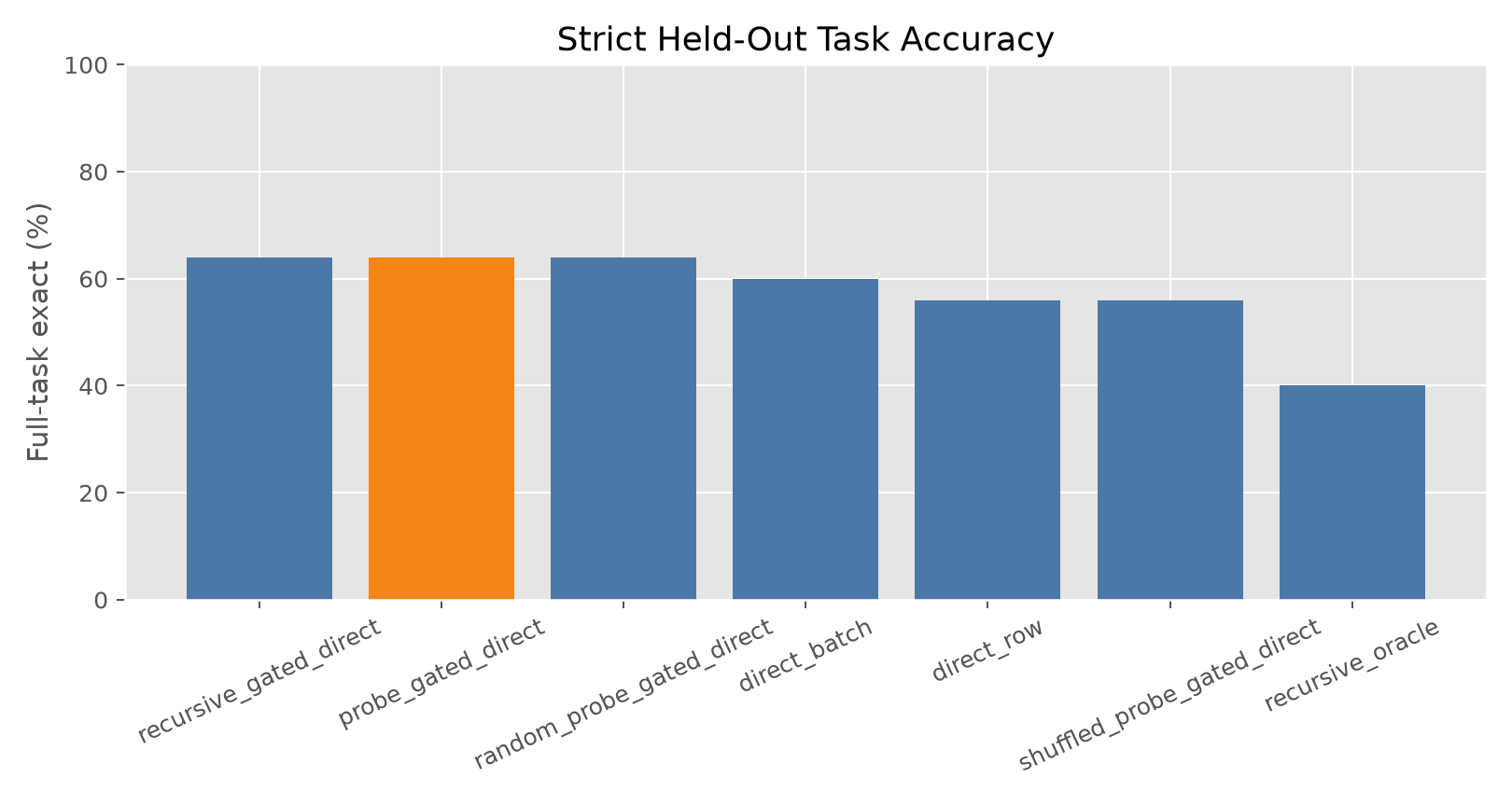
Bars show the share of tasks solved exactly right, one per method — plain by-hand answering, program only, and gates using real, random, no, or scrambled quiz answers; taller is better.
Takeaway → The real-quiz, random-quiz, and no-quiz gates land at exactly the same height, so the disagreement quiz bought nothing — the caution gate, not the quiz, delivered the lift.
Data table
| method | full-task exact |
|---|---|
| direct row-by-row | 56% |
| program only | 40% |
| gate (no probes) | 64% |
| disagreement-probe gate | 64% |
| random-probe gate | 64% |
| shuffled-label gate | 56% |
Numbers from experiments/qwen_disagreement_probe_program_induction/analysis/summary.csv
Technical framing
Full-task exact match: gated program use ties across probe variants — The simple direct-fallback gate lifts 56% to 64%; disagreement probes add nothing beyond it (probe and random-probe gates also 64%).
How to read
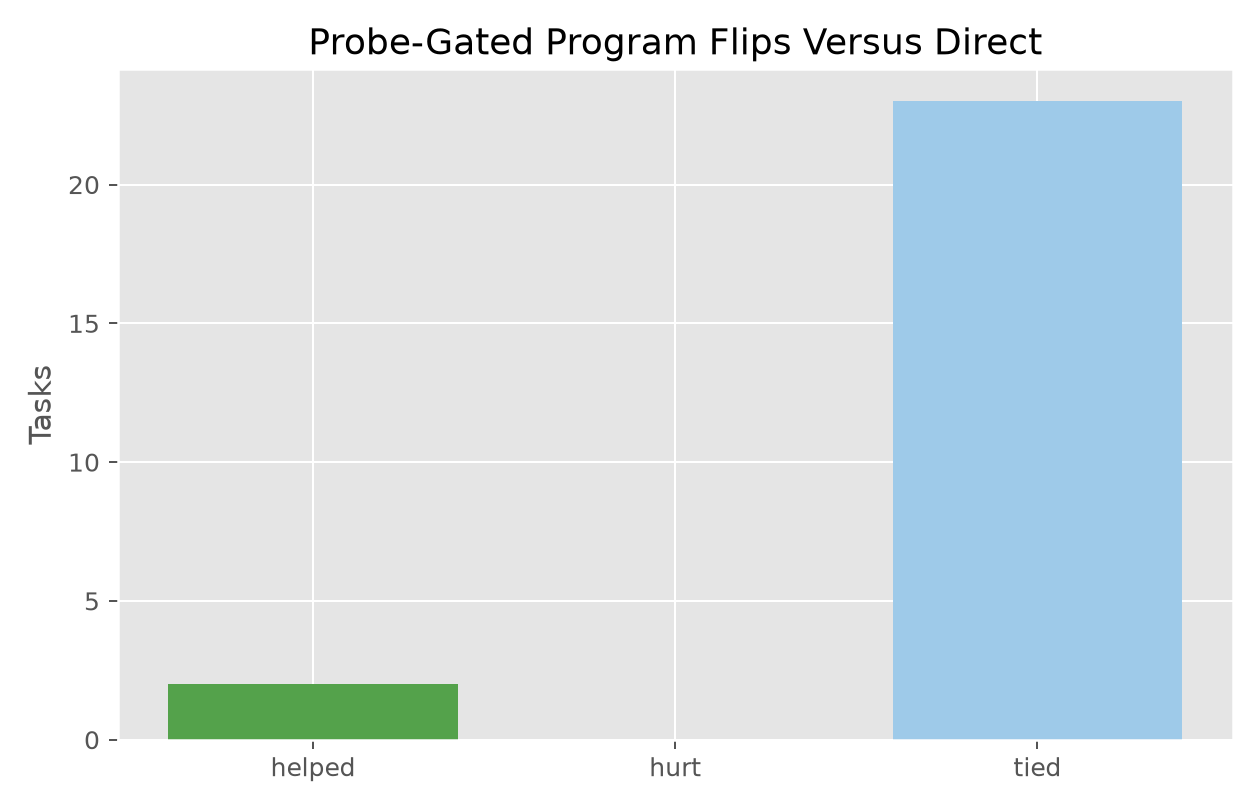
For each method, one bar counts tasks it improved over plain answering and another counts tasks it broke, out of 25; more improved and fewer broken is better. Raw programs broke six to fourteen tasks; both caution gates broke none.
Takeaway → Running programs unguarded wrecks many tasks; the cautious gate keeps the two wins while breaking nothing — its whole value is restraint.
Data table
| method | tasks helped | tasks hurt |
|---|---|---|
| disagreement-probe gate | 2 | 0 |
| gate (no probes) | 2 | 0 |
| program only | 2 | 6 |
| monolithic program | 2 | 7 |
| shuffled recursive | 1 | 14 |
Numbers from experiments/qwen_disagreement_probe_program_induction/analysis/summary.csv
Technical framing
Tasks helped vs hurt relative to direct answering (25 tasks) — Raw generated programs hurt 6-7 tasks; the conservative fallback gates keep the 2 wins while hurting none.
How to read
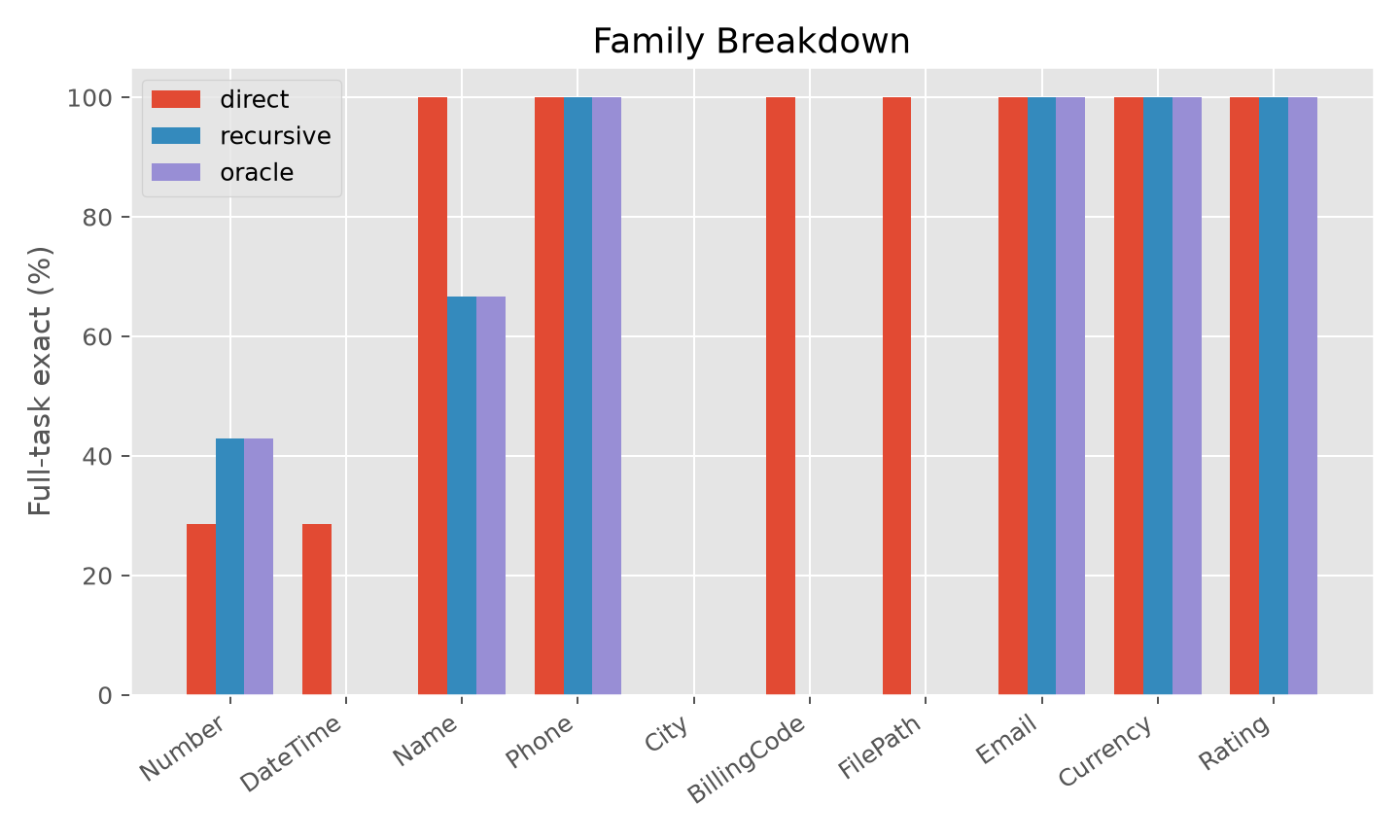
Paired bars per text-format category compare plain answering against the disagreement-quiz gate; taller is better. Every category matches except number-formatting, where the gate rises from about 29% to about 57%.
Takeaway → All of the gate's advantage comes from number-formatting tasks; everywhere else it simply equals plain answering.
Data table
| task family | direct row-by-row | disagreement-probe gate |
|---|---|---|
| BillingCode | 100% | 100% |
| City | 0% | 0% |
| Currency | 100% | 100% |
| DateTime | 28.6% | 28.6% |
| 100% | 100% | |
| FilePath | 100% | 100% |
| Name | 100% | 100% |
| Number | 28.6% | 57.1% |
| Phone | 100% | 100% |
| Rating | 100% | 100% |
Technical framing
Full-task exact by task family: direct vs probe-gated — All of the gated method's gain comes from Number tasks; every other family matches direct answering exactly.
How to read
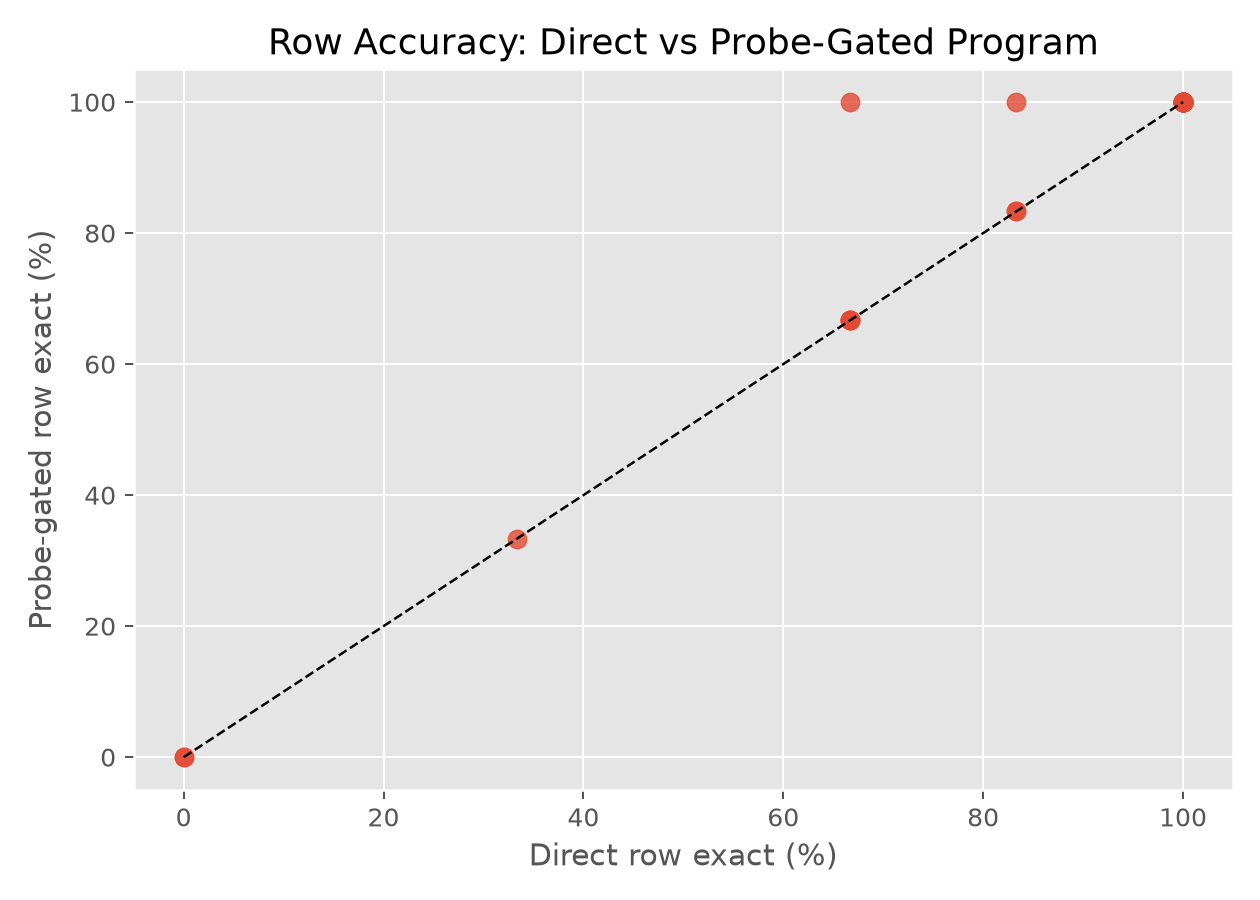
Bars show the share of individual items transformed exactly right, one per method; taller is better. All gated variants tie near 83%, plain answering trails slightly, and the ungated program arms fall to 45% or below.
Takeaway → At the item level the gated methods tie again, while trusting raw programs roughly halves accuracy and scrambled answers collapse it to near nothing.
Data table
| Method | Row exact |
|---|---|
| Recursive gated | 82.7% |
| Probe gated | 82.7% |
| Random-probe gated | 82.7% |
| Direct row | 80.7% |
| Shuffled-probe gated | 80.7% |
| Direct batch | 76% |
| Recursive program | 44.7% |
| Probe program | 44.7% |
| Monolithic program | 40.7% |
| Recursive shuffled | 6% |
Numbers from experiments/qwen_disagreement_probe_program_induction/analysis/summary.csv
Technical framing
Row-level exact match by method — At the row level all gated variants tie at 82.7%; ungated program arms roughly halve accuracy and shuffled labels collapse to 6%.
How to read
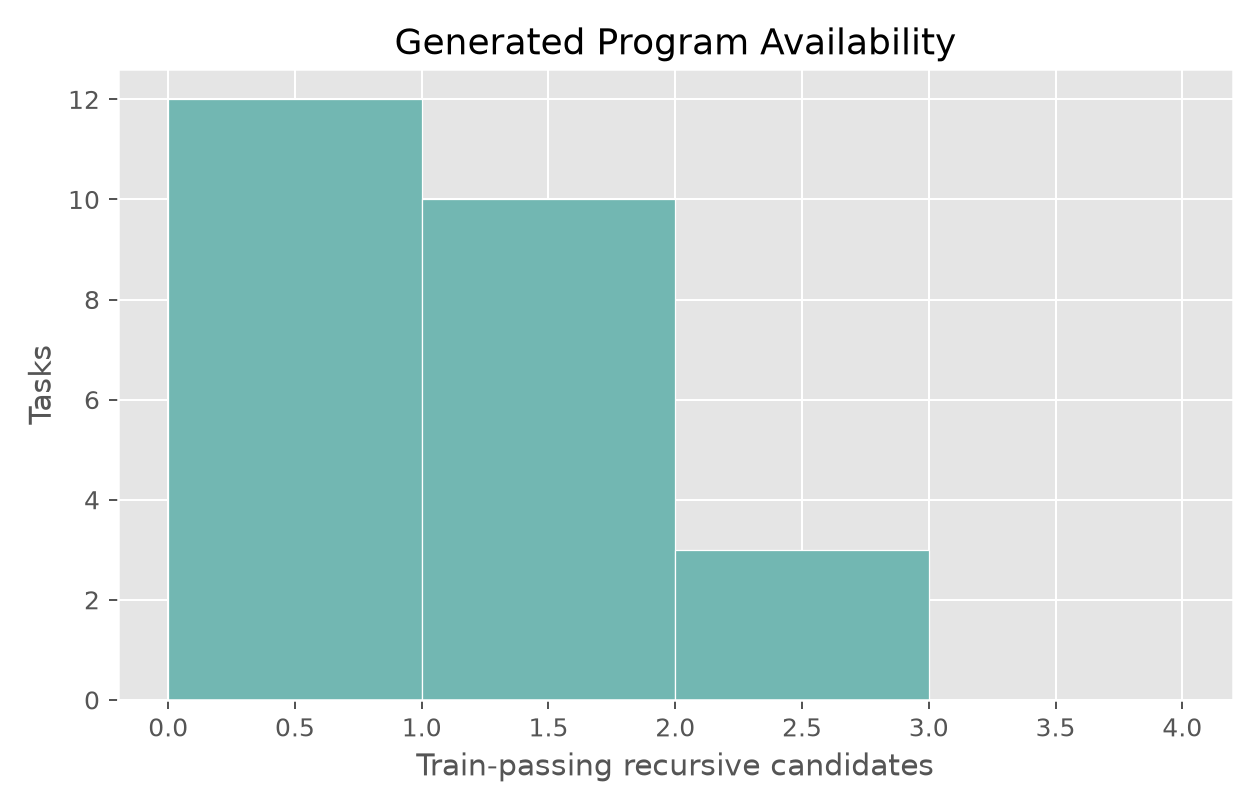
Per method, bars show the share of tasks where a generated program passed the visible examples or was actually used — this measures supply of usable programs, not final accuracy. Programs fit on 52% of tasks; the cautious gates trust only 40 to 44%.
Takeaway → Programs often fit the shown examples, yet the gate deliberately trusts fewer of them, trading coverage for safety; scrambled-answer quizzes trust none.
Data table
| Method | Train-pass rate |
|---|---|
| Recursive program | 52% |
| Probe program | 52% |
| Recursive oracle | 52% |
| Monolithic program | 48% |
| Recursive gated | 44% |
| Probe gated | 40% |
| Random-probe gated | 40% |
| Recursive shuffled | 20% |
| Shuffled-probe gated | 0% |
Numbers from experiments/qwen_disagreement_probe_program_induction/analysis/summary.csv
Technical framing
Share of tasks with a train-passing program used or found, by method — Programs pass visible examples on 52% of tasks, but the conservative gates only trust them on 40-44%; shuffled-label probes trust none.
How to read
Paired bars per category compare plain answering against raw unguarded programs at the item level; taller is better. They match on prices, emails, phones, and ratings, but programs collapse on file paths, billing codes, and especially dates and times.
Takeaway → Raw programs handle simple formats fine but fall apart on structured ones, explaining why running them unguarded is risky.
Data table
| Task family | Direct row | Recursive program (ungated) |
|---|---|---|
| BillingCode | 100% | 0% |
| City | 66.7% | 33.3% |
| Currency | 100% | 100% |
| DateTime | 59.5% | 9.5% |
| 100% | 100% | |
| FilePath | 100% | 0% |
| Name | 100% | 66.7% |
| Number | 76.2% | 45.2% |
| Phone | 100% | 100% |
| Rating | 100% | 100% |
Numbers from experiments/qwen_disagreement_probe_program_induction/analysis/family_summary.csv
Technical framing
Row exact by task family: direct answering vs raw generated programs — Ungated programs match direct answering on Currency/Email/Phone/Rating but collapse on BillingCode, FilePath, and especially DateTime.
In the author’s words from the Report · “Interpretation”
Direct row-by-row answering solves 56.0% of tasks under strict full-task exactness. The selected executable program without probe selection solves 40.0%. The non-probe gated method solves 64.0%. The disagreement-probe gated method solves 64.0%. Random-probe gated selection solves 64.0%, and shuffled-label probe selection solves 56.0%. The disagreement-probe gated method helps 2 tasks and hurts 0 tasks relative to direct row-by-row answering. The hidden diagnostic oracle over train-passing generated programs solves 40.0%, and at least one candidate passes visible examples on 52.0% of tasks. The shuffled-label control checks whether probe labels matter. The random-probe control checks whether disagreement ranking matters. … Read the full result →
Overview
Standalone experiment for selecting task-local executable transformation programs with model-labeled disagreement probes.
Large reusable artifacts are stored under:
/workspace/large_artifacts/qwen_disagreement_probe_program_induction
Primary outputs:
src/qwen_disagreement_probe_program_induction.pyexperiment_log.mdruns/analysis/reports/
Report
Rendered from reports/qwen_disagreement_probe_program_induction_report.md
Question
Can model-labeled disagreement probes select better task-local executable programs than visible examples alone?
The method asks the model to write Python transform(row) candidate functions. Candidate programs are executed on visible examples. Synthetic probe inputs are generated from the visible examples, ranked by candidate disagreement, and labeled by the model. Program selection uses visible examples plus probe labels. Held-out rows are used only for final scoring.
Setup
- Run:
main_v1 - Dataset: public text-transformation tasks.
- Tasks:
25 - Visible examples per task:
4 - Held-out cap per task:
6 - Program variants:
monolithic,robust - Repair rounds:
1 - Disagreement probes per task:
4 - Probe label variants:
plain,consistency - Probe score threshold for gated use:
0.67 - Elapsed seconds:
1556.2
Main Result
| method | tasks | row_exact | full_task_exact | train_pass_rate | tasks_helped_vs_direct | tasks_hurt_vs_direct |
|---|---|---|---|---|---|---|
| recursive_gated_direct | 25 | 82.7% | 64.0% | 44.0% | 2 | 0 |
| probe_gated_direct | 25 | 82.7% | 64.0% | 40.0% | 2 | 0 |
| random_probe_gated_direct | 25 | 82.7% | 64.0% | 40.0% | 2 | 0 |
| direct_batch | 25 | 76.0% | 60.0% | 2 | 1 | |
| direct_row | 25 | 80.7% | 56.0% | 0 | 0 | |
| shuffled_probe_gated_direct | 25 | 80.7% | 56.0% | 0.0% | 0 | 0 |
| recursive_program | 25 | 44.7% | 40.0% | 52.0% | 2 | 6 |
| probe_program | 25 | 44.7% | 40.0% | 52.0% | 2 | 6 |
| recursive_oracle | 25 | 44.7% | 40.0% | 52.0% | 2 | 6 |
| monolithic_program | 25 | 40.7% | 36.0% | 48.0% | 2 | 7 |
| recursive_shuffled | 25 | 6.0% | 4.0% | 20.0% | 1 | 14 |
Interpretation
Direct row-by-row answering solves 56.0% of tasks under strict full-task exactness. The selected executable program without probe selection solves 40.0%. The non-probe gated method solves 64.0%. The disagreement-probe gated method solves 64.0%. Random-probe gated selection solves 64.0%, and shuffled-label probe selection solves 56.0%.
The disagreement-probe gated method helps 2 tasks and hurts 0 tasks relative to direct row-by-row answering. The hidden diagnostic oracle over train-passing generated programs solves 40.0%, and at least one candidate passes visible examples on 52.0% of tasks.
The shuffled-label control checks whether probe labels matter. The random-probe control checks whether disagreement ranking matters. A useful result should beat direct answering, the non-probe gate, and both probe controls.
Verdict
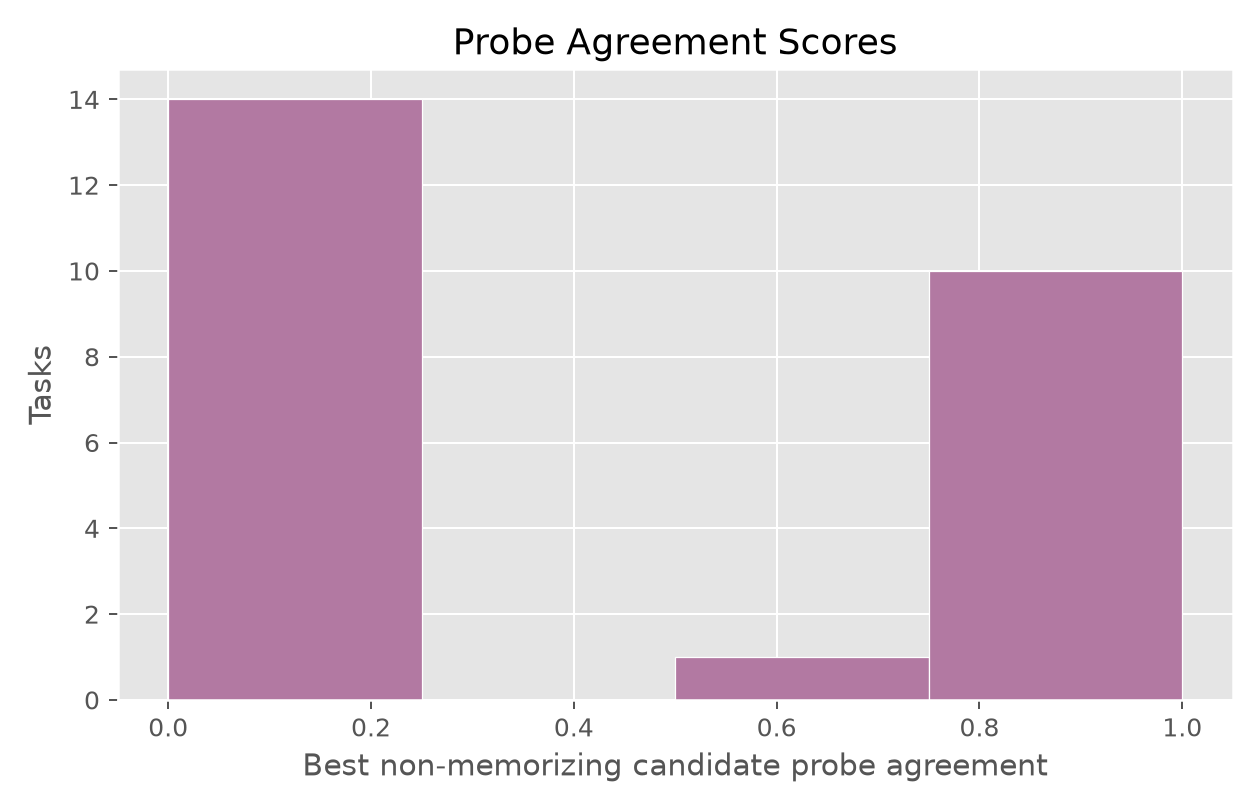
Disagreement probes did not add measurable selection power in this run. The probe-gated method tied the non-probe gate at 64.0% and tied the random-probe gate at 64.0%. Probe-gated and non-probe gated decisions differed on 0 of 25 tasks, while probe-gated and random-probe gated outcomes matched on 25 of 25 tasks.
The deployable gain came from the conservative direct-fallback gate: it used generated programs on 11 tasks and improved full-task exactness from 56.0% to 64.0% without hurting any direct-answer successes. The disagreement-probe gate used generated programs on 10 tasks, and the random-probe gate used generated programs on 10 tasks, but neither improved on that simpler gate.
Program Diagnostics
The raw executable-program arm is not deployable by itself: train-passing programs can be too narrow, often literal branches or partial parsers. The gated arms use a generated program only when the selected train-passing candidate does not look like a literal example table and its probe agreement clears the configured threshold; otherwise they fall back to direct row-by-row answering.
The probe score distribution is reported separately because a method that only wins by falling back everywhere is not a useful program selector.
Charts
Task Details
| task_id | family | heldout_rows | direct_full_exact | recursive_full_exact | recursive_gated_full_exact | probe_gated_full_exact | random_probe_gated_full_exact | shuffled_probe_gated_full_exact | recursive_oracle_full_exact | recursive_train_pass_count | probe_gated_used_program | probe_gated_score | probe_gated_helped_vs_direct | probe_gated_hurt_vs_direct |
|---|---|---|---|---|---|---|---|---|---|---|---|---|---|---|
| Number.000044 | Number | 6 | False | True | True | True | True | False | True | 1 | True | 0.75 | True | False |
| Number.000093 | Number | 3 | False | True | True | True | True | False | True | 1 | True | 0.75 | True | False |
| BillingCode.000002 | BillingCode | 6 | True | False | True | True | True | True | False | 0 | False | 0 | False | False |
| City.000011 | City | 3 | False | False | False | False | False | False | False | 1 | False | 0 | False | False |
| Currency.000004 | Currency | 6 | True | True | True | True | True | True | True | 1 | True | 1 | False | False |
| DateTime.000012 | DateTime | 6 | False | False | False | False | False | False | False | 1 | True | 1 | False | False |
| DateTime.000035 | DateTime | 6 | True | False | True | True | True | True | False | 0 | False | 0 | False | False |
| DateTime.000077 | DateTime | 6 | False | False | False | False | False | False | False | 0 | False | 0 | False | False |
| DateTime.000083 | DateTime | 6 | False | False | False | False | False | False | False | 0 | False | 0 | False | False |
| DateTime.000088 | DateTime | 6 | False | False | False | False | False | False | False | 0 | False | 0 | False | False |
| DateTime.000094 | DateTime | 4 | True | False | True | True | True | True | False | 0 | False | 0 | False | False |
| DateTime.000098 | DateTime | 6 | False | False | False | False | False | False | False | 0 | False | 0 | False | False |
| Email.000013 | 6 | True | True | True | True | True | True | True | 2 | True | 1 | False | False | |
| FilePath.000001 | FilePath | 6 | True | False | True | True | True | True | False | 0 | False | 0 | False | False |
| Name.000013 | Name | 6 | True | True | True | True | True | True | True | 2 | False | 0.5 | False | False |
| Name.000026 | Name | 6 | True | False | True | True | True | True | False | 0 | False | 0 | False | False |
| Name.000028 | Name | 6 | True | True | True | True | True | True | True | 2 | True | 1 | False | False |
| Number.000048 | Number | 4 | True | False | True | True | True | True | False | 0 | False | 0 | False | False |
| Number.000074 | Number | 6 | False | False | False | False | False | False | False | 0 | False | 0 | False | False |
| Number.000075 | Number | 6 | False | False | False | False | False | False | False | 0 | False | 0 | False | False |
| Number.000081 | Number | 6 | False | False | False | False | False | False | False | 1 | False | 0 | False | False |
| Number.000088 | Number | 6 | True | True | True | True | True | True | True | 1 | True | 1 | False | False |
| Phone.000005 | Phone | 6 | True | True | True | True | True | True | True | 1 | True | 1 | False | False |
| Phone.000017 | Phone | 6 | True | True | True | True | True | True | True | 1 | True | 1 | False | False |
| Rating.000001 | Rating | 6 | True | True | True | True | True | True | True | 1 | True | 1 | False | False |
Family Summary
| family | direct_row | monolithic_program | probe_gated_direct | recursive_gated_direct | recursive_oracle | recursive_program |
|---|---|---|---|---|---|---|
| BillingCode | 1 | 0 | 1 | 1 | 0 | 0 |
| City | 0 | 0 | 0 | 0 | 0 | 0 |
| Currency | 1 | 1 | 1 | 1 | 1 | 1 |
| DateTime | 0.286 | 0 | 0.286 | 0.286 | 0 | 0 |
| 1 | 1 | 1 | 1 | 1 | 1 | |
| FilePath | 1 | 0 | 1 | 1 | 0 | 0 |
| Name | 1 | 0.667 | 1 | 1 | 0.667 | 0.667 |
| Number | 0.286 | 0.429 | 0.571 | 0.571 | 0.429 | 0.429 |
| Phone | 1 | 1 | 1 | 1 | 1 | 1 |
| Rating | 1 | 0 | 1 | 1 | 1 | 1 |
Limitations
Generated code is sandboxed by a conservative AST pass, so some potentially valid programs may be rejected. The benchmark tasks are public text transformations and do not cover arbitrary software engineering problems. Full-task exact is intentionally strict and can be much lower than row accuracy.
Artifacts
- Run directory:
/workspace/experiments/qwen_disagreement_probe_program_induction/runs/main_v1 - Summary:
analysis/summary.csv - Task details:
analysis/task_summary.csv - Candidate programs:
analysis/candidates.csv - Probe labels:
analysis/probe_labels.csv - Figures:
analysis/figures/
Experiment log 4
Show the running log (4 entries)
Setup
- Created a fresh standalone experiment directory.
- Large artifacts are kept under
/workspace/large_artifacts/qwen_disagreement_probe_program_induction. - Primary metric: strict full-task exact on held-out rows.
- Secondary metrics: row exact, generated-program train-pass rate, probe-label usefulness, and candidate-selection flips.
Run smoke_no_qwen
- Time UTC:
2026-06-27T18:05:55.692908+00:00 - Elapsed seconds:
0.8 - Config:
{"answer_max_new_tokens": 64, "batch_max_new_tokens": 320, "code_max_new_tokens": 520, "heldout_cap": 3, "max_probe_pool": 40, "min_heldout": 3, "no_qwen": true, "probe_count": 3, "probe_label_variants": "plain", "probe_score_min": 0.75, "repair_max_new_tokens": 560, "repair_rounds": 1, "repair_variants": "minimal,broaden,conditional", "run_name": "smoke_no_qwen", "run_shuffled": true, "sample_seed": 20260627, "task_limit": 3, "train_n": 4, "variants": "monolithic,robust"} - Tasks:
3 - Direct row-by-row full-task exact:
0.0% - Recursive selected-program full-task exact:
0.0% - Recursive gated-direct full-task exact:
0.0% - Disagreement-probe gated-direct full-task exact:
0.0% - Recursive train-pass rate:
0.0% - Recursive oracle among train-passing candidates:
0.0%
Run smoke_qwen_5
- Time UTC:
2026-06-27T18:10:38.193113+00:00 - Elapsed seconds:
255.2 - Config:
{"answer_max_new_tokens": 48, "batch_max_new_tokens": 220, "code_max_new_tokens": 420, "heldout_cap": 3, "max_probe_pool": 40, "min_heldout": 3, "no_qwen": false, "probe_count": 3, "probe_label_variants": "plain", "probe_score_min": 0.67, "repair_max_new_tokens": 420, "repair_rounds": 1, "repair_variants": "minimal,broaden,conditional", "run_name": "smoke_qwen_5", "run_shuffled": true, "sample_seed": 20260627, "task_limit": 5, "train_n": 4, "variants": "monolithic,robust"} - Tasks:
5 - Direct row-by-row full-task exact:
60.0% - Recursive selected-program full-task exact:
20.0% - Recursive gated-direct full-task exact:
60.0% - Disagreement-probe gated-direct full-task exact:
60.0% - Recursive train-pass rate:
80.0% - Recursive oracle among train-passing candidates:
20.0%
Run main_v1
- Time UTC:
2026-06-27T18:37:15.412379+00:00 - Elapsed seconds:
1556.2 - Config:
{"answer_max_new_tokens": 56, "batch_max_new_tokens": 300, "code_max_new_tokens": 420, "heldout_cap": 6, "max_probe_pool": 40, "min_heldout": 3, "no_qwen": false, "probe_count": 4, "probe_label_variants": "plain,consistency", "probe_score_min": 0.67, "repair_max_new_tokens": 420, "repair_rounds": 1, "repair_variants": "minimal,broaden,conditional", "run_name": "main_v1", "run_shuffled": true, "sample_seed": 20260627, "task_limit": 25, "train_n": 4, "variants": "monolithic,robust"} - Tasks:
25 - Direct row-by-row full-task exact:
56.0% - Recursive selected-program full-task exact:
40.0% - Recursive gated-direct full-task exact:
64.0% - Disagreement-probe gated-direct full-task exact:
64.0% - Recursive train-pass rate:
52.0% - Recursive oracle among train-passing candidates:
40.0% - Interpretation: disagreement probes did not add measurable selection power. Probe-gated, non-probe gated, and random-probe gated selection all reached
64.0%; shuffled probe labels fell back to the direct baseline at56.0%. Probe-gated and non-probe gated outcomes differed on0/25tasks, so the deployable gain came from conservative program/direct gating rather than probe-based discrimination.
Figures 6
Data files 12
Result tables and metrics copied from the experiment folder — preview inline or open the raw file.
analysis/family_summary.csv2.7 kBanalysis/summary.csv662 Banalysis/task_summary.csv11 kBruns/main_v1/family_summary.csv2.7 kBruns/main_v1/summary.csv662 Bruns/main_v1/task_summary.csv11 kBruns/smoke_no_qwen/family_summary.csv649 Bruns/smoke_no_qwen/summary.csv498 Bruns/smoke_no_qwen/task_summary.csv2.7 kBruns/smoke_qwen_5/family_summary.csv1.1 kBruns/smoke_qwen_5/summary.csv604 Bruns/smoke_qwen_5/task_summary.csv3.7 kB
Reproduce
The run commands are documented inside the experiment folder (see the README).