Qwen Recursive Ephemeral Program Induction
The one idea you need
Give a model four before-and-after examples of a text cleanup and ask it to write one small reusable rule for the pattern, like a spreadsheet formula. Some rules truly generalize; others just hard-code the four examples. The trick is knowing which to trust.
The question
If a model turns a handful of examples into a small reusable rule, does running that rule beat just answering each new row directly?
What we found
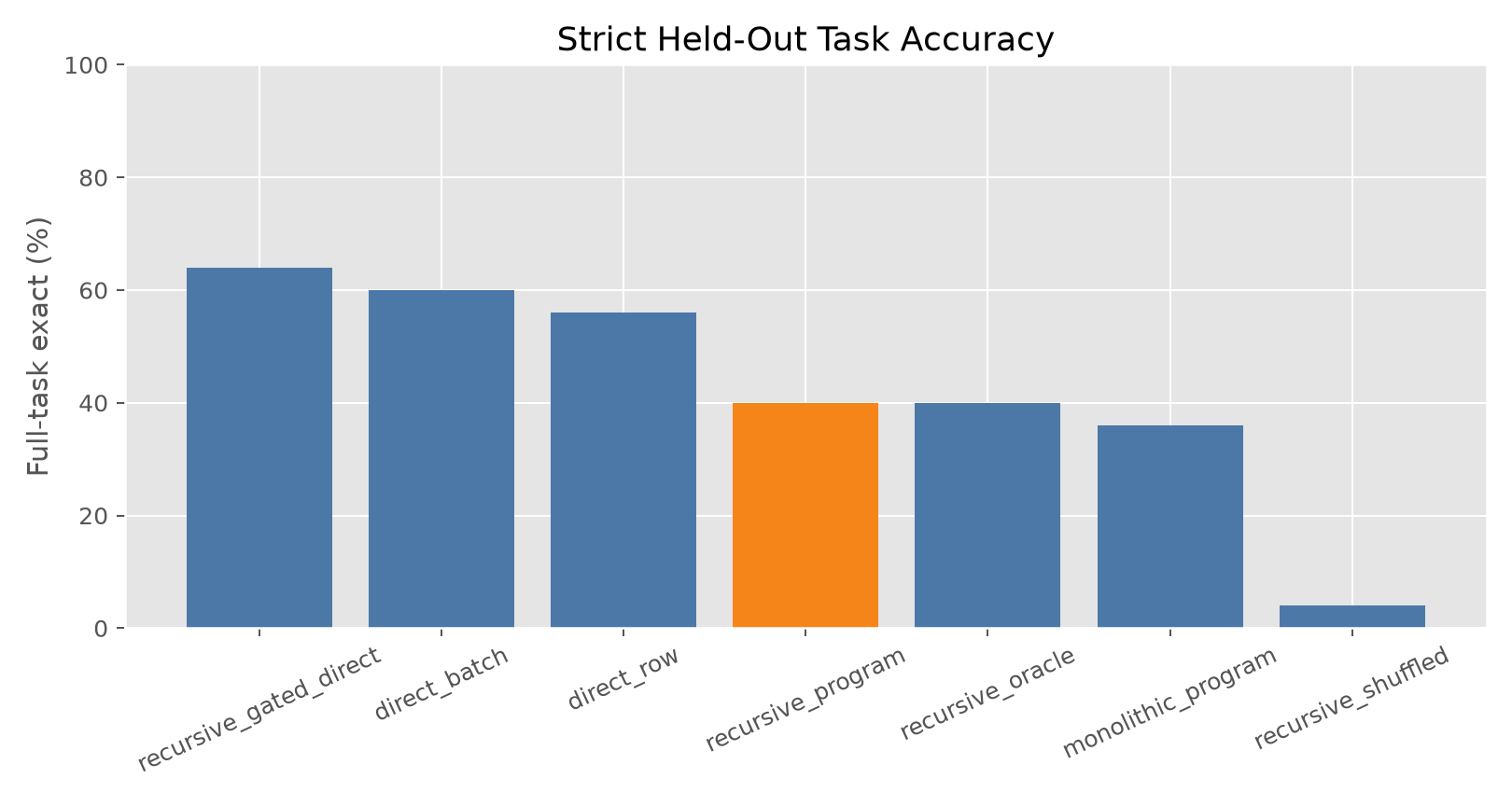
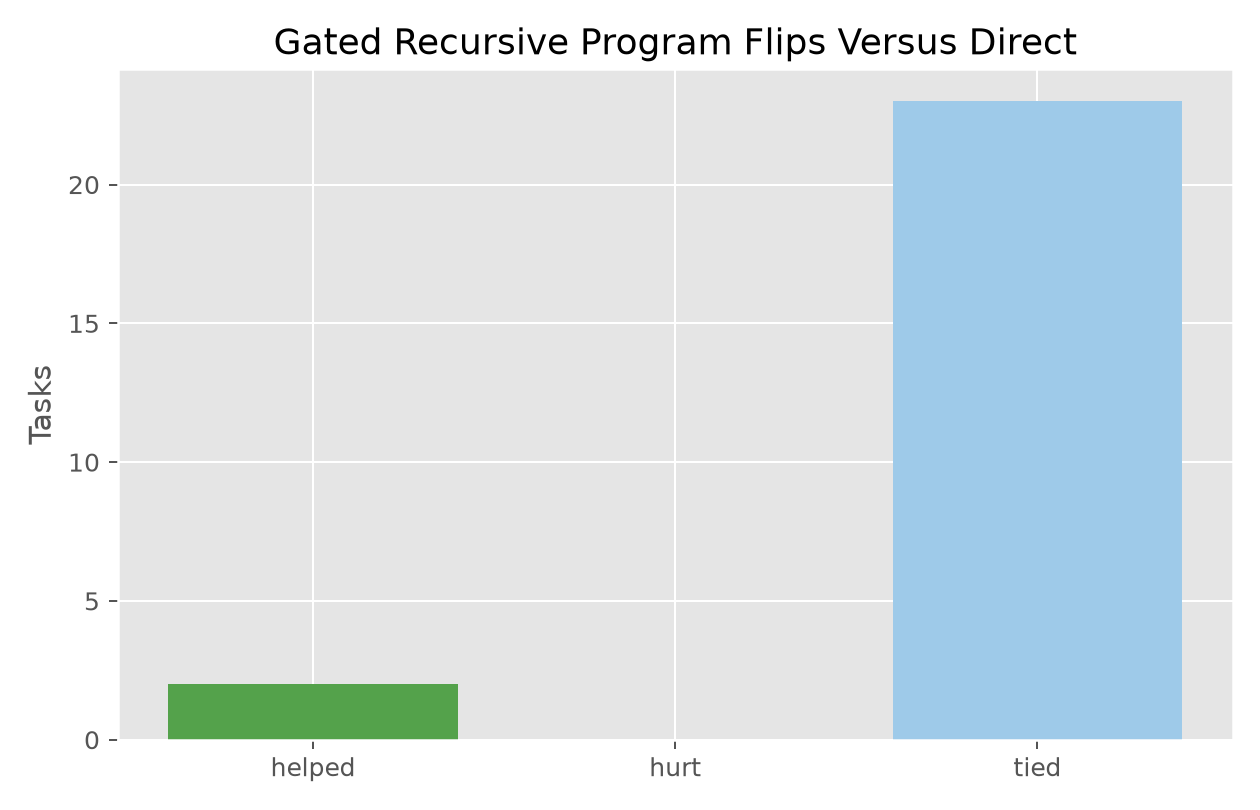
Only when you check the rule first. On its own, a model writing and applying a reusable rule solved 40% of tasks perfectly versus 56% for plain row-by-row answering, and it broke six tasks direct answering had solved. Adding a gate that uses the rule only when it passes the shown examples and isn't a memorized lookup lifted success to 64%, fixing two tasks and breaking none.
Why it matters
Don't deploy a self-written transformation rule blind. Run it against your known examples, reject rules that merely memorize those examples, and fall back to answering row-by-row otherwise. That gate turns a net loss into a clean gain.
On this page
Results at a glance 6
How to read
Each group is one way of solving the tasks; taller bars are better. One bar is the share of tasks solved perfectly with every row right, the other the share of individual rows correct. The gated rule stands tallest; the scrambled-example control sits near the floor.
Takeaway → The trust-gated rule is the tallest whole-task bar, edging out plain answering, while blind rules and the scrambled control fall far below both.
Data table
| method | full-task exact | row exact |
|---|---|---|
| gated program + fallback | 64% | 82.7% |
| direct batch | 60% | 76% |
| direct row-by-row | 56% | 80.7% |
| recursive program | 40% | 44.7% |
| monolithic program | 36% | 40.7% |
| shuffled-label control | 4% | 6% |
Numbers from experiments/qwen_recursive_ephemeral_program_induction/analysis/summary.csv
Technical framing
Held-out task success by method: gated program induction beats direct answering — Raw induced programs underperform direct answering (40% vs 56%), but gating on non-memorizing train-passing programs lifts it to 64%.
How to read
For each method, one bar counts tasks it newly solved and another counts tasks it broke that plain answering had solved, out of 25. More rescued and fewer broken is better.
Takeaway → Blind rules break six or seven tasks to win two, but the gated version keeps both wins with a zero-height broken bar.
Data table
| method | tasks helped | tasks hurt |
|---|---|---|
| gated program + fallback | 2 | 0 |
| direct batch | 2 | 1 |
| recursive program | 2 | 6 |
| monolithic program | 2 | 7 |
| shuffled-label control | 1 | 14 |
Numbers from experiments/qwen_recursive_ephemeral_program_induction/analysis/summary.csv
Technical framing
Tasks helped vs hurt relative to the direct row-by-row baseline — Ungated programs win 2 tasks but break 6-7 that direct answering solved; the gate keeps both wins while introducing zero losses.
How to read
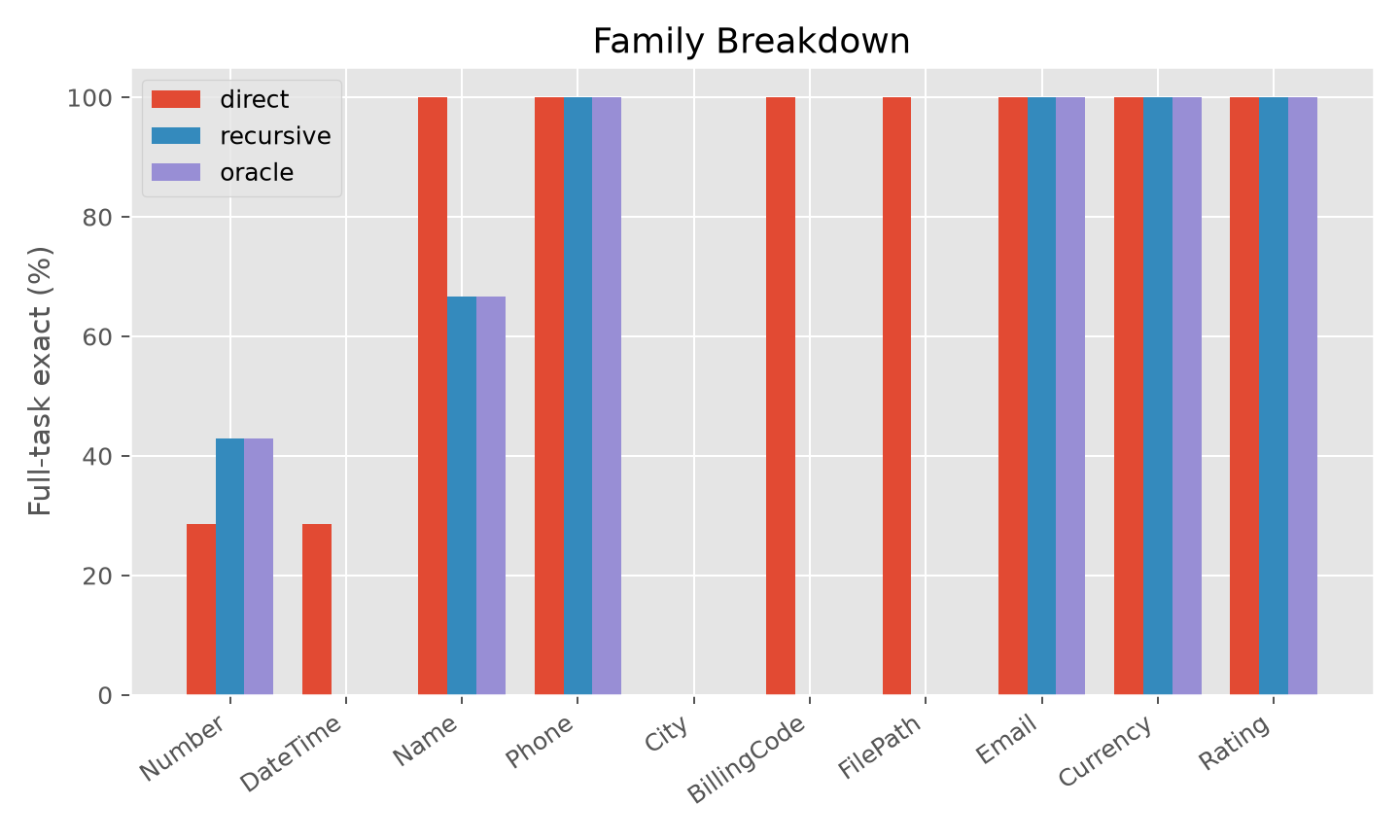
Each group is a task type such as numbers, dates, names, file paths, billing codes, and ratings; bars compare plain answering, blind rules, and the gated rule. Taller is better.
Takeaway → Blind rules genuinely lift number tasks yet flatten to zero on dates, file paths, and billing codes, while the gated bar matches whichever approach is best in every type.
Data table
| task family | direct row-by-row | recursive program | gated program + fallback |
|---|---|---|---|
| Number | 28.6% | 42.9% | 57.1% |
| DateTime | 28.6% | 0% | 28.6% |
| Name | 100% | 66.7% | 100% |
| FilePath | 100% | 0% | 100% |
| BillingCode | 100% | 0% | 100% |
| Rating | 100% | 100% | 100% |
Numbers from experiments/qwen_recursive_ephemeral_program_induction/analysis/family_summary.csv
Technical framing
Full-task exact by task family: where programs help and where they break — Program induction genuinely helps Number tasks but wrecks DateTime, FilePath and BillingCode; the gate matches the best arm per family.
How to read
Each method has two bars: the share of individual rows correct and the share of whole tasks correct with no mistakes anywhere. Taller is better.
Takeaway → Plain answering loses a big chunk moving from rows to perfect whole tasks, while rule methods stay low on both because they tend to miss an entire task at once.
Data table
| Method | Row exact | Full-task exact |
|---|---|---|
| Gated program+direct | 82.7% | 64% |
| Direct batch | 76% | 60% |
| Direct row-by-row | 80.7% | 56% |
| Recursive program | 44.7% | 40% |
| Program oracle | 44.7% | 40% |
| Monolithic program | 40.7% | 36% |
| Shuffled-label control | 6% | 4% |
Numbers from report table (reports/qwen_recursive_ephemeral_program_induction_report.md, Main Result)
Technical framing
Row-level accuracy vs strict full-task exactness by method — Direct answering loses 25pts moving from row to full-task exactness; program arms lose little because they fail whole tasks at once.
How to read
For each rule method, one bar shows how often a rule matched the few shown examples and the other how often it solved the whole task on new rows. A truly working rule would have both bars high.
Takeaway → Blind rules match the shown examples about half the time but solve fewer new tasks, and the scrambled control fits examples while solving almost nothing, exposing false matches.
Data table
| Program arm | Train-pass rate (visible examples) | Full-task exact (held-out) |
|---|---|---|
| Gated program+direct | 44% | 64% |
| Recursive program | 52% | 40% |
| Monolithic program | 48% | 36% |
| Shuffled-label control | 20% | 4% |
Numbers from report table (reports/qwen_recursive_ephemeral_program_induction_report.md, Main Result)
Technical framing
Passing visible examples does not mean generalizing to held-out rows — Raw programs pass visible examples on 52% of tasks but solve only 40% held-out; the shuffled control even train-passes 20% yet solves 4%.
How to read
Each task type has two bars comparing plain answering with blind rules on the share of individual rows correct on new data. Taller is better.
Takeaway → Rules track plain answering on currency, email, phone, and rating tasks but collapse toward zero on dates, billing codes, and file paths even row by row.
Data table
| Task family | Direct row-by-row | Recursive program |
|---|---|---|
| BillingCode | 100% | 0% |
| City | 66.7% | 33.3% |
| Currency | 100% | 100% |
| DateTime | 59.5% | 9.5% |
| 100% | 100% | |
| FilePath | 100% | 0% |
| Name | 100% | 66.7% |
| Number | 76.2% | 45.2% |
| Phone | 100% | 100% |
| Rating | 100% | 100% |
Numbers from analysis/family_summary.csv
Technical framing
Row-level accuracy by task family: where induced programs collapse — Programs match direct answering on Currency/Email/Phone/Rating but collapse on DateTime, BillingCode, and FilePath even at the row level.
In the author’s words from the Report · “Interpretation”
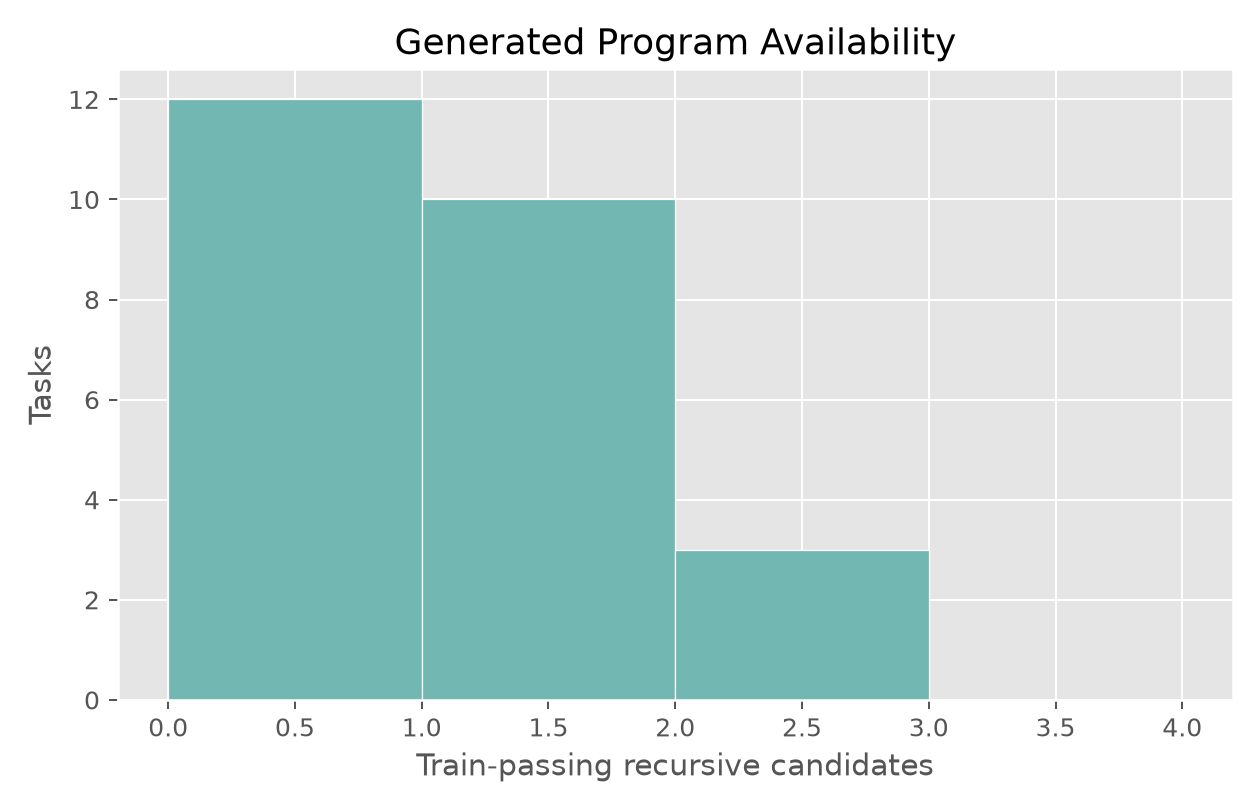
Direct row-by-row answering solves 56.0% of tasks under strict full-task exactness. The selected recursive executable program solves 40.0%. The gated recursive method, which falls back to direct answering when no non-memorizing train-passing program is available, solves 64.0%. The hidden diagnostic oracle over train-passing generated programs solves 40.0%, and at least one recursive candidate passes visible examples on 52.0% of tasks. The gated recursive method helps 2 tasks and hurts 0 tasks relative to direct row-by-row answering. The shuffled-label control is included to check whether executable programs can be induced from mismatched examples. A useful executable-program result should beat both direct answering and this shuffled control.
Overview
Standalone experiment for inducing task-local executable transformation programs from sparse examples.
Large reusable artifacts are stored under:
/workspace/large_artifacts/qwen_recursive_ephemeral_program_induction
Primary outputs:
src/qwen_recursive_ephemeral_program_induction.pyexperiment_log.mdruns/analysis/reports/
Report
Rendered from reports/qwen_recursive_ephemeral_program_induction_report.md
Question
Can a frozen language model convert sparse input-output examples into a task-local executable program that is more consistent than direct row-by-row answering?
The method asks the model to write a Python transform(row) function. Candidate programs are executed on visible examples. Only visible examples are used for selection and repair. Held-out rows are used only for final scoring.
Setup
- Run:
main_v1 - Dataset: public text-transformation tasks.
- Tasks:
25 - Visible examples per task:
4 - Held-out cap per task:
6 - Program variants:
monolithic,robust - Repair rounds:
1 - Elapsed seconds:
1444.2
Main Result
| method | tasks | row_exact | full_task_exact | train_pass_rate | tasks_helped_vs_direct | tasks_hurt_vs_direct |
|---|---|---|---|---|---|---|
| recursive_gated_direct | 25 | 82.7% | 64.0% | 44.0% | 2 | 0 |
| direct_batch | 25 | 76.0% | 60.0% | 2 | 1 | |
| direct_row | 25 | 80.7% | 56.0% | 0 | 0 | |
| recursive_program | 25 | 44.7% | 40.0% | 52.0% | 2 | 6 |
| recursive_oracle | 25 | 44.7% | 40.0% | 52.0% | 2 | 6 |
| monolithic_program | 25 | 40.7% | 36.0% | 48.0% | 2 | 7 |
| recursive_shuffled | 25 | 6.0% | 4.0% | 20.0% | 1 | 14 |
Interpretation
Direct row-by-row answering solves 56.0% of tasks under strict full-task exactness. The selected recursive executable program solves 40.0%. The gated recursive method, which falls back to direct answering when no non-memorizing train-passing program is available, solves 64.0%. The hidden diagnostic oracle over train-passing generated programs solves 40.0%, and at least one recursive candidate passes visible examples on 52.0% of tasks.
The gated recursive method helps 2 tasks and hurts 0 tasks relative to direct row-by-row answering.
The shuffled-label control is included to check whether executable programs can be induced from mismatched examples. A useful executable-program result should beat both direct answering and this shuffled control.
Program Diagnostics
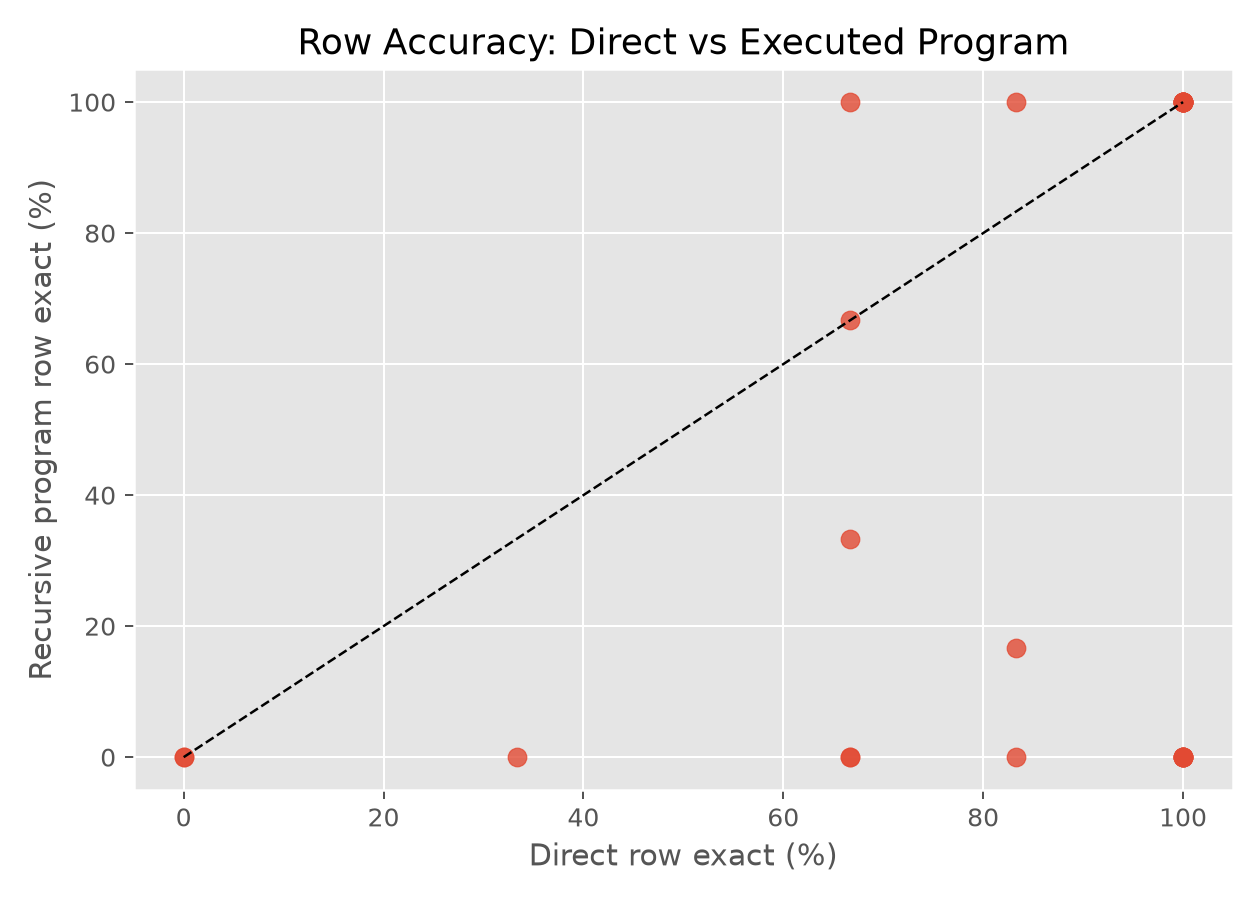
The raw executable-program arm is not deployable by itself: it passes visible examples on 52.0% of tasks but drops to 40.0% full-task exact and hurts 6 tasks that direct row-by-row answering solved. Most damage comes from train-fitting programs that are too narrow, often literal branches or partial parsers.
The gated arm uses an executable program only when a train-passing candidate does not look like a literal example table; otherwise it falls back to direct row-by-row answering. It uses generated programs on 11/25 tasks, solves 16/25 tasks overall, and captures both program-only wins without introducing any direct-baseline losses.
The shuffled-label control solves only 1/25 tasks and hurts 14 direct-baseline successes, so the generated programs are not succeeding from formatting alone. The useful signal is real, but sparse.
Charts
Task Details
| task_id | family | heldout_rows | direct_full_exact | recursive_full_exact | recursive_gated_full_exact | recursive_oracle_full_exact | recursive_train_pass_count | recursive_gated_used_program | recursive_gated_helped_vs_direct | recursive_gated_hurt_vs_direct |
|---|---|---|---|---|---|---|---|---|---|---|
| Number.000044 | Number | 6 | False | True | True | True | 1 | True | True | False |
| Number.000093 | Number | 3 | False | True | True | True | 1 | True | True | False |
| BillingCode.000002 | BillingCode | 6 | True | False | True | False | 0 | False | False | False |
| City.000011 | City | 3 | False | False | False | False | 1 | False | False | False |
| Currency.000004 | Currency | 6 | True | True | True | True | 1 | True | False | False |
| DateTime.000012 | DateTime | 6 | False | False | False | False | 1 | True | False | False |
| DateTime.000035 | DateTime | 6 | True | False | True | False | 0 | False | False | False |
| DateTime.000077 | DateTime | 6 | False | False | False | False | 0 | False | False | False |
| DateTime.000083 | DateTime | 6 | False | False | False | False | 0 | False | False | False |
| DateTime.000088 | DateTime | 6 | False | False | False | False | 0 | False | False | False |
| DateTime.000094 | DateTime | 4 | True | False | True | False | 0 | False | False | False |
| DateTime.000098 | DateTime | 6 | False | False | False | False | 0 | False | False | False |
| Email.000013 | 6 | True | True | True | True | 2 | True | False | False | |
| FilePath.000001 | FilePath | 6 | True | False | True | False | 0 | False | False | False |
| Name.000013 | Name | 6 | True | True | True | True | 2 | True | False | False |
| Name.000026 | Name | 6 | True | False | True | False | 0 | False | False | False |
| Name.000028 | Name | 6 | True | True | True | True | 2 | True | False | False |
| Number.000048 | Number | 4 | True | False | True | False | 0 | False | False | False |
| Number.000074 | Number | 6 | False | False | False | False | 0 | False | False | False |
| Number.000075 | Number | 6 | False | False | False | False | 0 | False | False | False |
| Number.000081 | Number | 6 | False | False | False | False | 1 | False | False | False |
| Number.000088 | Number | 6 | True | True | True | True | 1 | True | False | False |
| Phone.000005 | Phone | 6 | True | True | True | True | 1 | True | False | False |
| Phone.000017 | Phone | 6 | True | True | True | True | 1 | True | False | False |
| Rating.000001 | Rating | 6 | True | True | True | True | 1 | True | False | False |
Family Summary
| family | direct_row | monolithic_program | recursive_gated_direct | recursive_oracle | recursive_program |
|---|---|---|---|---|---|
| BillingCode | 1 | 0 | 1 | 0 | 0 |
| City | 0 | 0 | 0 | 0 | 0 |
| Currency | 1 | 1 | 1 | 1 | 1 |
| DateTime | 0.286 | 0 | 0.286 | 0 | 0 |
| 1 | 1 | 1 | 1 | 1 | |
| FilePath | 1 | 0 | 1 | 0 | 0 |
| Name | 1 | 0.667 | 1 | 0.667 | 0.667 |
| Number | 0.286 | 0.429 | 0.571 | 0.429 | 0.429 |
| Phone | 1 | 1 | 1 | 1 | 1 |
| Rating | 1 | 0 | 1 | 1 | 1 |
Limitations
Generated code is sandboxed by a conservative AST pass, so some potentially valid programs may be rejected. The benchmark tasks are public text transformations and do not cover arbitrary software engineering problems. Full-task exact is intentionally strict and can be much lower than row accuracy.
Artifacts
- Run directory:
/workspace/experiments/qwen_recursive_ephemeral_program_induction/runs/main_v1 - Summary:
analysis/summary.csv - Task details:
analysis/task_summary.csv - Candidate programs:
analysis/candidates.csv - Figures:
analysis/figures/
Experiment log 6
Show the running log (6 entries)
Setup
- Created a fresh standalone experiment directory.
- Large artifacts are kept under
/workspace/large_artifacts/qwen_recursive_ephemeral_program_induction. - Primary metric: strict full-task exact on held-out rows.
- Secondary metrics: row exact, train-pass rate, generated-program validity, and oracle headroom among train-passing generated programs.
Run smoke_no_qwen
- Time UTC:
2026-06-27T10:43:22.094485+00:00 - Elapsed seconds:
0.6 - Config:
{"answer_max_new_tokens": 64, "batch_max_new_tokens": 320, "code_max_new_tokens": 520, "heldout_cap": 3, "min_heldout": 3, "no_qwen": true, "repair_max_new_tokens": 560, "repair_rounds": 1, "repair_variants": "minimal,broaden,conditional", "run_name": "smoke_no_qwen", "run_shuffled": true, "sample_seed": 20260627, "task_limit": 3, "train_n": 4, "variants": "monolithic,helpers,robust"} - Tasks:
3 - Direct row-by-row full-task exact:
0.0% - Recursive selected-program full-task exact:
0.0% - Recursive train-pass rate:
0.0% - Recursive oracle among train-passing candidates:
0.0%
Run smoke_qwen_3
- Time UTC:
2026-06-27T10:47:05.311065+00:00 - Elapsed seconds:
198.9 - Config:
{"answer_max_new_tokens": 48, "batch_max_new_tokens": 220, "code_max_new_tokens": 360, "heldout_cap": 3, "min_heldout": 3, "no_qwen": false, "repair_max_new_tokens": 380, "repair_rounds": 1, "repair_variants": "minimal,broaden,conditional", "run_name": "smoke_qwen_3", "run_shuffled": true, "sample_seed": 20260627, "task_limit": 3, "train_n": 4, "variants": "monolithic,helpers,robust"} - Tasks:
3 - Direct row-by-row full-task exact:
66.7% - Recursive selected-program full-task exact:
33.3% - Recursive train-pass rate:
66.7% - Recursive oracle among train-passing candidates:
33.3%
Run smoke_qwen_5_v2
- Time UTC:
2026-06-27T10:54:41.415308+00:00 - Elapsed seconds:
402.9 - Config:
{"answer_max_new_tokens": 48, "batch_max_new_tokens": 220, "code_max_new_tokens": 360, "heldout_cap": 3, "min_heldout": 3, "no_qwen": false, "repair_max_new_tokens": 380, "repair_rounds": 1, "repair_variants": "minimal,broaden,conditional", "run_name": "smoke_qwen_5_v2", "run_shuffled": true, "sample_seed": 20260627, "task_limit": 5, "train_n": 4, "variants": "monolithic,helpers,robust"} - Tasks:
5 - Direct row-by-row full-task exact:
60.0% - Recursive selected-program full-task exact:
20.0% - Recursive train-pass rate:
40.0% - Recursive oracle among train-passing candidates:
20.0%
Run smoke_qwen_5_helpers
- Time UTC:
2026-06-27T11:05:15.279262+00:00 - Elapsed seconds:
530.7 - Config:
{"answer_max_new_tokens": 48, "batch_max_new_tokens": 220, "code_max_new_tokens": 420, "heldout_cap": 3, "min_heldout": 3, "no_qwen": false, "repair_max_new_tokens": 420, "repair_rounds": 1, "repair_variants": "minimal,broaden,conditional", "run_name": "smoke_qwen_5_helpers", "run_shuffled": true, "sample_seed": 20260627, "task_limit": 5, "train_n": 4, "variants": "monolithic,helpers,robust"} - Tasks:
5 - Direct row-by-row full-task exact:
60.0% - Recursive selected-program full-task exact:
20.0% - Recursive train-pass rate:
80.0% - Recursive oracle among train-passing candidates:
20.0%
Run main_v1
- Time UTC:
2026-06-27T11:32:03.844775+00:00 - Elapsed seconds:
1444.3 - Config:
{"answer_max_new_tokens": 56, "batch_max_new_tokens": 300, "code_max_new_tokens": 420, "heldout_cap": 6, "min_heldout": 3, "no_qwen": false, "repair_max_new_tokens": 420, "repair_rounds": 1, "repair_variants": "minimal,broaden,conditional", "run_name": "main_v1", "run_shuffled": true, "sample_seed": 20260627, "task_limit": 25, "train_n": 4, "variants": "monolithic,robust"} - Tasks:
25 - Direct row-by-row full-task exact:
56.0% - Recursive selected-program full-task exact:
40.0% - Recursive gated-direct full-task exact:
64.0% - Recursive train-pass rate:
52.0% - Recursive oracle among train-passing candidates:
40.0%
Figures 5
Data files 18
Result tables and metrics copied from the experiment folder — preview inline or open the raw file.
analysis/family_summary.csv2.2 kBanalysis/summary.csv434 Banalysis/task_summary.csv6.0 kBruns/main_v1/family_summary.csv2.2 kBruns/main_v1/summary.csv434 Bruns/main_v1/task_summary.csv6.0 kBruns/smoke_no_qwen/family_summary.csv429 Bruns/smoke_no_qwen/summary.csv298 Bruns/smoke_no_qwen/task_summary.csv1.1 kBruns/smoke_qwen_3/family_summary.csv489 Bruns/smoke_qwen_3/summary.csv523 Bruns/smoke_qwen_3/task_summary.csv1.1 kBruns/smoke_qwen_5_helpers/family_summary.csv690 Bruns/smoke_qwen_5_helpers/summary.csv344 Bruns/smoke_qwen_5_helpers/task_summary.csv1.6 kBruns/smoke_qwen_5_v2/family_summary.csv645 Bruns/smoke_qwen_5_v2/summary.csv374 Bruns/smoke_qwen_5_v2/task_summary.csv1.5 kB
Reproduce
The run commands are documented inside the experiment folder (see the README).